
Fire Protection Systems: Detection, Suppression and Passive Protection
Discovery, installation, maintenance, consultancy and training for systems that detect fire early, stop it spreading and support safe evacuation.
In short
Fire protection systems are the combined measures that detect a fire early, suppress it or limit its spread, and support safe evacuation: detection and alarm, sprinklers and gas suppression, firestopping and emergency lighting. Sora Yazılım provides discovery, installation, maintenance and training services for these systems in İzmir and its surroundings.
Which fire protection systems are there?
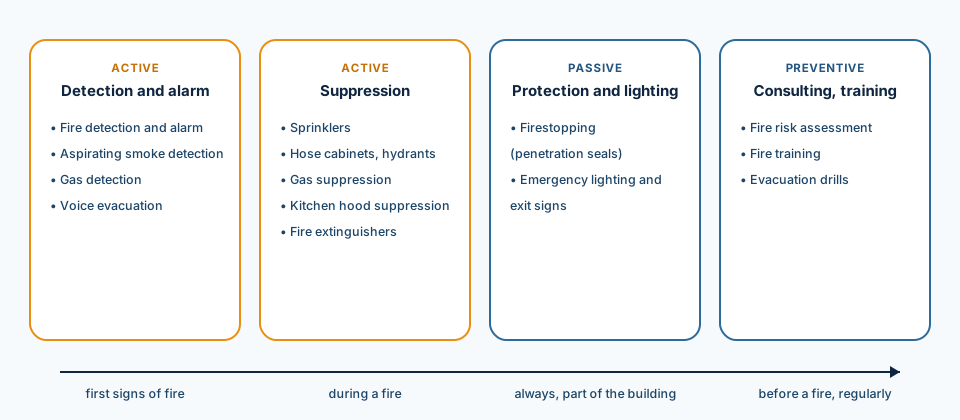
We group fire protection systems into four families. Each card leads to a detailed page explaining what the system does and what our service scope covers.
Detection and alarm
- Fire Detection and Alarm SystemsFire panels, detectors, call points, sounder-beacons and cause-and-effect setup.View
- Aspirating Smoke DetectionVery early detection by sampling air in data centres, high ceilings and warehouses.View
- Gas Detection SystemsDetecting flammable and toxic gas leaks, with alarms and shut-off valve control.View
- Voice Alarm and Evacuation SystemsLife-safety voice evacuation messages triggered by the fire alarm panel.View
Suppression
- Sprinkler SystemsAutomatic water suppression with heat-activated sprinkler heads and piping.View
- Fire Hose Cabinets and HydrantsFixed installations: hose cabinets, hydrants and fire brigade connections.View
- Gas Suppression Systems (FM-200, Novec 1230, CO2)Extinguishing fires with suppression gas in server rooms, archives and similar spaces.View
- Kitchen Hood SuppressionAutomatic suppression of cooking-oil fires in commercial kitchen hoods and fryers.View
- Fire Extinguisher Supply and ServicingChoosing and supplying portable extinguishers, refilling and periodic checks.View
Passive protection and lighting
What is the difference between active and passive fire protection?
Active fire protection covers the systems that respond when a fire breaks out (detection, alarm, suppression); passive fire protection covers the measures built into the structure that limit the spread of fire and smoke. A safe building uses both.
| Layer | Role | Example systems | When it acts |
|---|---|---|---|
| Detection and warning (active) | Spotting a fire early and warning people | Fire detection and alarm, aspirating smoke detection, voice evacuation | At the first signs of fire |
| Suppression (active) | Controlling or extinguishing the fire | Sprinklers, gas suppression, kitchen hood suppression, hose reels, fire extinguishers | Triggered by detection or heat, automatically or manually |
| Passive protection | Limiting the spread of fire and smoke and protecting escape routes | Firestopping, fire compartments, emergency lighting and wayfinding signs | Continuously; as part of the building fabric during a fire |
| Consultancy and training | Identifying risks and preparing people | Fire risk assessment, fire safety training and evacuation drills | Before any fire, at regular intervals |
Which systems a building must have depends on its use and characteristics and, for projects in Türkiye, is set by regulation; selection and design are carried out by a qualified design engineer. We explain detection in detail on the fire detection and alarm systems page and automatic water suppression on the sprinkler systems page.
How does a fire protection project run?
A fire protection project starts by reviewing the current situation and the approved design, continues with installation and testing to that approved design, and is completed with training and regular maintenance.
- Discovery call: we discuss how the building is used, the existing systems and your needs.
- Review of the current state and design: the approved design, existing equipment and maintenance records are examined.
- Design: where required, it is prepared by a qualified design engineer and submitted to the relevant authority for approval.
- Proposal and schedule: the systems, scope and order of works are set out in writing.
- Installation: the systems are installed to the approved design.
- Testing and commissioning: the systems and the scenarios between them are tested and recorded.
- Training and maintenance: building staff are trained and periodic maintenance is planned.
How do fire protection systems work with low-voltage systems?
During an alarm, the fire alarm panel sends signals to low-voltage systems to make evacuation easier; these interfaces should be planned from the start of the project and tested at commissioning.
We bring together cabling, networks, security and building systems on our low-voltage (ELV) systems page.
- Releasing card-controlled doors and turnstiles on escape routes: access control, turnstile and time attendance systems.
- Starting the voice evacuation message zone by zone: voice alarm and voice evacuation systems.
- Sending lifts to a designated floor and managing ventilation and smoke control.
- Monitoring and logging alarm information through building automation (BMS).
Which regulations apply to fire safety?
For projects in Türkiye, the core rules on protecting buildings from fire are set by the Regulation on the Protection of Buildings from Fire (Binaların Yangından Korunması Hakkında Yönetmelik); the relevant standards cover product and installation requirements for each system.
The Regulation was first published in the Official Gazette of 19.12.2007, No. 26735, and has been amended several times since. It defines the responsibilities of building owners, managers and occupants and which systems are required in which buildings. We recommend checking the current text on mevzuat.gov.tr.
This page provides general information and is not legal or engineering advice. Decisions specific to your building are based on the approved design, a qualified design engineer and the relevant authority.
What should you check first for fire safety?
Before any survey, a few simple points that a building manager can check alone will reveal most of the gaps.
- Are escape routes and the areas in front of fire doors clear, and do the doors close by themselves?
- Is the fire panel in normal state, or is there a pending fault or a silenced warning?
- Are fire extinguishers in place and accessible, and is the last inspection date legible?
- Do emergency lighting and exit signs work?
- Have openings around cable and pipe penetrations in walls been sealed?
- Do you know the dates of the last maintenance and test records and of the last fire drill?
What are the common mistakes with fire protection systems?
Most problems with fire protection systems appear not during installation but in the years that follow.
- Forgetting fire safety during refurbishment: new partitions change detection and suppression coverage.
- Leaving penetrations open: cables pulled later breach fire compartments.
- Maintaining on paper only: a test that is not recorded is as good as a test that was never done.
- Installing systems in isolation: door, lift and voice evacuation interfaces are never tested.
- Skipping training: users who do not know the system cannot take the right action during an alarm.
Frequently asked questions
Which fire protection systems does my building need?
Are both active and passive fire protection necessary?
Why is maintenance of fire protection systems so important?
Do fire protection systems need updating after a refurbishment or change of use?
Which areas do you cover for fire protection systems?
How is a discovery call arranged?
Sources
- Presidency of the Republic of Türkiye, Legislation Information System (mevzuat.gov.tr), “Regulation on the Protection of Buildings from Fire (Binaların Yangından Korunması Hakkında Yönetmelik), Official Gazette 19.12.2007, No. 26735”, 2007 (as amended). https://www.mevzuat.gov.tr/mevzuat?MevzuatNo=200712937&MevzuatTur=21&MevzuatTertip=5
Fire protection systems request
Including the building type, location, existing systems and your needs speeds up the first conversation.
- Free discovery call
- No commitment; the quote is prepared after the survey.
- Service area
- İzmir and its surroundings (districts such as Menemen and Selçuk, plus Manisa and Aydın)
- Your personal data
- Form details are processed to answer your request; see the privacy notice for details. Privacy notice
Let us talk about your fire safety needs
New installation, upgrade, maintenance or training: tell us about your building and its current state, and we will start the discovery process together.