
CCTV and IP Camera Systems: Security Camera Installation
A video surveillance system planned from the start around what is recorded, why, and for how long: survey, installation, commissioning and maintenance.
In short
IP camera systems (CCTV, closed-circuit television) are the video surveillance infrastructure that views and records a building's entrances, perimeter and interior and makes them available for remote monitoring. They suit offices, factories, warehouses, shops and residential complexes. Sora Yazılım provides CCTV installation, recording and storage planning and maintenance in İzmir and its surroundings.
What is a CCTV and IP camera system and what is it for?
Closed-circuit television (CCTV) takes camera images into a recording and monitoring setup that only authorised people can view; an IP camera system is the current form of CCTV, carrying those images over the computer network. The aim is to deter incidents, monitor live and review past footage when needed.
The value of a camera system comes from its plan more than from the number of cameras: which points need enough detail to recognise a face, where a general view is enough, how long recordings are kept and who may view them are all decided at the start.
This page covers video surveillance infrastructure. Reading number plates at vehicle entrances and controlling the barrier is the subject of our licence plate recognition and parking management page, while door release and authorising people fall under access control systems. A camera records; the system that detects an unauthorised entry and raises an alarm is an intruder alarm system.
Which buildings and needs are IP camera systems suited to?
Buildings with busy entrances and exits, valuable stock or many visitors, where footage may need to be reviewed after an incident, benefit most from IP camera systems.
- Offices and office towers: building entrance, reception, car park entrance and common areas.
- Factories and warehouses: loading bays, stock areas, the perimeter and gates.
- Shops and retail: the checkout area, sales floor and stockrooms.
- Residential complexes: entrance gates, car parks, children's play areas and perimeter walls.
- Schools and healthcare facilities: entrances and exits, corridors and shared areas such as grounds.
- Hotels and accommodation: the lobby, car park, service entrances and plant rooms.
What types of camera system are there and what are the components?
Camera systems fall into two broad groups: analogue and HD analogue systems connected to a recorder over coaxial cable, and IP systems that carry images over network cable. New installations mostly use IP systems; HD analogue is still an option where existing coaxial cabling is to be reused.
| Feature | Analogue / HD analogue system | IP camera system |
|---|---|---|
| Cabling | Coaxial cable plus a separate power feed | Network cable; power often over the same cable (PoE) |
| Recorder | DVR (digital video recorder) | NVR (network video recorder) or server-based recording |
| Image and analytics | Limited to the resolution and features the recorder supports | On-camera analytics (such as intrusion zones and line crossing) and a wider choice of resolutions |
| Expansion | Limited by the recorder's channel count | Flexible, depending on network and licence capacity |
| Typical use | Smaller buildings with existing coaxial cabling | New installations, multi-building sites or remotely monitored premises |
Which option suits you is decided during the survey, based on the existing cabling, the number of cameras, the retention period and monitoring needs. The main components of an IP camera system are:
- Cameras: dome, bullet or PTZ (pan-tilt-zoom) types, chosen for indoor or outdoor use, lighting conditions and field of view.
- Recorder and storage: an NVR or server, with disks sized for the retention period.
- PoE switch: the active device that both powers the cameras and connects them to the network.
- Cabling: network runs from each camera back to the cabinet, with fibre links to remote points.
- Monitoring: security room screens, client software and mobile access for authorised users.
- Uninterruptible power supply (UPS): so recording continues during a power cut.
What does our camera system service scope include?
Our security camera installation service runs from the survey to periodic maintenance; the detailed scope of each project is written into the proposal after the survey.
- Survey: review of the areas to be covered, lighting conditions, existing cabling and network infrastructure.
- Camera layout plan: the purpose (overview, recognition, detail) and field of view for each camera.
- Retention and storage calculation, recorder and camera selection, bill of materials and procurement.
- Cabling, camera mounting and recorder installation.
- Network configuration: separating the camera network, setting up users and permissions.
- Commissioning: adjusting viewing angles, testing night images and recording.
- User training: live viewing, searching footage and exporting clips.
- Periodic maintenance: camera cleaning, disk and recording checks, software updates (subject to contract).
How does a camera system project run?
The process starts with a discovery call about what will be monitored and why, and ends with the system tested and handed over to users with training.
- Discovery call: we discuss the building, the areas to be covered and your expectations.
- Site survey: camera positions, lighting conditions, cable routes and the cabinet location are inspected.
- Layout plan and storage calculation: camera types, fields of view and the retention period are defined.
- Proposal: scope, bill of materials and work schedule are put in writing.
- Installation: cabling, mounting and recorder installation are carried out.
- Commissioning and testing: angles, night images, recording and remote access are tried out.
- Training and handover: searching and exporting footage and user permissions are explained.
Which factors affect the choice and the cost?
The cost of a camera system is driven mainly by the number and type of cameras, the retention period and the cabling conditions; an exact figure can only be given after the survey.
We do not publish price ranges: even with the same number of cameras, differences in lighting, retention period and cable routes change the cost of two buildings significantly.
- Number of cameras and the level of detail needed at each point.
- Camera type: indoor or outdoor, night vision, PTZ requirement, analytics features.
- Retention period, recording quality and the storage capacity these require.
- Cable routes, working at height and the need for fibre to remote points.
- Condition of the existing installation: whether coaxial or network cable can be reused.
- Remote monitoring, monitoring several buildings from one centre and the number of users.
Which standards and regulations apply?
Video surveillance systems for security applications are covered in Europe by the EN 62676 series of standards; because cameras record images of people, projects in Türkiye must also take Türkiye's Personal Data Protection Law (KVKK, Law No. 6698) into account.
Camera recording is processing of personal data. Which areas are monitored and for what purpose, how long recordings are kept and who can access them are your decisions as the data controller. For guidance on informing the people concerned, see the KVKK Authority's page on the obligation to inform (in Turkish), and for general guidance the Personal Data Protection Authority website. This page does not give legal advice; the system is configured with these decisions, the relevant legislation and, where needed, your legal adviser's opinion in mind.
- EN 62676-1-1:2014 — Video surveillance systems for use in security applications, Part 1-1: System requirements, General.
- Türkiye's Personal Data Protection Law (KVKK), Law No. 6698 (Official Gazette 07.04.2016, No. 29677).
How does a camera system work with other systems?
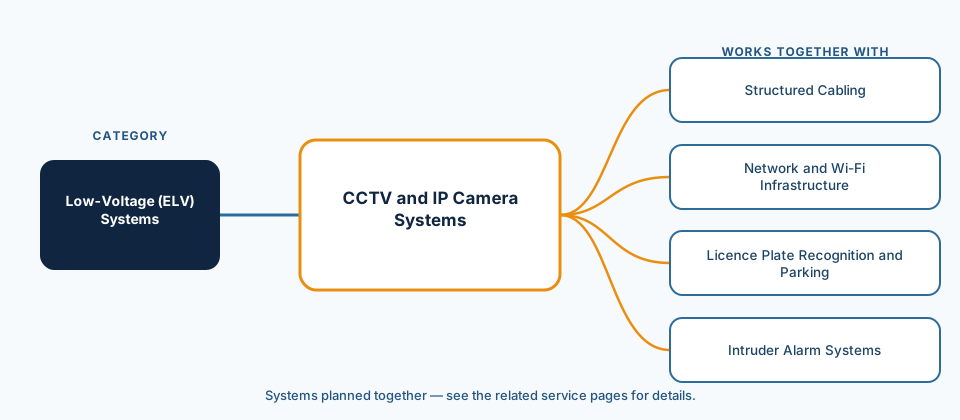
A camera system records on its own; when it works together with systems such as intruder alarms, access control and licence plate recognition, the footage of an event appears at the right moment on the right screen.
IP cameras run over the building's cabling and are often powered over PoE from the same cabinet, so the link, outlet and cabinet plan is drawn up together with structured cabling. Separating the camera network from the corporate network and setting up remote access securely is the job of network and wireless infrastructure.
Bringing the relevant camera onto the monitoring screen when an alarm is raised can be set up with intruder alarm systems, and matching door events to footage with the access control system. Our low-voltage (ELV) systems page summarises how all the security and building systems are planned together.
Which questions do we ask during the survey?
A sound camera plan starts with being clear about what is monitored and why, so we work through the following questions together during the survey.
- What is the purpose in each area: a general view, recognising a person, or detail such as cash or goods?
- How long will recordings be kept, and who will be able to view and export them?
- What are the lighting conditions at night; are there entrances with backlight or glare?
- Will any existing cameras, cables or recorders be reused?
- Will footage be monitored remotely; will several buildings be managed from one centre?
- Does any camera's field of view take in a neighbouring property, a public area or a space that requires privacy?
What are the common mistakes in camera systems?
Most problems stem not from camera quality but from positioning without a defined purpose and from neglected maintenance and security.
- Positioning without a purpose: a wide-angle camera sees everything but may not give enough detail to recognise a person when an incident happens.
- Not calculating storage: disks fill up before the intended period and older footage is overwritten without anyone deciding to.
- Leaving default passwords: manufacturer passwords and unpatched software on cameras and recorders are a serious security weakness.
- Not separating the camera network: cameras sitting on the same network as corporate computers spread risk to both.
- Not testing recording: even when the live image is fine, check regularly that footage is actually being recorded.
- Forgetting to inform people: informing people in areas covered by cameras should be part of the installation plan.
Related services
- Structured CablingIn-building copper horizontal cabling, racks, patch panels, labelling and testing.View
- Network and Wi-Fi InfrastructureSwitch and access point installation, coverage planning, VLAN and guest network setup.View
- Licence Plate Recognition and ParkingPlate reading at vehicle entrances, barrier control and parking records.View
- Intruder Alarm SystemsAlarm panel, motion and contact detectors, sirens and zone planning.View
Frequently asked questions
Can existing analogue cameras be used when moving to an IP system?
How long should camera recordings be kept?
Can I view the cameras on my phone?
What should I consider for night-time images?
How does the discovery call work?
Which areas do you cover for camera systems?
Sources
- CENELEC (Estonian Centre for Standardisation catalogue), “EN 62676-1-1:2014 — Video surveillance systems for use in security applications — Part 1-1: System requirements — General”, 2014. https://www.evs.ee/en/evs-en-62676-1-1-2014
- Presidency of the Republic of Türkiye, Legislation Information System, “Law No. 6698 on the Protection of Personal Data (Official Gazette 07.04.2016, No. 29677)”, 2016. https://www.mevzuat.gov.tr/mevzuat?MevzuatNo=6698&MevzuatTur=1&MevzuatTertip=5
- Personal Data Protection Authority (KVKK), “Obligation to Inform (Aydınlatma Yükümlülüğü)”, 2018. https://www.kvkk.gov.tr/Icerik/2033/Aydinlatma-Yukumlulugu-
Camera system request
Including the building type, approximate number of cameras, whether there is an existing system and the location speeds up the first conversation.
- Free discovery call
- No commitment; the quote is prepared after the survey.
- Service area
- İzmir and its surroundings (districts such as Menemen and Selçuk, plus Manisa and Aydın)
- Your personal data
- Form details are processed to answer your request; see the privacy notice for details. Privacy notice
Let us talk about your camera system
For a new installation, an upgrade or maintenance, share your building and the areas you want to monitor, and we will start the survey process together.