
Fire Extinguisher Supply, Servicing and Refilling
Choosing, supplying, positioning and periodically checking portable extinguishers that match the fire risk in your building, in a single plan.
In short
A fire extinguisher (portable fire extinguisher) is a portable device that lets one person tackle a fire in its early stage by hand. Offices, shops, factories, warehouses and the common areas of residential buildings all need them. Sora Yazılım provides extinguisher selection, supply, positioning, periodic inspection and fire extinguisher refilling follow-up in İzmir and its surroundings.
What is a fire extinguisher and what does it do?
A fire extinguisher discharges its agent under pressure to put out a small fire that has just started, before it grows; when it is the right type, in the right place and properly maintained, it is the fastest tool for first response.
Not every extinguisher suits every fire: solids, flammable liquids, gases, metals and cooking oils are treated as different classes of fire, and the label on each extinguisher states which classes it is suitable for. An extinguisher of the wrong type may fail to put the fire out and can even put the user at risk.
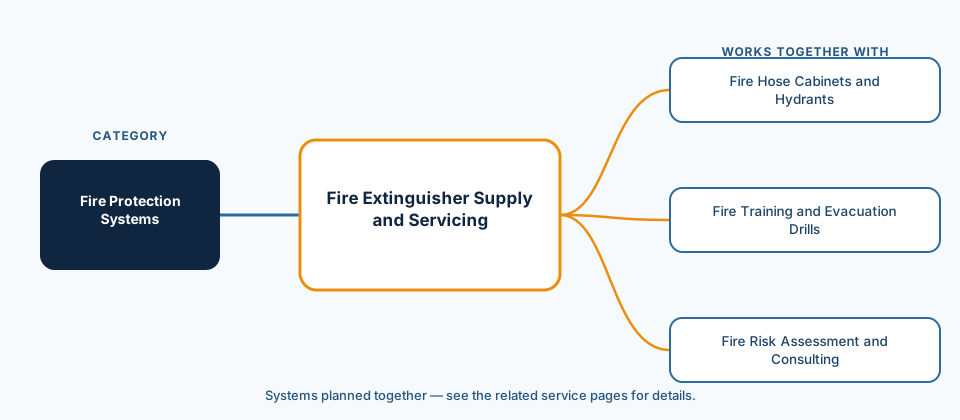
This page covers portable and wheeled extinguishers. The fixed water installation in a building, meaning fire hose reels and hydrants, is the subject of our fire hose reel and hydrant systems page; the two kinds of protection do not replace each other and are planned together.
Which buildings and areas need fire extinguishers?
For projects in Türkiye, the Regulation on the Protection of Buildings from Fire calls for portable extinguishers in buildings; their type and number are set according to the building's hazard class and floor area.
- Offices and shops: at accessible points on each floor and in each section, with electrical equipment in mind.
- Factories and workshops: with the type chosen to suit the materials and flammable liquids used in production.
- Warehouses and car parks: together with wheeled extinguishers in large areas.
- Boiler rooms, electrical rooms and comms rooms: with a type that matches the risk of the technical space.
- Kitchens: with an extinguisher suited to cooking-oil fires.
- Common areas of residential complexes: stairwells, car parks and technical spaces.
What types of fire extinguisher are there and what are the components?
The common extinguisher types are dry powder, carbon dioxide (CO2), foam, water and wet chemical for cooking-oil fires; the choice depends on the fire risk in the area to be protected.
| Type | Typical use | Points to watch |
|---|---|---|
| Dry powder (multi-purpose) | General areas, car parks, warehouses, vehicles | Leaves powder residue; can cause clean-up problems with electronics and in sensitive areas. |
| Carbon dioxide (CO2) | Electrical panels, comms rooms, laboratories | Leaves no residue; use in small enclosed spaces needs care. |
| Foam | Areas with flammable liquids, general use | Suitability for use on electrical equipment should be checked on the label. |
| Water | Fires in solids such as paper, wood and textiles | May not be suitable on electrical equipment or cooking-oil fires. |
| Wet chemical | Commercial and industrial kitchens | Intended for cooking-oil fires. |
The suitable classes of fire for each type are stated on the extinguisher's label, and the choice is made on that basis. The main parts of an extinguisher are:
- Body (cylinder): holds the agent and, in stored-pressure types, the propellant gas.
- Valve and lever: start and stop the discharge.
- Safety pin and tamper seal: prevent accidental discharge; a broken seal shows that the extinguisher needs checking.
- Pressure gauge: on stored-pressure types, shows whether the pressure is within the correct range.
- Hose and nozzle: direct the agent to the base of the fire.
- Label and inspection tag: show the operating instructions, suitable classes of fire and inspection history.
What does our fire extinguisher service scope include?
The service scope runs from identifying needs to tracking periodic inspections; the details of the scope are written into the proposal after discovery.
- Discovery: how each area is used, the fire risk and the condition of existing extinguishers.
- Recommendations on type and number for each class of fire and area.
- Supplying extinguishers, mounting them on brackets or stands and fitting location signs.
- An inventory of existing extinguishers: type, location, inspection date.
- Planning periodic inspection, maintenance and refilling work and tracking the records.
- A short briefing for users on how to use an extinguisher.
For projects in Türkiye, the regulation requires companies that refill and service extinguishers to hold the relevant competence certificate. We recommend asking for the certificates of whoever will carry out the refilling and maintenance at proposal stage.
How does the fire extinguisher service run?
The process starts by mapping the current situation, is completed once gaps are closed and records are put in order, and continues with periodic inspections.
- Discovery call: we discuss how the building is used and its existing extinguishers.
- Site survey: areas, risks and the condition of existing devices are inspected.
- Inventory and recommendations: missing, wrong-type or overdue extinguishers are listed.
- Proposal: types, numbers and scope are put in writing.
- Supply and positioning: extinguishers are mounted at accessible points and their locations are signed.
- Records: each extinguisher's location and inspection date are recorded.
- Periodic inspection and refilling: inspection dates are tracked, and used or unserviceable extinguishers are sent for servicing.
Which factors affect the choice and the cost?
The cost depends mainly on the number, type and capacity of extinguishers needed; the condition of existing devices also decides whether new purchases or refilling and maintenance are required.
We do not publish price ranges; the type and number required vary widely with the building's use and the condition of existing extinguishers.
- The building's floor area, number of storeys and hazard class.
- The type of risk to protect against: electrical, flammable liquids, cooking oil, sensitive equipment.
- Extinguisher type and capacity; any need for wheeled units.
- The number of existing extinguishers and whether they are still serviceable.
- Brackets, stands, cabinets and location signs needed.
- The contract scope for periodic inspection and refilling.
Which standards and regulations apply?
For projects in Türkiye, the core rules on portable extinguishers are in the Regulation on the Protection of Buildings from Fire, which refers to the relevant standards for extinguisher quality and maintenance.
The number of extinguishers, travel distance, mounting height and inspection intervals are defined in the regulation and the relevant standards; for your building, these sources and, where needed, the opinion of the local fire brigade are the reference.
- Regulation on the Protection of Buildings from Fire (Binaların Yangından Korunması Hakkında Yönetmelik, Official Gazette 19.12.2007, No. 26735, as amended) — sets out how extinguishers are chosen for the class of fire, positioned and periodically inspected, and says they should not be kept out of sight, for example behind doors or in closed cupboards. The current text should be checked on mevzuat.gov.tr.
- TS 862-EN 3 — the regulation requires portable extinguishers to hold a quality certificate to this standard; TS EN 1866 is cited for wheeled extinguishers. Its European counterpart, EN 3-7:2004+A1:2007, defines the characteristics, performance requirements and test methods for portable extinguishers.
- TS ISO 11602-2 — the regulation calls for periodic inspection and maintenance of extinguishers to be carried out to this standard.
How do fire extinguishers work alongside other fire safety measures?
An extinguisher is for one person's response in the first minutes of a fire; once a fire grows, fixed suppression systems, alarms and evacuation take over. That is why extinguishers are planned together with the building's other measures.
For the overall picture of other fire systems, see our fire protection systems page.
- Knowing how to use them: an extinguisher only works if the person using it knows it; hands-on practice is part of fire safety training and evacuation drills.
- Identifying risks: which type is needed in which area becomes clear through a fire risk assessment.
- Kitchens: an extinguisher complements fixed kitchen hood suppression systems rather than replacing them.
- Fixed water installation: extinguisher locations are considered together with nearby fire hose reels and hydrants.
Which questions do we ask during discovery?
A sound extinguisher plan starts with understanding what could burn in each area and who will respond; during discovery we work through the following questions together.
- Which sections does the building have; where are the electrical panels, comms room, kitchen or flammable liquid store?
- Are the type, location and last inspection date of the existing extinguishers known?
- Are the extinguishers visible and accessible, or does anything block them?
- Are there sections that affect the choice of type, such as hospital wards, care homes or areas with sensitive equipment?
- Do staff know how to use an extinguisher?
- Who keeps the inspection and refilling records?
What are the common mistakes with fire extinguishers?
The most frequent problems are the wrong choice of type, locations nobody can reach and inspections nobody tracks.
- Putting the same type everywhere: a powder extinguisher in a comms room can do more harm to the equipment than to the fire.
- Hiding extinguishers behind doors or in cupboards: nobody can find them during a fire.
- Rehanging a partly used extinguisher: once discharged, it cannot be relied on until it has been serviced.
- Ignoring the seal and the pressure gauge: an extinguisher that has lost pressure may not work.
- Leaving an empty spot while an extinguisher is being serviced: the regulation calls for a temporary replacement to be left during servicing.
Related services
- Fire Hose Cabinets and HydrantsFixed installations: hose cabinets, hydrants and fire brigade connections.View
- Fire Training and Evacuation DrillsStaff fire training, extinguisher use and evacuation drill exercises.View
- Fire Risk Assessment and ConsultingIdentifying fire risks in a building and prioritised improvement recommendations.View
Frequently asked questions
Which fire extinguisher should I choose?
When should a fire extinguisher be refilled?
Is the building left without extinguishers during refilling?
How many fire extinguishers does a building need?
What is the difference between a fire extinguisher and a fire hose reel?
How does the discovery call work?
Which areas do you cover for fire extinguisher services?
Sources
- Presidency of the Republic of Türkiye, Legislation Information System (mevzuat.gov.tr), “Regulation on the Protection of Buildings from Fire (Binaların Yangından Korunması Hakkında Yönetmelik), Official Gazette 19.12.2007, No. 26735”, 2007 (as amended). https://www.mevzuat.gov.tr/mevzuat?MevzuatNo=200712937&MevzuatTur=21&MevzuatTertip=5
- CEN (Estonian Centre for Standardisation and Accreditation catalogue), “EN 3-7:2004+A1:2007 — Portable fire extinguishers — Part 7: Characteristics, performance requirements and test methods”, 2007. https://www.evs.ee/tooted/evs-en-3-7-2004+a1-2007
Fire extinguisher request
Including the building type, approximate floor area, number of existing extinguishers and their last inspection date speeds up the first conversation.
- Free discovery call
- No commitment; the quote is prepared after the survey.
- Service area
- İzmir and its surroundings (districts such as Menemen and Selçuk, plus Manisa and Aydın)
- Your personal data
- Form details are processed to answer your request; see the privacy notice for details. Privacy notice
Let us talk about your fire extinguishers
For new supply, filling gaps or periodic inspection, tell us about your building and existing extinguishers, and we will start the discovery process together.