
Building Automation (BMS) and KNX Smart Building Systems
Infrastructure that monitors and controls lighting, heating and cooling and other building systems from one place: discovery, programming, commissioning and maintenance.
In short
A building automation system (BMS) monitors functions such as lighting, heating and cooling, blinds and energy use from one place and controls them through scenes and schedules; KNX is a widely used open standard in this field. It suits offices, hotels, schools and homes. Sora Yazılım provides building automation and KNX smart building services in İzmir and its surroundings.
What are building automation and KNX, and what do they do?
A building automation system (building management system, BMS) brings the status of a building's technical systems onto a single screen and controls them according to predefined rules; the aim is comfort, energy efficiency and easier operation.
KNX is an open protocol that lets lighting, heating and cooling, blinds and similar devices communicate over a common bus, even when they come from different manufacturers; it is standardised in Europe as the EN 50090 series and internationally as the ISO/IEC 14543-3 series. Switches, sensors and actuators connect to the same bus and their functions are assigned in software, so what a button does can be reprogrammed later without changing any cables.
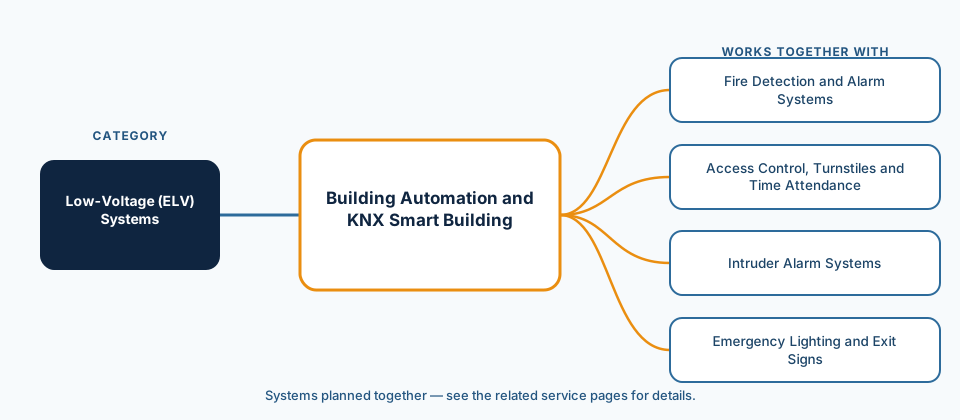
This page covers the layer that connects and manages systems; it does not re-explain the connected systems themselves. Fire, security and access control systems work independently under their own rules and standards; building automation monitors their status and brings them into scenes only as far as permitted. For the full range of building systems, see our low-voltage (ELV) systems page.
Which buildings and needs is building automation suitable for?
Building automation delivers the most benefit in buildings with many rooms, changing patterns of use or high energy consumption.
- Offices and office towers: lighting and HVAC that follow occupancy, and out-of-hours shutdown scenes.
- Hotels and accommodation: energy management with the room key card, and HVAC set back in unoccupied rooms.
- Schools and public buildings: scheduling by hours of use and central monitoring.
- Homes, villas and residences: lighting scenes and control of blinds and climate.
- Shops and restaurants: opening and closing scenes and shop window lighting.
- Factory offices and warehouses: energy consumption monitoring, fault and alarm notifications.
What types of building automation system are there and what are the components?
Building automation is best thought of in three layers: sensors and actuators in the field, the communication bus that links them, and the monitoring and management software. Communication can use open protocols such as KNX or proprietary systems tied to a single manufacturer.
| Feature | Open protocol (e.g. KNX) | Proprietary (closed) system |
|---|---|---|
| Device choice | Compatible devices from different manufacturers can be used together | Usually limited to one manufacturer's product family |
| Programming | Done with a standard tool; another integrator can take over | May remain tied to the manufacturer's software and installer |
| Expansion | New devices can be added to the same bus | Limited to the options the product family offers |
| Points to watch | Taking delivery of the programming project file | Long-term continuity of spare parts and support |
Which approach suits a building depends on its scale, expected expansion and the preferences of the operations team. The main components are:
- Sensors: motion and occupancy, temperature, humidity, light level, window contacts.
- User interfaces: smart switches, room control panels, touch screens and a mobile app.
- Actuators: lighting relays and dimmers, blind and shutter motors, valve and fan controls.
- Bus and power supply: the shared data bus for the devices.
- Gateways: connect the automation to the IP network, HVAC systems or other protocols.
- Monitoring and management software: status, alarm, energy report and scheduling screens.
What does our building automation service scope include?
Our building automation service scope runs from needs analysis to commissioning and maintenance; the detail of the scope is written into the proposal after discovery for each project.
- Discovery and needs analysis: which functions will be automated and how they will be used.
- Preparing the system architecture and device list; device selection and procurement.
- Running the bus and mounting devices in distribution boards (coordinated with the electrical installation).
- Device programming, scenes and schedules.
- Building the monitoring screens and user interfaces.
- Links to other systems: defining monitoring points and permitted control points.
- Commissioning, functional testing and handover of the project file and documents.
- Training for users and the operations team; periodic maintenance and change support (under contract).
How does a building automation project run?
The process starts with understanding how the building is used; the earlier automation is planned, the better it fits the electrical installation.
- Discovery call: we discuss the building, how it is used and what you expect.
- Needs analysis: the functions and scenes to be automated are listed.
- Architecture and device list: the protocol, devices and board layout are defined and coordinated with the electrical design.
- Proposal: the scope, device list and work schedule are put in writing.
- Installation: the bus is run and devices are mounted.
- Programming and testing: scenes are set up and every function and link is tried.
- Training and handover: the user interfaces are explained and the project file and documents are handed over.
- Maintenance and changes: scenes are updated as the use of the building changes.
Which factors affect the choice and the cost?
The cost of building automation depends mostly on the number of functions and rooms connected, the chosen system and integration needs; an exact figure comes after discovery.
We do not publish price ranges; in two buildings of the same size, the scope of automation can differ greatly depending on how they are used.
- Number of functions, rooms and zones to be automated.
- Choice of an open protocol or a proprietary system.
- New build or occupied building; the state of the existing electrical installation.
- Type and number of user interfaces: switches, panels, screens, app.
- Systems to be integrated and the gateways they require.
- Need for energy monitoring, reporting and remote access.
Which standards and regulations apply?
KNX is standardised in Europe as the EN 50090 series and internationally as the ISO/IEC 14543-3 series; where automation connects to life-safety systems, for projects in Türkiye the provisions of the Regulation on the Protection of Buildings from Fire are decisive.
- ISO/IEC 14543-3 series (2006) — Home Electronic System (HES) architecture, communication layers; the KNX protocol was published as an international standard in this series.
- EN 50090 series — Home and Building Electronic Systems (HBES); the structure of the series is defined in EN 50090-1:2011.
- Regulation on the Protection of Buildings from Fire (Binaların Yangından Korunması Hakkında Yönetmelik, Official Gazette 19.12.2007, No. 26735, as amended): requires that the controls of systems such as building automation must in no way obstruct the emergency control actions carried out from the fire control panel during a fire or similar emergency.
This is why the fire scenario belongs to the fire panel, not to the automation: building automation can monitor the status coming from the fire panel and, if defined in the design, adapt comfort functions accordingly, but it does not take the place of emergency controls.
How does building automation integrate with other systems?
Building automation does not rebuild other systems; it takes their status information, shows it on one screen and brings them into scenes as far as permitted.
- Fire detection and alarm system: alarm and fault status can be passed to the automation screen; emergency controls stay with the fire panel.
- Access control and time attendance systems: scenes such as switching on lighting and HVAC for a section when someone badges in.
- Intruder alarm systems: switching the building to an energy-saving mode when the alarm is set.
- Emergency lighting systems: bringing test and fault information from centrally monitored luminaires onto one screen.
- HVAC equipment and energy meters: control through gateways, consumption monitoring and reporting.
Which questions do we ask during discovery?
Good automation rests on understanding what people do in the building throughout the day; during discovery we work through the following questions together.
- Which functions do you want to automate: lighting, HVAC, blinds, energy monitoring?
- Is the building new or occupied; what stage is the electrical design at?
- Who will use the system and who will manage it; is remote access needed?
- Which existing systems do you want to see on a single screen?
- Do an open protocol and handover of the project file matter to you?
- Which sections or functions are expected to be added later?
What are the common mistakes in building automation?
Most problems come from late planning, missing documentation and scenes that forget the user.
- Thinking about it after the electrical design: if the bus and board positions are not planned from the start, walls have to be opened up again.
- Not taking delivery of the project file: without the programming data, handing the system over to another integrator becomes difficult.
- Automating everything: scenes that users cannot override by hand quickly turn into complaints.
- Loading the fire scenario onto the automation: emergency controls must stay with the fire panel.
- Leaving remote access unprotected: a management screen exposed to the internet is a risk without a secure network configuration and strong authentication.
Related services
- Fire Detection and Alarm SystemsFire panels, detectors, call points, sounder-beacons and cause-and-effect setup.View
- Access Control, Turnstiles and Time AttendanceCard and biometric access, turnstiles, door control and staff time attendance.View
- Intruder Alarm SystemsAlarm panel, motion and contact detectors, sirens and zone planning.View
- Emergency Lighting and Exit SignsLuminaires and exit signs that light escape routes during a power failure.View
Frequently asked questions
What is KNX and why is it chosen?
Can building automation be added to an existing building?
Does building automation save energy?
Does building automation replace fire and security systems?
How does the discovery call work?
Which areas do you cover for building automation?
Sources
- KNX Association, “#KNXis35: KNX history and evolution (EN 50090, 2003; ISO/IEC 14543-3, 2006)”, 2025. https://knx.org/news/knxis35-knx-history-and-evolution
- ISO/IEC (Estonian Centre for Standardisation and Accreditation catalogue), “ISO/IEC 14543-3-1:2006 — Home Electronic System (HES) architecture — Part 3-1: Communication layers — Application layer for network based control of HES Class 1”, 2006. https://www.evs.ee/en/iso-iec-14543-3-1-2006
- CENELEC (Estonian Centre for Standardisation and Accreditation catalogue), “EN 50090-1:2011 — Home and Building Electronic Systems (HBES) — Part 1: Standardization structure”, 2011. https://www.evs.ee/en/evs-en-50090-1-2011
- Presidency of the Republic of Türkiye, Legislation Information System (mevzuat.gov.tr), “Regulation on the Protection of Buildings from Fire (Binaların Yangından Korunması Hakkında Yönetmelik), Official Gazette 19.12.2007, No. 26735”, 2007 (as amended). https://www.mevzuat.gov.tr/mevzuat?MevzuatNo=200712937&MevzuatTur=21&MevzuatTertip=5
Building automation request
Including the building type, approximate floor area and the functions you want to automate speeds up the first conversation.
- Free discovery call
- No commitment; the quote is prepared after the survey.
- Service area
- İzmir and its surroundings (districts such as Menemen and Selçuk, plus Manisa and Aydın)
- Your personal data
- Form details are processed to answer your request; see the privacy notice for details. Privacy notice
Let us talk about your building automation project
Whether it is a new build or an occupied building, share your needs and we will start the discovery and proposal process together.