
Fire Safety Training and Evacuation Drills
Planned training and drills so that staff know what to do in a fire and evacuation is tested on site.
In short
Fire safety training and evacuation drills are hands-on work in which the people in a building learn how to raise the alarm, how to use an extinguisher and how to leave safely, then practise it on site. They suit workplaces, schools, hotels and residential complexes. Sora Yazılım provides fire training and drill services in İzmir and its surroundings.
What are fire safety training and evacuation drills, and what do they do?
Fire safety training teaches the people in a building their duties in a fire and how to use an extinguisher; an evacuation drill (fire drill) tests that knowledge with the real building, real escape routes and real people. Together they turn the emergency plan on paper into something that works.
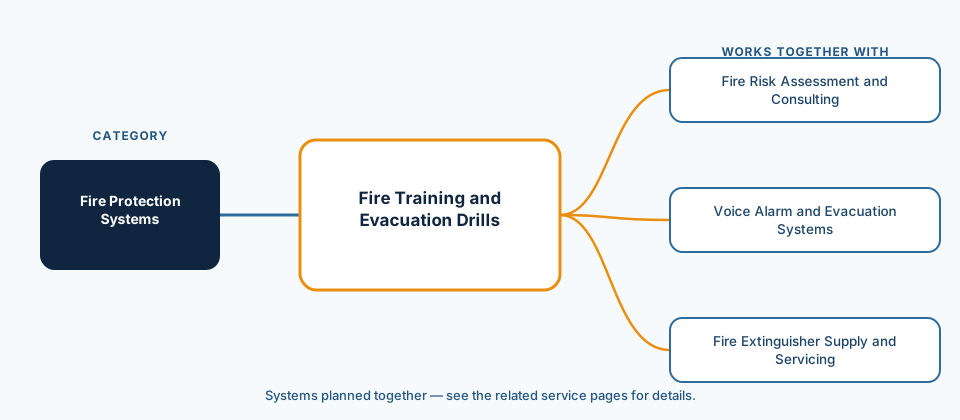
This page covers the delivery stage: giving the training, planning and running the drill, and reviewing the results. Identifying the risks in a building and ranking them by priority is the subject of our fire risk assessment and consulting page; an assessment helps decide which topics the training should emphasise.
The most common problem in drills is not lack of knowledge but habit: people try to leave by the door they came in, go back for their belongings or head for the lift. Regular drills make it possible to see these behaviours on site and correct them.
Which buildings and people are fire training and drills suitable for?
Fire training and drills are useful in any building with staff, students, guests or residents; for workplaces in Türkiye, the legislation lists training and drills among the employer's duties.
- Staff in offices, office towers and commercial businesses.
- Factories, workshops and warehouses, including those working in shifts.
- Hotels and other accommodation; evacuation of staff and guests.
- Schools and training centres; teachers, staff and students.
- Healthcare and care facilities; evacuation of people who cannot move on their own.
- Residential complexes and business centres; management, security and technical staff.
What types of fire training and drill are there?
The work is planned by audience as general awareness, extinguisher practice, emergency team training and evacuation drills; the drill itself can be announced, unannounced or a tabletop scenario exercise.
| Type | Who it is for | Content |
|---|---|---|
| General fire awareness training | Everyone in the building | Raising the alarm, recognising the alarm, escape routes, assembly point |
| Extinguisher practice | Staff and designated personnel | Choosing the type and hands-on use in a controlled setting |
| Emergency team training | Firefighting, rescue, protection and first-aid teams | Team duties, communication, briefing the fire brigade |
| Tabletop scenario exercise | Managers and team leaders | Testing decision-making and communication through a scenario |
| Evacuation drill (announced or unannounced) | Everyone in the building | Testing evacuation on site, from the alarm to the roll call at the assembly point |
The parts of a drill are:
- Preparation: reviewing the emergency plan, team lists, escape routes and the assembly point.
- Scenario: setting conditions such as where the fire starts and which exit cannot be used.
- Observers: people on each floor and at exits who watch the evacuation and take notes.
- Roll call: establishing at the assembly point who is out and who is missing.
- Review: a debrief after the drill, with a list of gaps and corrections.
What does our fire training and drill service scope include?
The service scope runs from preparation to the post-drill review report; the details are written into the proposal after discovery.
- Discovery: reviewing how the building is used, the number of people, shift patterns and the existing emergency plan.
- Preparing training content for each audience.
- General fire training and extinguisher practice in a controlled setting.
- Duty-focused sessions for emergency teams.
- Preparing the drill scenario together with the people responsible for the building.
- Running the drill, observing it and taking a roll call at the assembly point.
- Debrief meeting and drill report.
For workplaces in Türkiye, the people and organisations who may deliver mandatory occupational health and safety training are defined separately in the legislation. If the training needs to be documented under that obligation, we recommend asking for the authorisation and trainer certificates of whoever will deliver it at proposal stage.
How do fire training and drills run?
The process starts by getting to know the plan and the building, continues with training and the drill, and ends once the gaps seen in the drill have been closed.
- Discovery call: we discuss the building, the number of people and your expectations.
- Preparation: the emergency plan, team lists and escape routes are reviewed.
- Proposal: training groups, drill type and scope are set out.
- Training: general training and extinguisher practice are delivered in groups.
- Scenario: drill conditions are agreed with the people responsible for the building.
- Drill: the alarm is raised, the evacuation is observed and a roll call is taken at the assembly point.
- Review and report: the gaps observed and the recommendations are recorded.
Which factors affect the choice and the cost?
The scope and cost depend mainly on the number of participants, the number of training groups and the size of the drill.
We do not publish price ranges; the number of participants and the drill scope can differ greatly even between two workplaces of the same size.
- Number of participants and the number of groups needed for the shift pattern.
- Types of training: general training, extinguisher practice, team training.
- Materials for extinguisher practice and a suitable practice area.
- Drill scope: a single building, or several buildings or sections?
- Number of observers and the level of detail in the report.
- Out-of-hours delivery or delivery over more than one day.
Which regulations apply?
For workplaces in Türkiye, fire training and drills are governed by occupational health and safety legislation, and in buildings by the Regulation on the Protection of Buildings from Fire.
Drill frequency, team size and how training is documented vary with the nature of the workplace and the building; the current texts of the relevant legislation on mevzuat.gov.tr and an occupational safety specialist are the reference.
- Occupational Health and Safety Law No. 6331 (6331 sayılı İş Sağlığı ve Güvenliği Kanunu) — requires employers to prepare emergency plans, to appoint enough trained people for firefighting and evacuation, and to arrange training and drills.
- Regulation on Emergencies in Workplaces (İşyerlerinde Acil Durumlar Hakkında Yönetmelik, Official Gazette 18.06.2013, No. 28681, as amended) — covers the emergency plan, the support staff assigned to firefighting, rescue, protection and first aid, their training, and holding drills regularly and recording them.
- Regulation on the Protection of Buildings from Fire (Binaların Yangından Korunması Hakkında Yönetmelik, Official Gazette 19.12.2007, No. 26735, as amended) — calls for firefighting, rescue, protection and first-aid teams to be set up in certain buildings, for those teams to be trained through drills, and for firefighting and evacuation drills to be held in the building.
How is a drill planned alongside the building's fire systems?
A good drill also tests how the building's fire systems really work; the alarm, announcements and lighting are observed as part of the drill.
For the overall picture of fire systems, see our fire protection systems page.
- Announcements: evacuation messages can be given through voice alarm and voice evacuation systems; observers check that the message is heard and understood in every zone.
- Extinguishers: the types used in training should match those in the building; selection and inspection fall under fire extinguisher supply and servicing.
- Alarm: how the fire panel will be used during the drill and reset afterwards is planned in advance with the people responsible for the building.
- Escape routes: problems with doors, exit signs and emergency lighting are added to the observation notes.
Which questions do we ask during discovery?
For a realistic drill, during discovery we try to understand the daily routine of the building and its occupants; we work through the following questions together.
- What is the largest number of people in the building at one time; is there shift work or night use?
- Is there an up-to-date emergency plan and team list?
- Are there visitors, guests or people who cannot move on their own?
- Has an assembly point been set, and is the route to it safe?
- When was the last drill held; is there a record and a list of gaps?
- Which day and time suit the drill, and is some disruption to work acceptable?
What are the common mistakes with fire training and drills?
The value of a drill depends on how close it is to real conditions and on closing the gaps afterwards.
- Holding the drill only on paper: the form is filled in but nobody leaves the building.
- Always using the same scenario: what to do when the nearest exit is blocked is never practised.
- Forgetting visitors and people who cannot move on their own: the plan is written for staff only.
- Skipping the roll call at the assembly point: someone left inside goes unnoticed.
- Training only one shift: the night shift does not know the plan.
- Skipping the review: the gaps observed carry over unchanged to the next drill.
Related services
- Fire Risk Assessment and ConsultingIdentifying fire risks in a building and prioritised improvement recommendations.View
- Voice Alarm and Evacuation SystemsLife-safety voice evacuation messages triggered by the fire alarm panel.View
- Fire Extinguisher Supply and ServicingChoosing and supplying portable extinguishers, refilling and periodic checks.View
Frequently asked questions
How often should an evacuation drill be held?
Who should receive fire safety training?
Should we hold an unannounced drill?
Is a real extinguisher used in training?
What records are kept after a drill?
How does the discovery call work?
Which areas do you cover for fire training and drills?
Sources
- Presidency of the Republic of Türkiye, Legislation Information System (mevzuat.gov.tr), “Occupational Health and Safety Law No. 6331 (6331 sayılı İş Sağlığı ve Güvenliği Kanunu)”, 2012 (as amended). https://www.mevzuat.gov.tr/mevzuat?MevzuatNo=6331&MevzuatTur=1&MevzuatTertip=5
- Presidency of the Republic of Türkiye, Legislation Information System (mevzuat.gov.tr), “Regulation on Emergencies in Workplaces (İşyerlerinde Acil Durumlar Hakkında Yönetmelik), Official Gazette 18.06.2013, No. 28681”, 2013 (as amended). https://www.mevzuat.gov.tr/mevzuat?MevzuatNo=18493&MevzuatTur=7&MevzuatTertip=5
- Presidency of the Republic of Türkiye, Legislation Information System (mevzuat.gov.tr), “Regulation on the Protection of Buildings from Fire (Binaların Yangından Korunması Hakkında Yönetmelik), Official Gazette 19.12.2007, No. 26735”, 2007 (as amended). https://www.mevzuat.gov.tr/mevzuat?MevzuatNo=200712937&MevzuatTur=21&MevzuatTertip=5
Fire training and drill request
Including the building type, approximate number of people, shift pattern and the date of the last drill speeds up the first conversation.
- Free discovery call
- No commitment; the quote is prepared after the survey.
- Service area
- İzmir and its surroundings (districts such as Menemen and Selçuk, plus Manisa and Aydın)
- Your personal data
- Form details are processed to answer your request; see the privacy notice for details. Privacy notice
Let us talk about your fire training and drills
Tell us about your building, the number of people and your latest drill records, and we will draw up the training and drill plan together.