
Nurse Call Systems (Patient Call Systems)
A system that carries a call from a patient room, bathroom or toilet to the nurse station and the corridor: discovery, installation, commissioning and maintenance.
In short
A nurse call system lets a patient ask for help from the bed, bathroom or toilet at the press of a button and shows the call at the nurse station, in the corridor and on staff devices where needed. It suits hospitals, care homes and rehabilitation centres. Sora Yazılım provides nurse call installation and maintenance in İzmir and its surroundings.
What is a nurse call system and what does it do?
A nurse call system (patient call system) lets a patient or a person in care reach staff from where they are; the call stays visible until it is cancelled on site, so it is never lost which room has someone waiting for help.
The basic flow is simple: the call button at the bedside or in the bathroom is pressed, the corridor light above the room door comes on, and the display at the nurse station announces the call audibly and visually. Staff go to the room and clear the call with the in-room cancel button, which shows that the call has actually been answered on site.
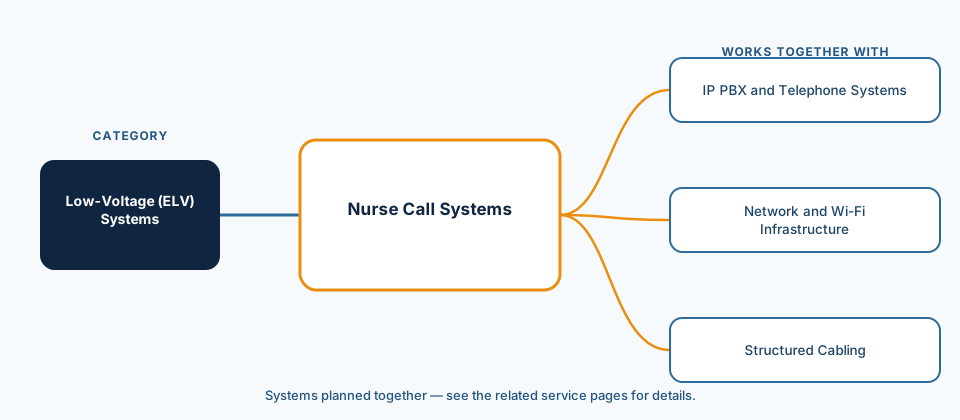
A nurse call system is not a fire alarm or a public address system; it carries a patient's individual request for help. In systems with speech and where calls are forwarded to staff phones, a link can be set up with IP PBX and telephone systems.
Which buildings is a nurse call system suitable for?
A nurse call system is installed in buildings where people who need care are in rooms separate from the staff.
- Hospitals, clinics and day treatment units.
- Care homes, elderly care centres and nursing homes.
- Rehabilitation and physiotherapy centres.
- Accessible toilets and bathrooms in hotels, shopping centres and public buildings.
- Units with special requirements, such as psychiatric wards; device selection in these units is assessed separately.
What types of nurse call system are there and what are the components?
Nurse call systems fall into two main types: light-and-tone (conventional) systems, and network-based (IP) systems with speech, in which the patient and staff can talk to each other.
| Feature | Light-and-tone (conventional) | IP-based, with speech |
|---|---|---|
| How the call is shown | Corridor light and indicator at the station | Corridor light, station screen and staff devices |
| Communication with the patient | None; staff go to the room | Staff can talk to the patient without going to the room |
| Cabling | A dedicated system line | Over the data network and structured cabling |
| Logging and reporting | Limited | Call and response information can be logged |
| Typical use | Small units, care homes | Large hospitals, multi-storey units |
The main components of the system are:
- Bedside call unit and handset: the patient can call without getting out of bed.
- Bathroom and toilet call: pull-cord or wet-area buttons; these calls are usually shown with a separate priority.
- In-room cancel and staff presence button: records that the call has been answered on site.
- Corridor (over-door) light: shows from the corridor which room the call came from.
- Nurse station indicator or screen: lists pending calls, their type and location.
- Forwarding to staff devices: in advanced systems, calls are sent to a phone or handheld terminal.
What does our nurse call service scope include?
Our nurse call service scope runs from discovery to periodic maintenance; the detail of the scope is written into the proposal after discovery.
- Discovery: reviewing the number of rooms, beds, bathrooms and toilets, the station locations and any existing system.
- Selecting the system type and devices; bill of materials and procurement.
- Cabling, device mounting and station set-up.
- Programming call types, priorities and the rules for forwarding to staff devices.
- Commissioning: testing every call point in every room and handing over the test records.
- Training for nursing and care staff.
- Periodic maintenance and fault support (under contract).
How does a nurse call project run?
The process starts with understanding how the unit works; in occupied healthcare buildings, work is split into sections and planned so that patient care is not disrupted.
- Discovery call: we discuss the type of unit, the number of rooms and the staffing pattern.
- Site survey: rooms, bathrooms, corridors and station locations are inspected.
- Plan and proposal: the system type, device list, scope and work schedule are put in writing.
- Installation: cabling and mounting are carried out section by section.
- Programming and testing: call types and priorities are defined and every call point is tried.
- Training, handover and maintenance: staff are trained, documents are handed over and maintenance is scheduled.
Which factors affect the choice and the cost?
The cost of a nurse call system depends mostly on the number of call points, the system type and the need to forward calls to staff devices; an exact figure comes after discovery.
We do not publish price ranges; two units with the same number of rooms can have very different needs depending on how care is organised and the existing infrastructure.
- Number of rooms, beds, bathrooms and toilets, and the resulting number of call points.
- Choice of a light-and-tone system or an IP-based system with speech.
- Number of nurse stations and the need for screens.
- Forwarding calls to staff phones or handheld terminals.
- Whether existing cabling and the data network can be used.
- The need to work section by section and out of hours in an occupied building.
Which standards and regulations apply?
One of the references widely used in Europe for nurse call systems is the German standard DIN VDE 0834; it covers device requirements, planning, installation, testing and operation of call systems in hospitals, nursing homes and similar institutions.
- DIN VDE 0834-1:2026-08 — call systems in hospitals, nursing homes and similar institutions, Part 1: device requirements, planning, installation, modification, extension, testing and operation. This edition replaces DIN VDE 0834-1:2016-06.
- Regulation on the Protection of Buildings from Fire (Binaların Yangından Korunması Hakkında Yönetmelik, Official Gazette 19.12.2007, No. 26735, as amended): for projects in Türkiye, it requires that supply and distribution cables and cable containment in healthcare buildings use halogen-free materials that do not produce toxic gas in a fire; this provision should also be taken into account when planning call system cabling.
Which standard is used as the reference is stated in the design and the proposal and is assessed together with the healthcare facility's own rules. In IP-based systems, if call logs are linked to room or patient information, personal data is being processed; publications from Türkiye's Personal Data Protection Authority under the Personal Data Protection Law (KVKK) offer guidance: Personal Data Protection Authority (KVKK).
How does a nurse call system integrate with other systems?
Conventional nurse call systems usually run independently on their own line; IP-based systems connect to the healthcare building's data network and telephone infrastructure.
In IP-based systems, planning network equipment and wireless coverage falls under network and wireless infrastructure, and the cable and outlet layout under structured cabling. If calls are forwarded to staff devices, wireless coverage needs to be planned across the whole unit, including corridors and rooms.
For other building systems in healthcare facilities, see our low-voltage (ELV) systems page.
Which questions do we ask during discovery?
The right call system starts with understanding how care works in the unit; during discovery we work through the following questions together.
- How many rooms, beds, bathrooms and toilets are there; is there an accessible toilet?
- How many nurse stations are there, and who monitors calls at night?
- Is speech with the patient, or forwarding calls to staff phones, required?
- Is there an existing call system; is an upgrade or an extension being considered?
- Which sections can be vacated during the work, and which hours are suitable?
What are the common mistakes with nurse call systems?
Most problems come from call points that were not fully planned and from ignoring how staff actually work.
- Forgetting bathrooms and toilets: there is no call point where falls and sudden illness happen most often.
- Allowing calls to be cancelled remotely: if a call is cleared from the station, nobody may notice that no one went to the room.
- Not thinking about the night shift: when nobody is at the station, it is unclear where the call ends up.
- Not keeping test records: a faulty call button is only noticed when it is really needed.
Related services
- IP PBX and Telephone SystemsIP PBX, desk phones, extension plan and call flow setup.View
- Network and Wi-Fi InfrastructureSwitch and access point installation, coverage planning, VLAN and guest network setup.View
- Structured CablingIn-building copper horizontal cabling, racks, patch panels, labelling and testing.View
Frequently asked questions
Should I choose a light-and-tone system or an IP-based system with speech?
Can an existing nurse call system be extended?
How is installation carried out in an occupied hospital?
How does the discovery call work?
Which areas do you cover for nurse call systems?
Sources
- DIN Media (DIN / VDE), “DIN VDE 0834-1:2026-08 — Call systems in hospitals, nursing homes and similar institutions — Part 1”, 2026. https://www.dinmedia.de/en/standard/din-vde-0834-1/402766070
- Presidency of the Republic of Türkiye, Legislation Information System (mevzuat.gov.tr), “Regulation on the Protection of Buildings from Fire (Binaların Yangından Korunması Hakkında Yönetmelik), Official Gazette 19.12.2007, No. 26735”, 2007 (as amended). https://www.mevzuat.gov.tr/mevzuat?MevzuatNo=200712937&MevzuatTur=21&MevzuatTertip=5
Nurse call system request
Including the type of facility, the number of rooms and beds and whether there is an existing system speeds up the first conversation.
- Free discovery call
- No commitment; the quote is prepared after the survey.
- Service area
- İzmir and its surroundings (districts such as Menemen and Selçuk, plus Manisa and Aydın)
- Your personal data
- Form details are processed to answer your request; see the privacy notice for details. Privacy notice
Let us talk about your nurse call system
For a new installation, extension or maintenance, tell us about your unit and its current state, and we will start the discovery process together.