
Voice Alarm and Voice Evacuation Systems (VA/VE)
Life-safety infrastructure that tells people what to do during a fire, with clear spoken messages, in the right zone and in the right order: discovery, installation, commissioning and maintenance.
In short
A voice alarm and voice evacuation system is a life-safety system that broadcasts recorded evacuation messages to the relevant zones on a signal from the fire detection system and allows live announcements when needed. It suits hotels, shopping centres, factories and high-rise buildings. Sora Yazılım provides installation, commissioning and maintenance of these systems in İzmir and its surroundings.
What is a voice alarm and voice evacuation system and what does it do?
A voice alarm and voice evacuation system (voice alarm system) is a life-safety system that, when a fire is detected, tells the people in a building what to do with clear spoken messages; unlike comfort systems installed for music and everyday announcements, it is triggered by the fire panel and designed with the relevant standards in mind.
Background music and general announcements are the subject of our public address and background music systems page. The same loudspeaker infrastructure can do both jobs; in that case the emergency announcement always takes priority and automatically cuts off all other uses.
Triggering usually comes through the fire detection and alarm system: scenarios such as an evacuation message for the zone in alarm and an alert or standby message for other zones are defined in the design. A siren only signals that something is wrong; a spoken message tells people where to go and how. An authorised person can also make live announcements from the microphone at the fire control point.
Which buildings need a voice alarm system?
For projects in Türkiye, the Regulation on the Protection of Buildings from Fire sets which buildings must have an announcement system that broadcasts automatic and live evacuation messages; the criteria include the building's use, size, number of occupants or beds, and height.
Whether the requirement applies, and its scope, are assessed by the qualified design engineer and the relevant authority. In practice, the buildings that most often need a voice alarm system are:
- Large hotels and accommodation facilities.
- Shopping centres, supermarkets and large buildings open to the public.
- Factories and industrial facilities.
- High-rise buildings and multi-storey office towers.
- Buildings such as hospitals and schools that require phased evacuation or staff direction.
- Crowded assembly venues such as exhibition, conference and sports venues.
What types of voice evacuation system are there and what are the components?
There are two basic ways of warning people in a building about a fire: audible and visual alarm devices such as sounders and beacons, or a voice alarm system that gives spoken messages. The table below compares them with comfort public address.
| Feature | Sounders and beacons | Voice evacuation (voice alarm) | Comfort public address |
|---|---|---|---|
| Warning given | Tone and light; does not say what to do | Spoken message: what is happening and where to go | Music and everyday announcements |
| Triggering | Fire panel | Fire panel and live announcements by an authorised person | User or timer |
| Zoned and phased evacuation | Limited | Different messages per zone, sequenced evacuation | Zoned announcements; no life-safety purpose |
| Monitoring | Circuits are monitored by the fire panel | Amplifiers, loudspeaker lines and power are monitored continuously | Usually not monitored |
| Standards framework | EN 54 series | EN 54-16, EN 54-24 and the related planning document | Not tied to a life-safety standard |
Which solution is used where is decided by the approved design. The main components of a voice evacuation system are:
- Voice alarm control and indicating equipment: receives the signal from the fire panel, distributes messages to zones and shows faults.
- Recorded messages: alert, evacuation and test messages, in more than one language where needed.
- Emergency microphone: lets an authorised person make live announcements from the fire control point.
- Amplifiers and standby amplifier: drive the loudspeaker lines; the changeover arrangement for a fault is set out in the design.
- Loudspeakers: ceiling, wall and horn loudspeakers designed for voice alarm systems.
- Standby power supply: keeps the system running when mains power fails.
- Fire-resistant cabling: for circuits that must keep working during a fire.
What does our voice alarm service scope include?
The service scope runs from discovery to periodic maintenance; where the design must be prepared by a qualified design engineer and approved, installation follows the approved design. The detail of the scope is written into the proposal after discovery.
- Discovery: reviewing how the building is used, the evacuation strategy, the existing fire design and any existing sound infrastructure.
- Equipment and loudspeaker selection to the design, bill of materials and procurement.
- Running loudspeaker lines and fire-resistant cables to the design and mounting equipment.
- Programming zone definitions, recorded messages and the priority order.
- Setting up the scenario link with the fire detection system.
- Commissioning: testing the message in every zone for audibility and intelligibility and handing over the test records.
- Training building staff in live announcements and system use.
- Periodic maintenance and testing (under contract).
Preparing and approving the fire design is the responsibility of the qualified engineer and the relevant authority. This page provides general information; decisions specific to your building are based on the approved design.
How does a voice alarm project run?
The process starts with discovery, continues with installation to the approved design and zone-by-zone testing, and carries on with periodic maintenance once the system has been handed over with user training.
- Discovery call: we discuss the building, its use, the evacuation strategy and the current situation.
- Site survey: sections, ceilings, acoustic conditions and cable routes are inspected.
- Design: an existing approved design is reviewed; if there is none, its preparation with a qualified design engineer is planned.
- Proposal: the equipment list, scope and work schedule are set out.
- Installation: lines are run and loudspeakers and control equipment are mounted.
- Programming and messages: zones, messages and fire panel scenarios are defined.
- Commissioning and testing: each zone is listened to, scenarios are tried and the results are recorded.
- Training, handover and maintenance: live announcements and fault follow-up are explained and periodic maintenance is scheduled.
Which factors affect the choice and the cost?
The cost of a voice alarm system depends mostly on the number of zones, the acoustics of the spaces, redundancy requirements and the cable route; an exact figure comes after discovery and design.
We do not publish price ranges; two buildings of the same size can have very different needs depending on the evacuation strategy and the approved design.
- Number of zones and the phased evacuation arrangement.
- Size, ceiling height and acoustics of the spaces, and the resulting number of loudspeakers.
- Standby amplifier and standby power requirements.
- Route and length of fire-resistant cabling.
- Number of messages and language options.
- Whether an existing comfort public address system will be integrated.
Which standards and regulations apply?
For projects in Türkiye, which buildings must have an announcement system and how it is to be used are set by the Regulation on the Protection of Buildings from Fire; in Europe, the relevant parts of the EN 54 series are used for voice alarm system components.
- Regulation on the Protection of Buildings from Fire (Binaların Yangından Korunması Hakkında Yönetmelik, Official Gazette 19.12.2007, No. 26735, as amended): requires the fire detection system to conform to TS EN 54, requires an announcement system broadcasting automatic and live evacuation messages in certain buildings, requires fire-resistant cable for voice evacuation circuits, and requires emergency announcements to take priority if the announcement system is also used for other purposes. The current text should be checked on mevzuat.gov.tr.
- EN 54-16:2008 — voice alarm control and indicating equipment.
- EN 54-24:2008 — components of voice alarm systems: loudspeakers.
- CEN/TS 54-32:2015 — technical specification for the planning, design, installation, commissioning, use and maintenance of voice alarm systems.
Sound systems used for emergencies other than fire fall under EN 50849:2017; that standard does not cover systems used for fire evacuation. The number of loudspeakers, sound levels and intelligibility targets are calculated for each building; the relevant standard and a qualified design engineer are the reference.
How does a voice alarm system integrate with other systems?
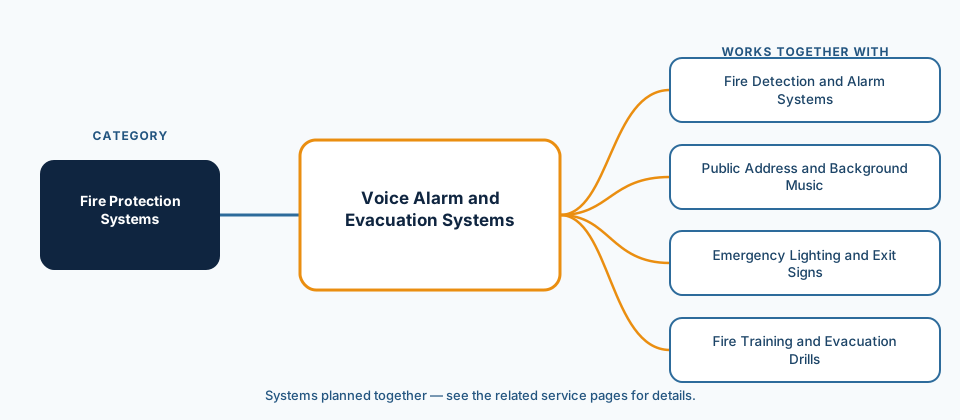
A voice alarm system is part of the fire detection system's scenario; it must work to the same plan, in the same sequence and without interfering with the other steps of the evacuation.
- The exits named in the announcements are kept the same as those shown by emergency lighting and exit signage systems along the escape routes.
- If a comfort public address system is shared, music and general announcements are cut off automatically in an emergency.
- In buildings that need phased evacuation, the order of zone messages is set up together with the fire scenario.
- For the messages and the live announcement arrangement to work, staff need to be familiar with them; this is covered by fire safety training and evacuation drills.
Which scenarios are used is specific to each building, and each one should be tested at commissioning. For the overall picture of other fire systems, see our fire protection systems page.
Which questions do we ask during discovery?
The right message and zone plan starts with understanding how the building will be evacuated; during discovery we work through the following questions together.
- What is the building's evacuation strategy: the whole building at once, or phased?
- Does the approved fire design set any requirement for the announcement system?
- Are there occupants who speak different languages; how many languages should the messages be in?
- Who will make live announcements, and from where?
- Is there a comfort public address system; will it be shared?
- Where are the high-ceilinged, reverberant or noisy areas?
- Where is the fire control point or security room; who should be notified during an alarm?
What are the common mistakes with voice alarm systems?
The most frequent problems come from confusing comfort and life-safety systems and from assuming that a message that can be heard is also understood.
- Treating a comfort system as voice alarm: a system with unmonitored lines and no standby power can fall silent exactly when it is needed most.
- Assuming audibility is enough: a loud but unintelligible message in a reverberant space does not help evacuation.
- Writing vague messages: a message that does not clearly say what to do and where to go causes hesitation.
- Not updating zones after refurbishment: new sections may receive no message or the wrong one.
- Putting fault warnings on hold: a line or amplifier fault means a silent zone in a real alarm.
Related services
- Fire Detection and Alarm SystemsFire panels, detectors, call points, sounder-beacons and cause-and-effect setup.View
- Public Address and Background MusicSpeakers and amplifiers for background music and general or zoned announcements.View
- Emergency Lighting and Exit SignsLuminaires and exit signs that light escape routes during a power failure.View
- Fire Training and Evacuation DrillsStaff fire training, extinguisher use and evacuation drill exercises.View
Frequently asked questions
If there is a voice alarm system, are sounders still needed?
Can an existing public address system be used for voice alarm?
How are evacuation messages prepared?
What is phased evacuation and how does a voice evacuation system support it?
How often should a voice alarm system be maintained?
How does the discovery call work?
Which areas do you cover for voice alarm systems?
Sources
- Presidency of the Republic of Türkiye, Legislation Information System (mevzuat.gov.tr), “Regulation on the Protection of Buildings from Fire (Binaların Yangından Korunması Hakkında Yönetmelik), Official Gazette 19.12.2007, No. 26735”, 2007 (as amended). https://www.mevzuat.gov.tr/mevzuat?MevzuatNo=200712937&MevzuatTur=21&MevzuatTertip=5
- CEN (Estonian Centre for Standardisation and Accreditation catalogue), “EN 54-16:2008 — Fire detection and fire alarm systems — Part 16: Voice alarm control and indicating equipment”, 2008. https://www.evs.ee/en/evs-en-54-16-2008
- CEN (Estonian Centre for Standardisation and Accreditation catalogue), “EN 54-24:2008 — Fire detection and fire alarm systems — Part 24: Components of voice alarm systems — Loudspeakers”, 2008. https://www.evs.ee/en/evs-en-54-24-2008
- CEN (Estonian Centre for Standardisation and Accreditation catalogue), “CEN/TS 54-32:2015 — Planning, design, installation, commissioning, use and maintenance of voice alarm systems”, 2015. https://www.evs.ee/en/cen-ts-54-32-2015
- CENELEC (Estonian Centre for Standardisation and Accreditation catalogue), “EN 50849:2017 — Sound systems for emergency purposes”, 2017. https://www.evs.ee/en/evs-en-50849-2017
Voice alarm system request
Including the building type, number of storeys and whether there is an existing fire alarm or sound system speeds up the first conversation.
- Free discovery call
- No commitment; the quote is prepared after the survey.
- Service area
- İzmir and its surroundings (districts such as Menemen and Selçuk, plus Manisa and Aydın)
- Your personal data
- Form details are processed to answer your request; see the privacy notice for details. Privacy notice
Let us talk about your voice alarm system
For a new installation, upgrade or maintenance, tell us about your building and its current state, and we will start the discovery process together.