
Structured Cabling Services: Installation, Labelling and Testing
An organised, documented and tested data infrastructure from the outlet to the cabinet, for offices, factories, hotels, schools and similar buildings.
In short
Structured cabling is the passive infrastructure that runs a building's data and voice links from the user outlet to the floor cabinet in a standardised layout. It suits offices, factories, hotels and schools. Sora Yazılım provides structured cabling installation in İzmir and its surroundings, covering copper horizontal cabling, cabinet and patch panel layout, labelling and link testing.
What is structured cabling and what is it for?
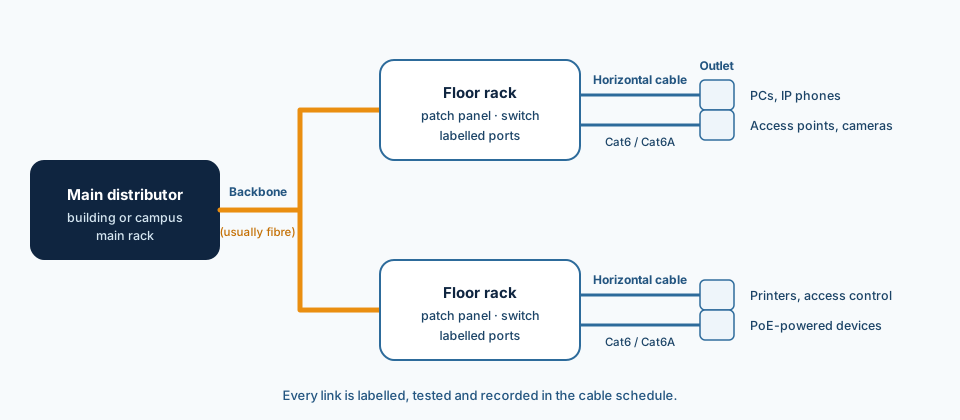
Structured cabling (a structured cabling system) brings the physical links used by computers, IP phones, cameras and wireless access points into one standardised architecture, so every link can be traced, tested and reused.
Ad hoc cabling works on day one, but when people move, the business grows or a fault occurs, nobody knows which cable goes where. Structured cabling separates links into layers: horizontal cabling runs from the floor cabinet to the user outlet, while the backbone connects cabinets to each other and to the main distributor.
This page focuses on copper horizontal cabling inside the building. The backbone between floors and buildings is usually fibre, which is covered on our fibre optic cabling page. Cabling is passive infrastructure: the active network layer of switches, access points and VLANs is covered under network and wireless infrastructure.
Which buildings and needs is structured cabling suited to?
Any building with several users and networked devices that will be in use for years and will change over time benefits from structured cabling.
- Offices and office towers: when desks move, links are re-patched at the panel instead of being re-pulled.
- Factories and warehouses: cable and route selection suited to the environment for terminals, cameras and handheld scanners on the shop floor.
- Hotels and accommodation: a shared infrastructure for wireless access points, IP phones and management systems in rooms, the lobby and common areas.
- Schools and education: classrooms, labs and administration managed from separate cabinets.
- Comms and server rooms: servers and network equipment connected with tidy patch cabling inside the cabinet.
Which cable types and components does structured cabling use?
Cat6 and Cat6A copper cable are the most common choices for in-building horizontal links, while fibre is preferred for the backbone depending on distance and bandwidth. The category is chosen in the design according to the required speed, device types and budget.
| Option | Typical use | Points to watch |
|---|---|---|
| Cat6 (usually U/UTP) | Standard office outlets, IP phones, printers | May be enough for today's needs; limited at points that will need 10 Gbit/s later. |
| Cat6A (U/UTP or shielded F/UTP) | Data-heavy points, wireless access points, PoE-powered devices | Specified for 10GBASE-T; the cable is thicker, so tray and trunking fill are planned accordingly. |
| Fibre backbone (multimode or single-mode) | Links between floor cabinets and between buildings | For long distances and high bandwidth; details on the fibre optic cabling page. |
The components matter as much as the cable itself: keystone jacks and outlets, patch panels, rack cabinets, cable trays and trunking, patch cords, in-cabinet cable management and earthing. A link not built from the same category and compatible components performs only as well as its weakest part.
What does our structured cabling service scope include?
Our structured cabling service runs from discovery to handover documents; the detailed scope of each project is written into the proposal after the survey.
- Discovery and needs analysis: outlet count, user and device list, expected growth.
- Plan for routes, outlet positions and cabinet locations.
- Cable category and component selection, bill of materials and procurement.
- Cable pulling, termination and in-cabinet layout (patch panels, cable management).
- Labelling of links, outlets and panels; cable schedule and cabinet layout document.
- Post-installation link testing and handover of test results.
- Optional periodic checks and additional outlet or link work.
How does a structured cabling project run?
The process starts with a discovery call and ends with every link tested and documented; in an occupied building the work is planned so it does not disrupt daily operations.
- Discovery call: we discuss the building, the number of users and the devices to connect.
- Site survey: cabinet location, routes, suspended ceilings and floor conditions are inspected.
- Design and bill of materials: outlet layout, cable category and cabinet layout are defined.
- Proposal: scope, materials and work schedule are put in writing.
- Installation: cables are pulled and terminated and the cabinet is laid out.
- Testing and label check: every link is tested and labels are checked against the cable schedule.
- Handover: the cable schedule, cabinet layout and test results are delivered.
Which factors affect the choice and the cost?
The cost of structured cabling is driven mainly by the number of outlets, how difficult the routes are and the cable category chosen; an exact figure can only be given after the survey.
We do not publish price ranges: even if two buildings have the same number of outlets, differences in routes and environment change the cost significantly.
- Number of outlets and links, number of floors and size of the area.
- Route conditions: suspended ceilings, raised floors, concrete penetrations, working at height.
- Cable category and shielding requirement (Cat6, Cat6A, U/UTP or F/UTP).
- Number of cabinets and their power, ventilation and space needs.
- Number of PoE-powered devices (cameras, access points, phones).
- Removal of existing cables and any need for out-of-hours work in an occupied building.
Which standards apply to structured cabling?
Structured cabling is usually designed to the international ISO/IEC 11801 series, the European EN 50173 series or the US-originated ANSI/TIA-568 series; which one applies to the project is stated in the proposal and contract.
Length limits, test parameters and acceptance values are taken from the chosen standard, and test results are reported against them. If a cable route passes through a fire-compartment wall, sealing the openings must be planned separately; that work falls under firestopping.
- ISO/IEC 11801-1:2017 — Information technology, generic cabling for customer premises, Part 1: General requirements.
- EN 50173-1:2018 — Information technology, generic cabling systems, Part 1: General requirements.
- ANSI/TIA-568.2-E (2024) — Balanced twisted-pair telecommunications cabling and components.
How does structured cabling work with other systems?
The same cabling infrastructure carries almost every networked building system, so the outlet and cabinet plan is drawn up with all the low-voltage systems in the building in mind, not just computers.
IP cameras are powered over PoE from the same cabinet and reach the recorder over these links; details are on the CCTV and IP camera systems page. Desk IP phones and phone system connections use the same infrastructure too: IP PBX and telephone systems.
For the wider picture, our low-voltage (ELV) systems page summarises how cabling relates to the other systems. Once the cabling is complete, buildings that need continuity on the server and comms room side can also consider our server maintenance agreement.
Which questions do we ask during discovery?
A sound cabling plan depends less on today's device count than on understanding how the building will be used in the coming years, so we work through the following questions together during discovery.
- How many users and desks are there, and will that number change in the next few years?
- Which devices will be cabled: cameras, access points, IP phones, card readers?
- Where will the cabinet go, and does that spot have power, ventilation and lockable access?
- Which routes can be used: suspended ceilings, raised floors or in-wall conduit?
- If the building stays occupied, which hours and areas are available for work?
- Will existing cables be removed, or will old and new run in parallel for a while?
What are the common mistakes in structured cabling?
Most problems stem not from the cable itself but from gaps in planning and documentation.
- Leaving links unlabelled: when a fault occurs, someone has to trace which outlet goes to which panel port.
- Sharing routes with power cables: if separation is not planned in the design, interference and safety issues follow.
- Thinking about the cabinet last: a cabinet without ventilation or space falls short at the first expansion.
- Accepting handover without testing: a link that seems to work can fail at high speed or under PoE load.
- Leaving no spare capacity: with no free space in panels and trays, every new outlet becomes a new project.
Related services
- Fibre Optic CablingBackbone and inter-building fibre links, splicing, termination and fibre testing.View
- Network and Wi-Fi InfrastructureSwitch and access point installation, coverage planning, VLAN and guest network setup.View
- CCTV and IP Camera SystemsCamera placement plan, recorders, storage and monitoring infrastructure.View
- IP PBX and Telephone SystemsIP PBX, desk phones, extension plan and call flow setup.View
Frequently asked questions
Should I choose Cat6 or Cat6A?
Can structured cabling be renewed in an occupied building?
Which documents are handed over at the end of the installation?
Is structured cabling the same as network installation?
How does the discovery call work?
Which areas do you cover for structured cabling?
Sources
- IEC / ISO, “ISO/IEC 11801-1:2017 — Information technology — Generic cabling for customer premises — Part 1: General requirements”, 2017. https://webstore.iec.ch/publication/26450
- CENELEC (Estonian Centre for Standardisation catalogue), “EN 50173-1:2018 — Information technology — Generic cabling systems — Part 1: General requirements”, 2018. https://www.evs.ee/en/evs-en-50173-1-2018
- Telecommunications Industry Association (TIA), “TIA Publishes New Standards: ANSI/TIA-568.2-E and ANSI/TIA-568.5-1”, 2024. https://tiaonline.org/?p=36976
Structured cabling request
Including the building type, approximate number of outlets and location speeds up the first conversation.
- Free discovery call
- No commitment; the quote is prepared after the survey.
- Service area
- İzmir and its surroundings (districts such as Menemen and Selçuk, plus Manisa and Aydın)
- Your personal data
- Form details are processed to answer your request; see the privacy notice for details. Privacy notice
Let us talk about your structured cabling project
Share your building plan, number of users and the devices to connect, and we will start the discovery and proposal process together.