
IP PBX Installation: Extension Planning, IP Phones and Call Flow
A business phone infrastructure that brings extensions, external lines and call routing into one system, used from desk phones, computers and mobiles.
In short
IP PBX installation means setting up a phone system that manages internal extensions, external lines and call routing over internet protocol, connecting the handsets and configuring the call flow. It suits offices, hotels, factories and multi-branch businesses. Sora Yazılım provides IP PBX and business phone system installation in İzmir and its surroundings.
What is an IP PBX and what is it for?
An IP PBX (VoIP phone system, IP telephone exchange) is a phone system that uses software to manage an organisation's internal extensions, external lines and how incoming calls reach the right person; the phones run over the computer network instead of separate telephone cabling.
In a traditional PBX, a separate line is run for every extension and adding features means adding hardware. With an IP PBX, an extension can be a networked desk phone, a softphone on a computer or a mobile app, and features such as an auto attendant, out-of-hours routing, call queues and voicemail are defined in software.
This page covers the on-site installation of the phone system: the extension plan, handset installation, network preparation and call flow configuration. Software versions and licence options are on our 3CX phone system catalogue page. The network the phones run on is covered under network and wireless infrastructure.
Which buildings and needs is an IP PBX suited to?
Any business with several extensions, a reception set-up that must route incoming calls to the right person, or more than one location benefits from an IP PBX.
- Offices and office towers: an extension plan by department, an auto attendant and remote staff connected to the same phone system.
- Multi-branch businesses: internal calls between branches and calls to a single number distributed to the branches.
- Hotels and accommodation: room phones, reception, room service and wake-up calls.
- Factories and warehouses: internal communication between the shop floor, dispatch and the office block, with handsets chosen for noisy areas.
- High call-volume teams: call queues and reporting for customer service and sales.
- Clinics and healthcare facilities: appointment lines, extensions between departments and out-of-hours routing.
What types of IP PBX are there and what are the components?
A phone system can be set up in three basic ways: a traditional or hybrid PBX in the building, an on-premises IP PBX running on a company server, or a cloud PBX hosted in a data centre; the choice depends on the number of users, the number of locations and how the business prefers to operate.
| Feature | Traditional / hybrid PBX | On-premises IP PBX | Cloud PBX |
|---|---|---|---|
| Extension infrastructure | A separate phone line for every extension | Computer network | Computer network and internet connection |
| Remote and mobile use | Limited | Possible with apps and remote access | Suited to it by design |
| Growth | Needs extra cards and hardware | Depends on licences and server capacity | By increasing licences or subscriptions |
| Hardware in the building | PBX cabinet | Server or virtual machine | Only phones and network devices |
| Point to watch | Spare parts and continuity of maintenance | Server maintenance, backups and power continuity | Quality of the internet connection and a backup |
Whichever model is chosen, the components that make up the system are similar:
- Phone system software: manages extensions, call flow, queues and recordings.
- External lines: a SIP trunk from the carrier and, if needed, a gateway for existing analogue or digital lines.
- IP desk phones: models with expansion modules for reception and heavy users.
- Softphone and mobile app: making calls as an extension from a computer or mobile phone.
- Analogue gateway: connects analogue devices such as fax machines, door phones or lift phones to the phone system.
- PoE switch and uninterruptible power supply (UPS): powers phones over the network cable and keeps them working during a power cut.
- Headsets and conference devices: for call-heavy staff and meeting rooms.
What does our IP PBX service scope include?
Our IP PBX service runs from needs analysis to user training; the detailed scope of each project is written into the proposal after the survey.
- Discovery: number of users and extensions, existing phone system and lines, calling habits, branch and remote working needs.
- Extension plan: numbering, groups, permissions and outbound dialling rules.
- Call flow design: auto attendant, in-hours and out-of-hours routing, call queues, voicemail.
- Selection of the phone system, handsets and accessories; bill of materials and procurement.
- Network preparation: a separate voice VLAN, prioritisation and a PoE capacity check.
- Phone system installation, coordination with your carrier for the trunk connection, and handset installation.
- Call testing, user and reception training, and handover of the extension list and configuration backup.
- Optional maintenance, updates and work to add or change extensions.
How does an IP PBX installation run?
The process starts with a discovery call, continues with the extension and call flow plan and ends with a planned move from the old system to the new one, scheduled for a time that keeps missed calls to a minimum.
- Discovery call: we discuss users, the existing system, your numbers and your expectations.
- Site visit: the cabinet, network equipment, cabling and phone points are inspected.
- Plan: the extension plan and call flow are drawn up together and the greeting messages are agreed.
- Proposal: the system model, equipment list, scope and changeover date are put in writing.
- Preparation: the network is configured, the phone system is installed and we work with your carrier on the trunk.
- Changeover: phones are put in place, numbers are routed to the new system and calls are tested.
- Training and handover: users and reception are shown how to use the system and the documents are handed over.
Which factors affect the choice and the cost?
The cost of an IP PBX is driven mainly by the number of users, the system model and licensing chosen, the type of handsets and whether the network is ready; an exact figure can only be given after the survey.
We do not publish price ranges: for two businesses with the same number of users, the cost varies noticeably depending on whether the network is ready and on the licence model chosen. Line rental and call charges depend on your subscription with your carrier.
- Number of users and extensions; number of simultaneous calls.
- Choice of on-premises or cloud phone system and the licence or subscription model.
- Mix of desk phones, softphones and mobile apps; reception equipment.
- Whether the network is ready: need for PoE switches, cabling and a UPS.
- Number of branches, remote users and integration requirements.
- Need to connect existing analogue devices and lines to the new system.
Which standards and regulations apply?
IP phone systems and handsets run on the SIP protocol, which sets up and manages calls, together with the Ethernet and VLAN standards; if call recording is used, personal data protection law also comes into play.
Call recordings, caller number logs and voicemail contain personal data. For projects in Türkiye where calls will be recorded, check the resources of the Personal Data Protection Authority (KVKK) on Türkiye's Personal Data Protection Law (KVKK) for topics such as privacy notices, retention and access, and review the details with your legal adviser. The telephone service itself is provided by your carrier.
- IETF RFC 3261 (June 2002) — SIP: Session Initiation Protocol; the protocol behind sessions between IP phones and the phone system and between the phone system and the carrier. It has been updated by later RFCs.
- IEEE 802.3-2022 — the Ethernet standard, which also covers powering phones over the network cable (PoE).
- IEEE 802.1Q-2022 — the standard on which VLANs are based; used to carry voice traffic on a separate virtual network.
How does an IP PBX work with other systems?
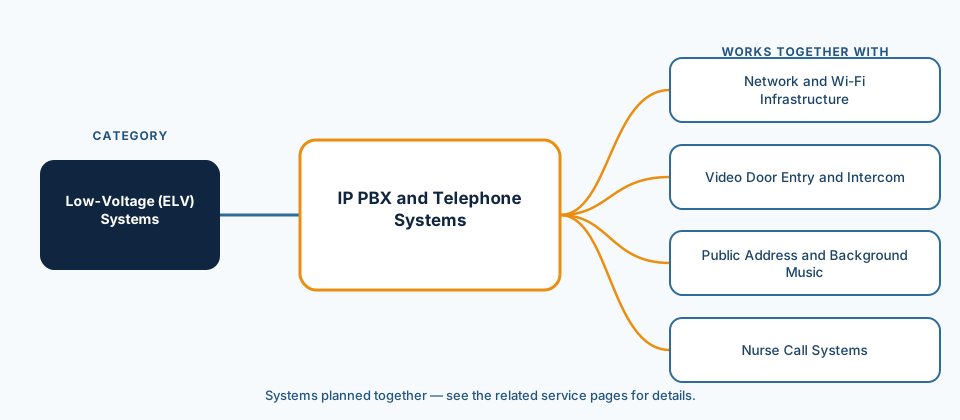
Because an IP PBX runs on the same network, it can be planned together with the building's other communication systems; which integrations are possible is decided in the design according to the methods the devices in use support.
Some door panels can connect to the phone system as an extension, so the visitor's call rings on the desk phone and the door can be opened from the phone. Details are on the video door entry and intercom systems page. General or zoned announcements made from the phone system can be fed to the building's loudspeakers through an amplifier connection: public address and background music systems.
In healthcare facilities, forwarding calls from patient rooms to the phones staff carry can be designed to suit the project: nurse call systems. If your teams work on a collaboration and meeting platform, one option for using it with the phone system is described on the 3CX Teams integration page. For the overall picture with the building's other systems, see the low-voltage (ELV) systems page.
Which questions do we ask during discovery?
The right phone system depends less on the equipment list than on understanding how calls move through the business, so we work through the following questions together during discovery.
- How many users are there, and who will use a desk phone, a computer or a mobile?
- Who answers incoming calls, and where should calls go out of hours and at peak times?
- Which carrier are your current numbers with, and will the same numbers be used on the new system?
- Will branches or remote users connect to the same phone system?
- Are there analogue devices that must stay connected, such as fax machines, door phones or lift phones?
- Do you need call recording, reporting or integration with customer management software?
What are the common mistakes in IP PBX installation?
Most call quality and availability problems stem not from the phone system but from an unprepared network and an unplanned call flow.
- Carrying voice on the data network without priority: under heavy data traffic, calls break up, crackle or lag.
- Ignoring PoE and power continuity: if the switch goes down in a power cut, every phone goes silent.
- Thinking about call flow last: without a planned auto attendant and out-of-hours routing, calls go unanswered.
- Not planning a backup connection: nobody has decided where calls go when the internet or the carrier line fails.
- Leaving the phone system unpatched and unprotected: a system exposed to the internet carries a risk of abuse and unwanted calls.
- Skipping user training: if basic tasks such as transferring and picking up calls are unknown, the system is not used efficiently.
Related services
- Network and Wi-Fi InfrastructureSwitch and access point installation, coverage planning, VLAN and guest network setup.View
- Video Door Entry and IntercomVideo calls with visitors, door release and communication between units.View
- Public Address and Background MusicSpeakers and amplifiers for background music and general or zoned announcements.View
- Nurse Call SystemsCalls from patient rooms, bathrooms and toilets to the nurse station.View
Frequently asked questions
Can we keep our existing phone numbers on the new system?
Do the phones work if the internet goes down?
Should we choose a cloud or an on-premises phone system?
Can remote staff use the same phone system?
How does the discovery call work?
Which areas do you cover for IP PBX installation?
Sources
- IETF / RFC Editor, “RFC 3261 — SIP: Session Initiation Protocol”, 2002. https://www.rfc-editor.org/rfc/rfc3261
- IEEE Standards Association, “IEEE 802.3-2022 — IEEE Standard for Ethernet”, 2022. https://standards.ieee.org/ieee/802.3/10422/
- IEEE Standards Association, “IEEE 802.1Q-2022 — Bridges and Bridged Networks”, 2022. https://standards.ieee.org/standard/802_1Q-2022.html
IP PBX request
Including the approximate number of users, your current phone system and carrier, and the location speeds up the first conversation.
- Free discovery call
- No commitment; the quote is prepared after the survey.
- Service area
- İzmir and its surroundings (districts such as Menemen and Selçuk, plus Manisa and Aydın)
- Your personal data
- Form details are processed to answer your request; see the privacy notice for details. Privacy notice
Let us talk about your IP PBX project
Whether it is a new installation, a move from an old phone system or connecting branches, share details of your users and current set-up, and we will start the discovery process together.