
Access Control, Turnstile and Time Attendance Systems
An access setup that defines who can pass through which door and at what times, and logs every entry and exit: survey, installation, commissioning and maintenance.
In short
Access control systems verify a person's identity at doors and turnstiles by card, PIN or mobile credential and let only authorised people through; a time and attendance system uses the same records to log staff arrival and departure times. Sora Yazılım provides access control, turnstile and time attendance installation in İzmir and its surroundings.
What is an access control and time attendance system and what is it for?
An access control system defines in software who can enter a building's doors, turnstiles and areas and at what times, and records every passage. A time and attendance system is the layer that turns those access records into working-hours and attendance reports.
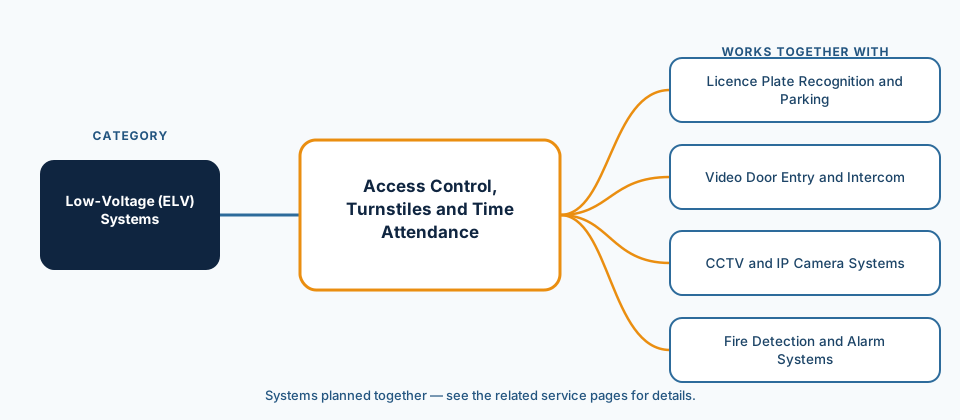
This page covers the passage of people. Reading number plates at vehicle entrances and controlling the barrier is the subject of our licence plate recognition and parking management page. Talking to a visitor at the door and releasing it from inside is covered under video door entry and intercom systems.
All three systems can work at the same entrance: staff pass with their card, vehicles enter by number plate, and visitors speak over the door entry system before being let in.
Which buildings and needs are access control systems suited to?
Buildings where not everyone should enter every area, where staff entries and exits need to be recorded, or where busy entrances need to be managed benefit from access control systems.
- Offices and office towers: building and floor entrances, management floors, server rooms.
- Factories and warehouses: staff entrances, production areas, stock and dispatch areas.
- Schools and education: the main entrance, administration and laboratories.
- Healthcare facilities: staff areas, medicine stores and plant rooms.
- Sports and leisure facilities: turnstiles for members-only areas.
- Residential complexes: pedestrian entrances, shared areas and technical rooms.
What types of access control system are there and what are the components?
Access control systems are distinguished by how they verify identity: card, PIN, mobile credential and biometric methods. Card-based systems are the most common; biometrics is an option that needs separate assessment because it involves processing special categories of personal data.
| Feature | Card-based (contactless card) access | Biometric access (fingerprint, face, palm) |
|---|---|---|
| Identity verification | Holding the card near the reader | Reading a physical characteristic unique to the person |
| Lost and shared cards | A card can be lost or handed to someone else; a lost card is cancelled immediately | No card to carry, but protecting the enrolment records and templates becomes critical |
| Personal data | Card numbers and access logs are personal data | Biometric data is listed in the Law as a special category of personal data |
| For time and attendance | The common, direct method | Needs separate assessment because of the Board's principle decision No. 2026/921 (see below) |
| Typical use | Building, floor and area entrances, turnstiles | A limited number of critical areas with a security justification |
Which method is used depends on how important the door is, the number of users and your personal data assessment. The main components of an access control system are:
- Reader: the device beside the door that reads the card, PIN or mobile credential.
- Controller: the device that evaluates permissions, releases the lock and keeps the records.
- Lock: a magnetic lock or electric strike, chosen for the door type and whether it is on an escape route.
- Door contact and exit button: detect a door left open and allow exit from inside.
- Turnstile: tripod, speed gate (swing or flap) or full-height types; one person at a time at busy entrances.
- Software: user and permission set-up, time schedules, access logs and attendance reports.
What does our access control service scope include?
Our access control and time attendance service runs from the survey to periodic maintenance; the detailed scope of each project is written into the proposal after the survey.
- Survey: review of doors, turnstile positions, escape routes, the number of users and any existing system.
- Permission plan: which user group may pass through which door and at what times.
- Reader, controller, lock and turnstile selection, bill of materials and procurement.
- Cabling, door hardware and turnstile installation.
- Software set-up: users, cards, time schedules and attendance reports.
- Integration of escape-route doors with the fire alarm panel (according to the approved design).
- Commissioning: testing every door, turnstile and scenario one by one.
- User training and periodic maintenance (subject to contract).
How does an access control project run?
The process starts with a discovery call about who needs to go where, and ends with every door tested and the software handed over to administrators with training.
- Discovery call: we discuss the building, user groups and your expectations.
- Site survey: doors, door types, escape routes and cable routes are inspected.
- Permission plan and device list: the reader, lock and turnstile for each door are defined.
- Proposal: scope, bill of materials and work schedule are put in writing.
- Installation: cabling, door hardware, turnstiles and controllers are installed.
- Software and integration: users are set up and links to the fire alarm and other systems are made.
- Testing, training and handover: every door and scenario is tried out and administrators learn to use the software.
Which factors affect the choice and the cost?
The cost of an access control system is driven mainly by the number of doors and turnstiles, the door types and the software features required; an exact figure can only be given after the survey.
We do not publish price ranges: even with the same number of doors, differences in door type, turnstile needs and integration scope change the cost of two buildings significantly.
- Number of doors to control and their type (glass, timber, metal, fire door).
- Turnstile type and number, and how busy the entrance is.
- Identification method: card, PIN, mobile credential or a combination.
- Number of users, time schedules and attendance reporting needs.
- Integration with systems such as the fire alarm, cameras, door entry and licence plate recognition.
- Cable routes and whether existing door hardware can be reused.
Which standards and regulations apply?
Electronic access control systems are covered internationally by IEC 60839-11-1 (EN 60839-11-1 in Europe); because the system processes personal data, projects in Türkiye must also take Türkiye's Personal Data Protection Law (KVKK, Law No. 6698) into account.
The Authority's public announcement on this decision (in Turkish) reports the assessment that processing biometric data solely to track working hours does not rest on the processing conditions in the Law and would not meet the principle of proportionality even with explicit consent; it also states that access to critical areas with a security justification will be assessed separately, case by case. For this reason, we offer non-biometric methods such as cards and mobile credentials as the first option in time attendance projects.
Which data is processed and for what purpose is your decision as the data controller; for current rules, see the Personal Data Protection Authority website. This page does not give legal advice; where needed, we recommend asking your legal adviser.
- EN 60839-11-1:2013 — Alarm and electronic security systems, Part 11-1: Electronic access control systems, System and components requirements.
- Türkiye's Personal Data Protection Law (KVKK), Law No. 6698 (Official Gazette 07.04.2016, No. 29677).
- The Personal Data Protection Board's Principle Decision No. 2026/921 of 29.04.2026 on Processing Biometric Data for Tracking Working Hours (Official Gazette 02.06.2026).
How does an access control system work with other systems?
Access control is where a building's security and life safety systems meet; the most important integration is releasing doors on escape routes in the event of a fire.
Releasing card-controlled doors and turnstiles on escape routes when the fire alarm activates is set up according to the approved design and tested at commissioning; details are on the fire detection and alarm systems page. Matching door events to footage, for example bringing up the camera on a forced door, can be done with CCTV and IP camera systems.
Releasing the door for a visitor who has spoken over the door entry system, and monitoring vehicle entrances with licence plate recognition in the same software, can also be planned to suit the project. Our low-voltage (ELV) systems page summarises how all the security systems are planned together.
Which questions do we ask during the survey?
A sound access control plan starts with being clear about who needs to enter where and when, so we work through the following questions together during the survey.
- How many users are there and how are they grouped: staff, managers, contractors, visitors?
- Which doors will be controlled, and which of them are on escape routes or are fire doors?
- Will access logs be used as attendance reports or exported to payroll software?
- Which identification method suits you: card, PIN or mobile credential?
- How will visitors be received, and how will temporary access be granted?
- Will any existing cards, readers or software be reused?
What are the common mistakes in access control systems?
Most problems stem not from the devices but from escape routes and permission management not being thought through at the start.
- Forgetting the escape route: a card-controlled door that does not release on a fire alarm is a life safety problem; every escape door must be addressed separately in the design.
- Not cancelling leavers' cards: unless permission management is defined as a process, old cards keep working.
- Opening every door to everyone: without permission groups and time schedules, the system becomes just an expensive door lock.
- Choosing biometrics without assessment: before buying biometric readers for attendance, carry out a personal data assessment.
- Overlooking door hardware: a lock that does not suit the door or a badly adjusted door closer leaves doors standing open.
Related services
- Licence Plate Recognition and ParkingPlate reading at vehicle entrances, barrier control and parking records.View
- Video Door Entry and IntercomVideo calls with visitors, door release and communication between units.View
- CCTV and IP Camera SystemsCamera placement plan, recorders, storage and monitoring infrastructure.View
- Fire Detection and Alarm SystemsFire panels, detectors, call points, sounder-beacons and cause-and-effect setup.View
Frequently asked questions
Should I choose a card-based or a biometric system for time attendance?
What happens to card-controlled doors in a fire?
Can access control be added to existing doors?
How are visitors managed in an access control system?
How does the discovery call work?
Which areas do you cover for access control?
Sources
- CENELEC (Estonian Centre for Standardisation catalogue), “EN 60839-11-1:2013 — Alarm and electronic security systems — Part 11-1: Electronic access control systems — System and components requirements”, 2013. https://www.evs.ee/en/evs-en-60839-11-1-2013
- Presidency of the Republic of Türkiye, Legislation Information System, “Law No. 6698 on the Protection of Personal Data (Official Gazette 07.04.2016, No. 29677)”, 2016. https://www.mevzuat.gov.tr/mevzuat?MevzuatNo=6698&MevzuatTur=1&MevzuatTertip=5
- Personal Data Protection Authority (KVKK), “Public announcement on requests for opinion regarding Principle Decision No. 2026/921 of 29.04.2026 on Processing Biometric Data for Tracking Working Hours (in Turkish)”, 2026. https://www.kvkk.gov.tr/Icerik/8912/29-04-2026-tarihli-ve-2026-921-sayili-mesai-takibi-amaciyla-biyometrik-veri-islenmesi-hakkinda-ilke-karari-na-iliskin-gorus-talepleri-hakkinda-kamuoyu-duyurusu
Access control request
Including the building type, approximate number of doors and users, attendance needs and the location speeds up the first conversation.
- Free discovery call
- No commitment; the quote is prepared after the survey.
- Service area
- İzmir and its surroundings (districts such as Menemen and Selçuk, plus Manisa and Aydın)
- Your personal data
- Form details are processed to answer your request; see the privacy notice for details. Privacy notice
Let us talk about your access control system
For a new installation, an upgrade or time attendance, share your doors and user groups, and we will start the survey process together.