
Public Address and Background Music Systems (PA Systems)
Sound infrastructure that delivers music and announcements to the right zone, clearly and at a balanced level: discovery, installation, tuning and maintenance.
In short
A public address and background music system (PA system) is the sound infrastructure that plays background music and general or zoned announcements through loudspeakers across a building. It suits shops, hotels, restaurants, factories, schools and offices. Sora Yazılım provides discovery, installation, tuning and maintenance of public address systems in İzmir and its surroundings.
What is a public address system and what does it do?
A public address system takes music and announcements from a central point and distributes them to loudspeakers in the chosen zones of a building; its purpose is comfort, information and the day-to-day running of the business.
This page covers public address for comfort and everyday use. Systems that are triggered by the fire panel during a fire, broadcast recorded evacuation messages and are subject to life-safety standards are a separate subject: voice alarm and voice evacuation systems. The same loudspeaker infrastructure can serve both purposes, but only if the project is designed around the emergency requirements from the start.
A public address system is built from a sound source (music player, radio, computer), a paging microphone, an amplifier that drives the sound and loudspeaker lines split into zones. Zone selection lets you make an announcement to the car park only, to one retail floor only or to the whole building at once.
Which buildings is a public address system suitable for?
A public address system is useful in any building where you need to reach people at the same time or shape the sound of a space.
- Shops and retail areas: background music, promotion and closing-time announcements.
- Hotels, restaurants and cafés: separate music and volume for areas such as the lobby, restaurant, pool and terrace.
- Factories and warehouses: shift and staff paging announcements in noisy production areas.
- Schools and training centres: bells and general announcements to classrooms and the playground.
- Offices and office towers: music in common areas and building announcements.
- Sports facilities and outdoor areas: weatherproof loudspeakers for stands, car parks and gardens.
What types of public address system are there and what are the components?
Public address systems are distinguished by how the sound reaches the loudspeakers: constant-voltage line (100 V line) systems common in buildings with many speakers, low-impedance systems for short runs, and IP-based systems that carry audio over the data network.
| Feature | Constant-voltage line (100 V) | Low impedance | IP-based |
|---|---|---|---|
| Typical use | Buildings with many speakers and long cable runs | A single hall with short speaker runs | Dispersed or multi-building sites with a network infrastructure |
| Cabling | Speaker cable, one line per zone | Short speaker cables | Existing data cabling and switches |
| Zoning | Through the amplifier or a zone selector | Limited | Flexible zones and scheduling in software |
| Points to watch | Speaker power taps and total load | Sound loss as distance grows | Network configuration and priority for audio traffic |
Which architecture fits is decided during discovery according to the size of the area, the number of zones and the existing infrastructure. The main components of the system are:
- Sound sources: music player, radio tuner or computer.
- Paging microphone and zone selector: chooses which zone an announcement goes to; pre-recorded messages and a chime can also be used.
- Pre-amplifier and mixer: combines the sources and gives announcements priority over music.
- Power amplifier: drives the loudspeaker lines.
- Loudspeakers: ceiling, wall, column and horn types, chosen for the space and its background noise.
- Local volume controls: let staff turn the sound in a zone up or down from that zone.
What does our public address service scope include?
Our public address service scope runs from discovery to periodic maintenance; the detail of the scope is written into the proposal after discovery for each project.
- Discovery: measuring the areas and identifying ceiling types, background noise and zoning needs.
- Preparing the zone plan and loudspeaker layout.
- Selecting loudspeakers, amplifiers and source equipment; bill of materials and procurement.
- Running loudspeaker lines, mounting equipment and organising the rack.
- Tuning volume and tone and balancing the zones against each other.
- Priority and scheduling settings: announcements ducking the music, bells and automatic messages.
- Commissioning, zone-by-zone testing and user training.
- Periodic maintenance and fault support (under contract).
How does a public address project run?
The process starts with a discovery call and ends with the system being tuned by ear on site; in occupied buildings, work is planned around the business's opening hours.
- Discovery call: we discuss how the building is used and where music and announcements are wanted.
- Site survey: ceilings, cable routes, acoustic conditions and existing equipment are inspected.
- Zone and loudspeaker plan: zones, loudspeaker types and positions are defined.
- Proposal: the scope, materials and work schedule are put in writing.
- Installation: lines are run and loudspeakers and amplifiers are mounted.
- Tuning and testing: each zone is listened to; volume, intelligibility and priority settings are adjusted.
- Training and handover: paging and zone selection are demonstrated and the wiring diagram is handed over.
Which factors affect the choice and the cost?
The cost of a public address system depends mostly on the number of zones and loudspeakers, the acoustics of the spaces and the cabling conditions; an exact figure comes after discovery.
We do not publish price ranges; two areas of the same size can need very different solutions because of differences in ceiling height, reverberation and background noise.
- Number of zones and whether each zone needs its own music or volume.
- Number and type of loudspeakers: ceiling, wall, column, outdoor.
- Acoustics of the space: ceiling height, hard surfaces, reverberation and background noise.
- Cabling: new lines, or reuse of existing lines or the data infrastructure.
- Whether the system will also be used for emergency announcements in the future.
- Integration needs such as the phone system, bells and scheduled broadcasts.
Which standards and regulations apply?
A public address system used only for music and everyday announcements is not tied to a dedicated product standard in the way life-safety systems are; the design follows the rules for electrical installations and the manufacturer's instructions. If the system is also to be used in an emergency, the regulations below come into play.
- Regulation on the Protection of Buildings from Fire (Binaların Yangından Korunması Hakkında Yönetmelik, Official Gazette 19.12.2007, No. 26735, as amended): for projects in Türkiye, it allows announcement systems to be used for general announcements and background music on condition that fire and other emergency announcements take priority and automatically override all other uses.
- EN 50849:2017 — sound systems for emergency purposes: systems that broadcast information to protect lives in emergencies other than fire. Systems used for fire evacuation are outside the scope of this standard.
- EN 54-16:2008 and EN 54-24:2008 — voice alarm control and indicating equipment and loudspeakers connected to fire detection and fire alarm systems; these systems are the subject of our voice alarm and voice evacuation page.
Using an existing comfort system for emergency announcements later on requires a separate assessment of whether its equipment, cables and power supply are suitable for that role; the decision is based on a qualified design engineer and the approved design.
How does a public address system integrate with other systems?
A public address system can take audio or signals from other systems in the building; the basic rule of integration is that priority always belongs to the emergency.
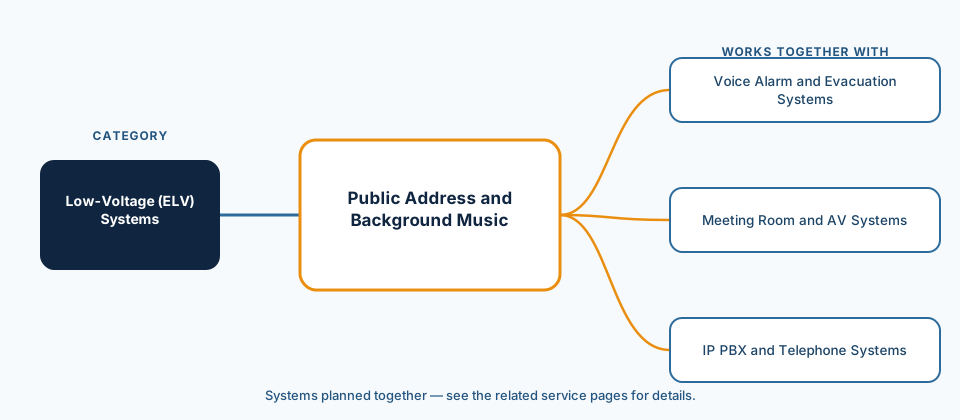
Microphones, presentation and display set-ups in meeting and conference rooms are a separate subject; how these rooms connect to the building-wide system is planned together with meeting room and AV systems. For needs such as making zoned announcements from a phone, a link can be set up with IP PBX and telephone systems.
In IP-based public address, audio travels over the building's data network, so the loudspeaker plan is considered together with structured cabling and the network plan. For the overall picture of building systems, see our low-voltage (ELV) systems page.
Which questions do we ask during discovery?
Good public address starts with understanding where sound is needed, for whom and when; during discovery we work through the following questions together.
- Which areas need music, and which need announcements only?
- How many separate zones are needed; will zones have different music or volume levels?
- What type of ceiling is there; are there suspended ceilings, high ceilings or open areas?
- How loud is the background noise; are there production areas, kitchens or crowded sections?
- Who will make announcements, and from where: reception, the security room, a phone?
- Will the system also be used for emergency announcements in the future; does the fire design require this?
- Can existing loudspeakers or cabling be reused?
What are the common mistakes with public address systems?
Most problems come not from the equipment but from layout and tuning: the sound is there, but nobody can understand it.
- Running a few loudspeakers very loud: people near a speaker are disturbed, while people further away cannot follow the announcement.
- Ignoring acoustics: reverberation from high ceilings and hard surfaces reduces speech intelligibility.
- Installing a single zone: the car park announcement reaches the restaurant and the closing announcement reaches the office floor.
- Skipping priority settings: announcements play over the music, or the music does not duck.
- Mistaking a comfort system for voice alarm: a system that is not triggered by the fire panel and not designed to emergency requirements cannot be relied on for evacuation.
Related services
- Voice Alarm and Evacuation SystemsLife-safety voice evacuation messages triggered by the fire alarm panel.View
- Meeting Room and AV SystemsAudio, video, presentation and video conferencing for meeting and training rooms.View
- IP PBX and Telephone SystemsIP PBX, desk phones, extension plan and call flow setup.View
Frequently asked questions
Is a public address system the same as a voice alarm system?
Can each zone have different music and volume?
Can existing loudspeakers be connected to a new system?
Will announcements be intelligible in noisy production areas and outdoors?
How does the discovery call work?
Which areas do you cover for public address systems?
Sources
- Presidency of the Republic of Türkiye, Legislation Information System (mevzuat.gov.tr), “Regulation on the Protection of Buildings from Fire (Binaların Yangından Korunması Hakkında Yönetmelik), Official Gazette 19.12.2007, No. 26735”, 2007 (as amended). https://www.mevzuat.gov.tr/mevzuat?MevzuatNo=200712937&MevzuatTur=21&MevzuatTertip=5
- CENELEC (Estonian Centre for Standardisation and Accreditation catalogue), “EN 50849:2017 — Sound systems for emergency purposes”, 2017. https://www.evs.ee/en/evs-en-50849-2017
- CEN (Estonian Centre for Standardisation and Accreditation catalogue), “EN 54-16:2008 — Fire detection and fire alarm systems — Part 16: Voice alarm control and indicating equipment”, 2008. https://www.evs.ee/en/evs-en-54-16-2008
- CEN (Estonian Centre for Standardisation and Accreditation catalogue), “EN 54-24:2008 — Fire detection and fire alarm systems — Part 24: Components of voice alarm systems — Loudspeakers”, 2008. https://www.evs.ee/en/evs-en-54-24-2008
Public address system request
Including the building type, the areas where you want music or announcements and whether there is an existing system speeds up the first conversation.
- Free discovery call
- No commitment; the quote is prepared after the survey.
- Service area
- İzmir and its surroundings (districts such as Menemen and Selçuk, plus Manisa and Aydın)
- Your personal data
- Form details are processed to answer your request; see the privacy notice for details. Privacy notice
Let us talk about your public address system
For a new installation, upgrade or maintenance, tell us about your building and how it is used, and we will start the discovery process together.