
Kitchen Hood Fire Suppression Systems for Commercial Kitchens
A fixed suppression system that responds automatically to cooking-oil fires on ranges, fryers and in the hood: discovery, installation, commissioning and maintenance.
In short
A kitchen hood fire suppression system is a fixed automatic system that detects a cooking-oil fire on ranges, fryers, in the hood or in the duct and discharges agent straight at the point of risk. It suits restaurants, hotels, staff canteens and food production kitchens. Sora Yazılım provides discovery, installation and maintenance for these systems in İzmir and its surroundings.
What is a kitchen hood fire suppression system and what does it do?
A kitchen hood fire suppression system (commercial kitchen fire suppression) detects a fire on the cooking line by heat, discharges agent onto appliance surfaces, into the hood and into the extract duct, and at the same time shuts off the gas supply to the cooking appliances.
Cooking-oil fires behave differently from ordinary fires: water on hot oil makes the flames erupt and spread, and grease build-up in the hood can carry a fire along the duct. The European classification of fires treats these fires as a separate class (Class F), and the extinguishing agent is chosen accordingly.
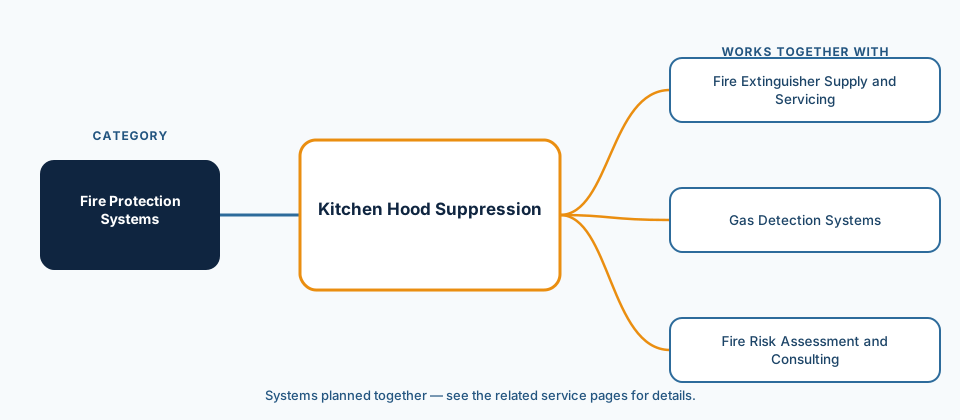
A hood system is fixed and automatic; the portable extinguishers a kitchen also needs are covered on our fire extinguisher supply and servicing page. The system that detects a gas leak and closes the valve is a different service, covered under gas detection systems; in kitchens the two are usually planned together.
Which kitchens is a hood suppression system suitable for?
Kitchen hood fire suppression is designed for commercial and industrial kitchens with heavy cooking, where greasy vapour builds up in the hood and duct; domestic kitchens are outside the scope of these systems.
For projects in Türkiye, the Regulation on the Protection of Buildings from Fire calls for automatic suppression on the hoods of certain non-residential kitchens, for example kitchens in shopping centres and high-rise buildings and in food production plants. Whether your kitchen falls within this scope is assessed by a qualified design engineer and the relevant authority.
- Kitchens in restaurants, cafés and fast food outlets.
- Main and satellite kitchens in hotels and other accommodation.
- Staff canteen kitchens in factories, schools, hospitals and public buildings.
- Food production plants and contract catering kitchens.
- Food and drink units in shopping centres and high-rise buildings.
What are the components of a kitchen hood suppression system?
The system is made up of a detection element, an agent cylinder, pipework and nozzles, a manual release and a gas shut-off connection. A portable extinguisher in the kitchen does not replace the fixed system; it complements it.
| Feature | Fixed kitchen hood suppression system | Portable extinguisher |
|---|---|---|
| Activation | Automatically by heat, or by the manual release | Only when a person intervenes |
| What it protects | Cooking appliances, hood, plenum and extract duct | The visible flame a person can reach |
| Gas shut-off | Connected so that it cuts the gas to the appliances on release | Does not cut the gas; the valve must be closed separately |
| Design | Designed around the layout of the cooking line | The type is chosen to suit the class of fire |
The main parts of the system are:
- Detection element: a heat-responsive device inside the hood, above the cooking appliances.
- Agent cylinder and control unit: holds an agent suited to cooking-oil fires and starts the discharge.
- Pipework and nozzles: direct the agent onto appliance surfaces, into the hood and plenum, and into the duct opening.
- Manual release: lets the person who sees the fire activate the system from the escape route.
- Gas shut-off valve connection: cuts the gas to the appliances when the system discharges.
- Alarm and monitoring connection: passes status information to the building's fire panel where needed.
What does our kitchen hood suppression service scope include?
The service scope runs from the kitchen survey to periodic maintenance; the details of each project are written into the proposal after discovery.
- Discovery: reviewing the cooking line, appliance types, hood and duct layout and the gas installation.
- System selection for the cooking line, bill of materials and procurement.
- Mounting the detection element, cylinder, pipework and nozzles.
- Connection to the gas shut-off valve and, where needed, to the fire panel.
- Commissioning, functional checks and handover of records.
- Briefing kitchen staff on the manual release and what to do when the system operates.
- Periodic maintenance and inspection (under contract).
Installing and servicing kitchen hood suppression systems may require specific authorisation or competence certificates. We recommend asking for the certificates of whoever carries out the work at proposal stage.
How does a kitchen hood suppression project run?
The process starts with a review of the cooking line and ends with testing the system and briefing staff; the work is scheduled outside the kitchen's service hours.
- Discovery call: we discuss how the kitchen is used, its appliances and the current situation.
- Site survey: hood dimensions, duct route and gas installation are inspected.
- Design: nozzle layout and agent quantity are set according to the system manufacturer's design rules and the project.
- Proposal: the bill of materials, scope and work schedule are set out.
- Installation: mounting is done outside service hours.
- Commissioning: detection, release and gas shut-off functions are checked.
- Handover and maintenance: staff are briefed and the maintenance plan is put in writing.
Which factors affect the choice and the cost?
The cost of a kitchen hood suppression system depends mainly on hood length, the number and type of appliances to protect and the duct layout; an exact figure comes after discovery.
We do not publish price ranges; two kitchens of the same size can have very different cooking lines and duct layouts.
- Number and length of hoods and the plenum design.
- Type and number of appliances to protect, such as fryers, grills and ranges.
- Length and route of the extract duct.
- Gas installation: the existing valve or the need for a new gas shut-off valve.
- Any need to connect to the fire panel or building automation.
- Whether work has to be done outside service hours.
Which standards and regulations apply?
For projects in Türkiye, the core rules are set by the Regulation on the Protection of Buildings from Fire; in Europe, EN 17446 is used for the design and testing of commercial kitchen fire suppression systems.
The number of nozzles, the quantity of agent and maintenance intervals are set for each system and kitchen; the relevant standard, the manufacturer's instructions and a qualified design engineer are the reference.
- Regulation on the Protection of Buildings from Fire (Binaların Yangından Korunması Hakkında Yönetmelik, Official Gazette 19.12.2007, No. 26735, as amended). Alongside hood suppression, it calls for gas detection, gas shut-off and warning installations in kitchens according to the gas used. The current text should be checked on mevzuat.gov.tr.
- EN 17446:2021+A1:2024 — Fire extinguishing systems in commercial kitchens: system design, documentation and test requirements. It covers cooking appliances, hoods, plenums and extract ducts; domestic kitchens are excluded.
- EN 2:1992/A1:2004 — Classification of fires; it defines fires involving vegetable or animal cooking oils and fats in cooking appliances as Class F.
How does a kitchen hood suppression system integrate with other systems?
A hood system can work on its own, but it gives a safer result when it is planned together with the kitchen's gas installation and the building's fire systems.
For the overall picture of other suppression and detection systems, see our fire protection systems page.
- Gas shut-off: the gas to the appliances is cut on discharge; gas leak detection can use the same valve.
- Signal to the fire panel: discharge or fault status can be passed to the fire detection and alarm system.
- Extract fan and ventilation: how the fan behaves is set in the project and in the system design.
- Risk assessment: the kitchen's effect on the building's overall fire risk can be reviewed as part of fire risk assessment and consulting.
Which questions do we ask during discovery?
The right system starts with understanding how the kitchen is actually used; during discovery we work through the following questions together.
- Which appliances are on the cooking line, and where are the fryers and grills?
- Will the position of any appliance change in the near future?
- Where do the hood and extract duct run, and how are they cleaned?
- Is natural gas or LPG used; is there a gas shut-off valve?
- Does the building have a fire panel, and will the kitchen be connected to it?
- If there is an existing system, where is its latest maintenance record?
What are the common mistakes with kitchen hood suppression systems?
Most problems come from a system that is not updated together with the kitchen after it has been installed.
- Moving appliances and leaving the nozzles where they were: a new fryer may end up with no nozzle above it.
- Skipping the gas shut-off connection: if gas keeps flowing, the fire can reignite.
- Placing the manual release away from the escape route: nobody can reach it during a fire.
- Neglecting hood and duct cleaning: grease build-up makes it easier for a fire to travel into the duct.
- Not keeping maintenance records: nobody knows when the system was last checked.
Related services
- Fire Extinguisher Supply and ServicingChoosing and supplying portable extinguishers, refilling and periodic checks.View
- Gas Detection SystemsDetecting flammable and toxic gas leaks, with alarms and shut-off valve control.View
- Fire Risk Assessment and ConsultingIdentifying fire risks in a building and prioritised improvement recommendations.View
Frequently asked questions
Which kitchens must have a hood fire suppression system?
Does a kitchen with a hood system still need fire extinguishers?
Why is the gas shut off when the system operates?
Does the system need reviewing if the kitchen layout changes?
How does the discovery call work?
Which areas do you cover for kitchen hood suppression?
Sources
- Presidency of the Republic of Türkiye, Legislation Information System (mevzuat.gov.tr), “Regulation on the Protection of Buildings from Fire (Binaların Yangından Korunması Hakkında Yönetmelik), Official Gazette 19.12.2007, No. 26735”, 2007 (as amended). https://www.mevzuat.gov.tr/mevzuat?MevzuatNo=200712937&MevzuatTur=21&MevzuatTertip=5
- CEN (Estonian Centre for Standardisation and Accreditation catalogue), “EN 17446:2021+A1:2024 — Fire extinguishing systems in commercial kitchens — System design, documentation, and test requirements”, 2024. https://www.evs.ee/en/evs-en-17446-2021-a1-2024-consolidated
- CEN (iTeh Standards catalogue), “EN 2:1992/A1:2004 — Classification of fires”, 2004. https://standards.iteh.ai/catalog/standards/cen/5add589f-66df-4cce-80a5-be35fbdcd35d/en-2-1992-a1-2004
Kitchen hood suppression request
Including the type of business, number of hoods, cooking appliances and the gas used speeds up the first conversation.
- Free discovery call
- No commitment; the quote is prepared after the survey.
- Service area
- İzmir and its surroundings (districts such as Menemen and Selçuk, plus Manisa and Aydın)
- Your personal data
- Form details are processed to answer your request; see the privacy notice for details. Privacy notice
Let us talk about fire protection for your kitchen
For a new installation, a kitchen refit or maintenance, tell us about your cooking line, and we will start the discovery process together.