
Licence Plate Recognition (ANPR) and Parking Management Systems
A car park setup that reads the plate at the vehicle entrance, opens the barrier for authorised vehicles and logs every entry and exit: survey, installation, commissioning and maintenance.
In short
A licence plate recognition system (automatic number plate recognition, ANPR or LPR) reads the plate with a camera at the vehicle entrance, checks it against a defined list and controls the barrier. It suits car parks at residential complexes, factories, offices and hotels. Sora Yazılım provides plate recognition and parking management installation and maintenance in İzmir and its surroundings.
What is a licence plate recognition system and what is it for?
A licence plate recognition system reads the plate of an approaching vehicle from the camera image and converts it to text; if the plate is on the resident or authorised vehicle list it opens the barrier, otherwise it hands over to security or the guest process, and it logs every entry and exit.
This page covers the entry of vehicles. Pedestrian gates, turnstiles and staff passing with cards are the subject of our access control, turnstile and time attendance systems page. General security monitoring and recording of the car park and perimeter is covered under CCTV and IP camera systems.
A plate recognition camera is installed differently from a general surveillance camera: its purpose is not to watch a wide area but to capture every vehicle's plate at a readable angle and with enough light.
Which buildings and needs is licence plate recognition suited to?
Car parks where regular vehicles are known in advance and vehicle entries and exits need to be recorded benefit most from licence plate recognition.
- Residential complexes: residents' vehicles enter without a remote or card, and guest vehicles are logged.
- Factories and logistics sites: staff, visitor and delivery vehicles are managed separately.
- Offices and office towers: parking quotas allocated to tenant companies.
- Hotels and accommodation: entry and exit records for guests' vehicles.
- Hospital and school car parks: separating staff and visitor areas.
What are the vehicle entry methods and plate recognition components?
Vehicle entrances are managed by three main methods: a remote or card, a long-range tag fixed to the vehicle, and plate recognition. Because plate recognition works without fitting anything to the vehicle, it stands out at entrances with guests and changing traffic.
| Feature | Remote or card | Long-range tag | Plate recognition |
|---|---|---|---|
| Needed in the vehicle | A remote or card with the driver | A tag fixed to the vehicle | Only a readable number plate |
| Guest vehicles | Needs a separate arrangement | Needs a separate arrangement | Can be managed by adding the plate to a list or by logging |
| Loss and sharing | A remote can be lost or handed to someone else | The tag stays with the vehicle | The plate stays with the vehicle |
| Points to watch | Cancelling lost remotes | Issuing tags and handling vehicle changes | Camera angle, lighting and plate cleanliness |
Some sites combine methods; for example, residents enter by plate recognition and service vehicles by card. The main components of a plate recognition and parking management system are:
- Plate recognition camera: a camera, usually with infrared illumination, that captures the plate readably by day and night.
- Recognition software: software running on the camera or a server that reads the plate and checks it against the list.
- Barrier: a boom barrier chosen to suit the entry and exit lanes.
- Vehicle detection and safety detectors: detect the vehicle's presence and stop the barrier lowering while a vehicle is beneath it.
- Parking management software: resident and guest lists, time schedules, entry and exit logs and reports.
- Optional components: occupancy signs, a guest registration screen, an intercom, and ticket or payment units for paid car parks.
What does our plate recognition service scope include?
Our plate recognition and parking management service runs from the survey to periodic maintenance; the detailed scope of each project is written into the proposal after the survey.
- Survey: review of the entry and exit lanes, vehicle approach direction, lighting conditions and any existing barrier.
- Planning the camera position and angle and the barrier and detector locations.
- Camera, barrier, software and detector selection, bill of materials and procurement.
- Cabling, installation and network connection.
- Software set-up: resident and guest lists, time schedules, user permissions.
- Commissioning: reading tests at different times and in different light, and barrier safety tests.
- User training: managing lists, searching records and reports.
- Periodic maintenance: camera cleaning, barrier and detector checks (subject to contract).
How does a plate recognition project run?
The process starts with a discovery call about how the entrance is used and ends with the system tested in real vehicle traffic and handed over to administrators with training.
- Discovery call: we discuss the number of vehicles, the resident and guest arrangements and your expectations.
- Site survey: lanes, approach distance, gradient, lighting and power availability are inspected.
- Layout plan and device list: the camera angle and the barrier and detector positions are defined.
- Proposal: scope, bill of materials and work schedule are put in writing.
- Installation: cabling, barrier and camera mounting and software set-up are carried out.
- Commissioning and testing: reading, barrier safety and logging are tried out under different conditions.
- Training and handover: list management and reports are explained to administrators.
Which factors affect the choice and the cost?
The cost of a plate recognition system is driven mainly by the number of lanes, the barrier type and the features required in the parking software; an exact figure can only be given after the survey.
We do not publish price ranges: even with the same number of lanes, differences in lighting, gradient, cable routes and software needs change the cost of two entrances significantly.
- Number of entry and exit lanes; whether entry and exit are at the same point or separate.
- Barrier type and boom length, and whether the existing barrier can be reused.
- Lighting conditions and the need for a pole or extra lighting for the camera position.
- Software features: resident groups, guest registration, quotas, reporting, charging.
- Cable routes: road crossings and the distance to the security gatehouse.
- Integration with access control and the camera system.
Which standards and regulations apply?
Where plate recognition cameras also record for security purposes, the EN 62676 series used for video surveillance systems can be taken into account; because plates and vehicle images can be linked to a person, projects in Türkiye must also consider Türkiye's Personal Data Protection Law (KVKK, Law No. 6698).
A number plate may qualify as personal data when it can be linked to the vehicle's owner or driver; resident lists, guest records and entry and exit history fall into the same category. How long records are kept and who can access them are your decisions as the data controller; for general guidance, see the Personal Data Protection Authority website. This page does not give legal advice.
The detectors and settings the barrier needs for vehicle and pedestrian safety are determined by the manufacturer's instructions and the site; these safety functions are tested separately during installation.
- EN 62676-1-1:2014 — Video surveillance systems for use in security applications, Part 1-1: System requirements, General.
- Türkiye's Personal Data Protection Law (KVKK), Law No. 6698 (Official Gazette 07.04.2016, No. 29677).
How does plate recognition work with other systems?
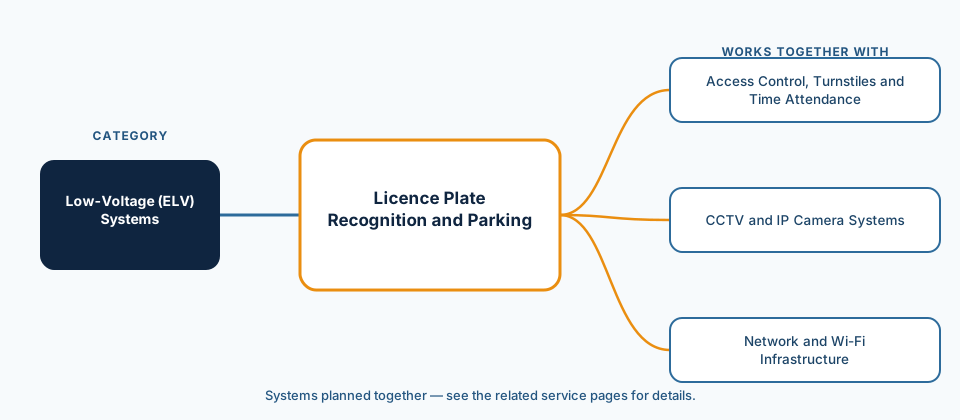
Plate recognition is usually the vehicle side of a building's entrance security; planned together with people access, camera recording and the network, the entrance is managed as one system.
Plate recognition cameras and barrier controllers connect to the software over the network; cabled or wireless links to remote entry points, separating the camera network and remote access are planned together with network and wireless infrastructure.
Monitoring vehicle entry in the same software as pedestrian turnstiles and card-controlled doors, and matching entry events to general surveillance footage, can be set up to suit the project. Our low-voltage (ELV) systems page summarises how all the security systems are planned together.
Which questions do we ask during the survey?
A sound plate recognition plan starts with understanding which vehicles use the entrance and how often, so we work through the following questions together during the survey.
- How many resident vehicles are there; how will guests, couriers and service vehicles be handled?
- Do entry and exit share a lane, and do queues form at peak times?
- At what angle and speed do vehicles approach the entrance; what are the lighting conditions at night?
- Will an existing barrier, remote or card system stay in use?
- Who will view entry and exit records, and for how long?
- Is the car park paid, quota-based, or is it only a matter of checking authorisation?
What are the common mistakes in plate recognition systems?
Most reading problems stem not from the software but from a poorly positioned camera and from tests not carried out under the site's real conditions.
- Using a general surveillance camera for plates: a wide-angle camera may not capture the plate in readable detail.
- Testing light and angle only in daytime: evening headlight glare and night conditions must be tested separately.
- Neglecting barrier safety: detectors must be installed correctly and tested regularly so the boom does not lower while a vehicle or pedestrian is beneath it.
- Not thinking about guests: a system set up with only a resident list burdens the security officer from the first guest vehicle.
- Not keeping the list up to date: plates of sold or replaced vehicles left on the list lead to unauthorised entry.
Related services
- Access Control, Turnstiles and Time AttendanceCard and biometric access, turnstiles, door control and staff time attendance.View
- CCTV and IP Camera SystemsCamera placement plan, recorders, storage and monitoring infrastructure.View
- Network and Wi-Fi InfrastructureSwitch and access point installation, coverage planning, VLAN and guest network setup.View
Frequently asked questions
Does licence plate recognition work at night and in bad weather?
How are guest vehicles managed?
Can plate recognition be added to an existing barrier?
Are plate recognition records personal data?
How does the discovery call work?
Which areas do you cover for plate recognition?
Sources
- CENELEC (Estonian Centre for Standardisation catalogue), “EN 62676-1-1:2014 — Video surveillance systems for use in security applications — Part 1-1: System requirements — General”, 2014. https://www.evs.ee/en/evs-en-62676-1-1-2014
- Presidency of the Republic of Türkiye, Legislation Information System, “Law No. 6698 on the Protection of Personal Data (Official Gazette 07.04.2016, No. 29677)”, 2016. https://www.mevzuat.gov.tr/mevzuat?MevzuatNo=6698&MevzuatTur=1&MevzuatTertip=5
Licence plate recognition request
Including the building type, number of entry and exit lanes, approximate number of vehicles and the location speeds up the first conversation.
- Free discovery call
- No commitment; the quote is prepared after the survey.
- Service area
- İzmir and its surroundings (districts such as Menemen and Selçuk, plus Manisa and Aydın)
- Your personal data
- Form details are processed to answer your request; see the privacy notice for details. Privacy notice
Let us talk about your plate recognition system
For a new installation or an upgrade of your existing entrance, share your entry points and vehicle arrangements, and we will start the survey process together.