
Fibre Optic Cabling: Backbone, Inter-Building Links, Splicing and Testing
Fibre infrastructure that connects floor cabinets and buildings, with documented splices and terminations, handed over only after every fibre is measured.
In short
Fibre optic cabling carries data as light through glass fibres and is mostly used for the backbone between floor cabinets and between buildings. It suits multi-storey offices, campuses, factories and residential complexes. Sora Yazılım provides fibre installation, fusion splicing, termination and fibre testing in İzmir and its surroundings.
What is fibre optic cabling and what is it for?
Fibre optic cabling (fibre cabling, optical fibre infrastructure) is a data infrastructure built from glass-fibre cables that carry light signals instead of electrical ones; it is used on links where copper cannot cope with the distance or the bandwidth.
Fibre is immune to electromagnetic interference and can cover far longer distances than copper in a single run. That is why, in most buildings, it is chosen for the backbone: the links that connect the main distributor to the floor cabinets and buildings to each other.
The copper links from the cabinet down to the user outlet are covered on our structured cabling page; this page focuses on backbone and inter-building fibre, splicing, termination and fibre testing. Fibre is passive infrastructure: the switches and wireless access points connected at each end are covered under network and wireless infrastructure.
Which buildings and needs is fibre optic cabling suited to?
Fibre makes a real difference in buildings with several floor cabinets, several separate buildings or a route too long for copper.
- Multi-storey offices and office towers: the backbone from the comms room to each floor cabinet.
- Factories, warehouses and industrial estates: inter-building links between separate structures such as the office block, the production hall and the warehouse; areas with heavy electrical interference.
- Campuses: links between blocks on school, university and hospital sites.
- Residential complexes and apartment buildings: fibre to each flat as part of the in-building telecommunications installation.
- Hotels and holiday resorts: connecting cabinets in scattered blocks to the main comms room.
- Remote camera and field points: perimeter security, car parks or gatehouses far from the nearest cabinet.
Which fibre cable types and components are used?
Fibre cables fall into two main groups, single-mode and multimode; which one is used is decided in the design according to distance, the interfaces of the devices to be connected and future speed needs.
| Feature | Single-mode (OS2) | Multimode (OM3/OM4/OM5) |
|---|---|---|
| Typical use | Inter-building links, campus backbone, long routes | In-building backbone, links inside comms rooms and data centres |
| Distance | Suited to long distances | Suited to short and medium distances |
| Future-proofing | The cable can often stay in place when speeds are upgraded | The grade chosen (OM3, OM4, OM5) affects the speeds it can support later |
Distance limits and acceptance values are calculated in the design according to the fibre grade, the application and the chosen standard. The sheath and construction suited to the route matter as much as the fibre itself: indoor cable, outdoor cable, armoured cable against rodents and mechanical stress, or indoor/outdoor cable that can run in both environments. The main components of a fibre infrastructure are:
- Fibre patch panel (ODF): the panel in the cabinet where fibres are terminated and splice trays are housed.
- Splice tray and pigtail: the arrangement in which each fibre in the cable is fusion-spliced to a short fibre with a factory-fitted connector.
- Connectors and adapters: connection types such as LC, SC or multi-fibre MPO, chosen to match the panel and the equipment.
- Splice closure: protects intermediate splices and branch points on inter-building routes.
- Patch cords: short fibre leads between the panel and the active equipment.
- Ducts, trunking and trays: protective duct on underground routes, trays and trunking inside the building.
What does our fibre optic cabling service scope include?
Our fibre service runs from the route survey to the handover of test reports; the detailed scope of each project is written into the proposal after the survey.
- Survey: cabinet and comms room locations, inter-building routes, condition of existing ducts and trunking.
- Fibre count, fibre type and cable construction, including a plan for spare fibres.
- Bill of materials and procurement: cable, patch panels, splice trays, connectors, splice closures.
- Cable installation: in-building trays and risers, underground ducts or other routes suited to the project.
- Fusion splicing and termination; tidy fibre management inside the panel.
- Labelling of links and panels; fibre allocation schedule and route sketch.
- Fibre testing: loss measurement with a light source and power meter, OTDR testing where needed, and handover of the results.
- Fault-finding, repair of broken links and additional fibre or connection work on existing routes.
How does a fibre optic cabling project run?
The process starts with a discovery call, continues with a route and fibre plan and ends with every fibre measured and documented.
- Discovery call: we discuss the points to connect and today's and expected bandwidth needs.
- Route survey: risers, trays, underground ducts and crossings between buildings are inspected on site.
- Fibre and cable plan: fibre type, fibre count, spare fibres and termination points are defined.
- Proposal: scope, materials and work schedule are put in writing.
- Installation and splicing: the cable is pulled, the fibres are spliced and terminated in the panels.
- Testing: every fibre is tested and the results are compared with the acceptance values in the design.
- Handover: the fibre allocation schedule, route sketch and test reports are delivered.
Which factors affect the choice and the cost?
The cost of fibre cabling is driven mainly by the length and difficulty of the route, the fibre count and the number of splice and termination points; an exact figure can only be given after the survey.
We do not publish price ranges: two links of the same length can cost very different amounts depending on whether the route runs through existing duct or needs new excavation.
- Route length and type: in-building riser, tray, underground duct or the need to lay new duct.
- Fibre count, fibre type and cable construction (indoor, outdoor, armoured).
- Number of splice and termination points; patch panel and splice closure requirements.
- Whether pre-terminated cable or on-site fusion splicing is preferred.
- Working conditions in an occupied building and the need to protect existing links.
- Testing scope and the level of detail required in the test reports.
Which standards and regulations apply to fibre cabling?
Fibre cabling is usually designed to generic cabling standards such as the ISO/IEC 11801 series and, after installation, tested to fibre testing standards such as ISO/IEC 14763-3; the standard that applies is stated in the proposal and contract.
Acceptable loss and the test method are set in the design according to link length, the number of splices and connectors and the chosen standard; test results are reported against these values. The information on this page does not replace a project design.
- ISO/IEC 11801-1:2017 — Information technology, generic cabling for customer premises, Part 1: General requirements.
- ISO/IEC 14763-3:2024 — Implementation and operation of customer premises cabling, Part 3: Testing of optical fibre cabling.
- ITU-T G.657 (08/2024) — Characteristics of a bending-loss insensitive single-mode optical fibre and cable.
- For projects in Türkiye: BTK Technical Specification for In-Building Electronic Communications Installations (Bina İçi Elektronik Haberleşme Tesisatı Teknik Şartnamesi, May 2018) — issued by the Information and Communication Technologies Authority (BTK), it governs fibre, CAT6 and coaxial installations up to each flat in residential buildings. An amendment to the Regulation on Electrical Internal Installations (Official Gazette 21.02.2018, No. 30339) made compliance with this specification mandatory for in-building electronic communications installations.
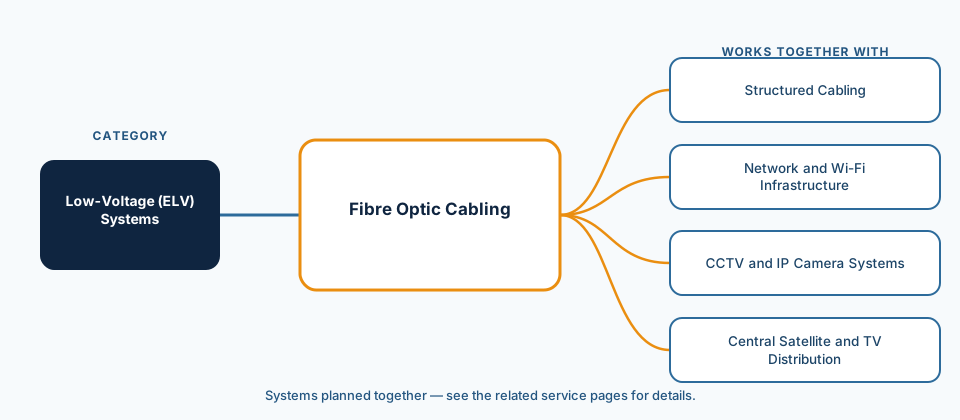
How does fibre optic cabling work with other systems?
Because fibre joins the building's cabinets into one network, it is the shared backbone for every low-voltage system connected at floor and building cabinets; the fibre count is therefore planned with all those systems in mind, not just the computer network.
Camera points far from a cabinet, car park entrances or perimeter security runs can be connected to the main recording centre over fibre; the camera side is covered on the CCTV and IP camera systems page. In multi-block complexes and hotels, distribution solutions that carry satellite and TV signals over fibre are also used: central satellite and TV distribution systems.
For the wider picture of how fibre relates to the other systems in a building, our low-voltage (ELV) systems page summarises the shared infrastructure plan.
Which questions do we ask during discovery?
A sound fibre plan depends less on today's connection than on understanding which points and systems will use these links in the coming years, so we work through the following questions together during discovery.
- Which cabinets and buildings will be connected, and where is the main comms room?
- Are there existing ducts, risers or trunking; are they full, and are they usable?
- Apart from the network, which systems will use this backbone: cameras, access control, TV distribution?
- Are the fibre modules of the end devices known, or will the equipment also need to be chosen?
- Does the route cross public land, a neighbouring plot or a road?
- If fibre links already exist, do you have the fibre allocation schedule and earlier test results?
What are the common mistakes in fibre optic cabling?
Most problems on fibre links stem not from the cable itself but from gaps in planning, splice quality and documentation.
- Leaving no spare fibres: pulling only as many fibres as today's link needs means a second cable run for the first new system.
- Ignoring bends and crushing: tight bends and over-tightened cable ties increase loss and can damage a fibre permanently.
- Plugging in connectors without cleaning them: dirt and dust on the end face are a frequent cause of connection loss.
- Accepting handover without a test report: the fact that light gets through does not show the link meets its acceptance values.
- Keeping no fibre allocation schedule: when a fault occurs, someone has to trace which fibre goes to which panel.
- Mixing single-mode and multimode components: an incompatible patch cord or module can stop the link working altogether.
Related services
- Structured CablingIn-building copper horizontal cabling, racks, patch panels, labelling and testing.View
- Network and Wi-Fi InfrastructureSwitch and access point installation, coverage planning, VLAN and guest network setup.View
- CCTV and IP Camera SystemsCamera placement plan, recorders, storage and monitoring infrastructure.View
- Central Satellite and TV DistributionBuilding-wide satellite and TV signal from a shared dish and distribution network.View
Frequently asked questions
Should I choose single-mode or multimode fibre?
What is fusion splicing and why does it matter?
How is a fibre link tested at handover?
Can fibre be added between two buildings later?
How does the discovery call work?
Which areas do you cover for fibre optic cabling?
Sources
- IEC / ISO, “ISO/IEC 11801-1:2017 — Information technology — Generic cabling for customer premises — Part 1: General requirements”, 2017. https://webstore.iec.ch/publication/26450
- IEC / ISO, “ISO/IEC 14763-3:2024 — Information technology — Implementation and operation of customer premises cabling — Part 3: Testing of optical fibre cabling”, 2024. https://webstore.iec.ch/en/publication/67723
- ITU-T, “G.657 — Characteristics of a bending-loss insensitive single-mode optical fibre and cable”, 2024. https://www.itu.int/rec/T-REC-G.657
- Information and Communication Technologies Authority of Türkiye (BTK), “In-Building Electronic Communications Installation and Technical Specification (Bina İçi Elektronik Haberleşme Tesisatı ve Teknik Şartnamesi)”, 2018. https://www.btk.gov.tr/bina-ici-elektronik-haberlesme-tesisati
- Official Gazette of the Republic of Türkiye (Resmî Gazete), “Regulation Amending the Regulation on Electrical Internal Installations (21.02.2018, No. 30339)”, 2018. https://www.resmigazete.gov.tr/eskiler/2018/02/20180221-1.htm
Fibre optic cabling request
Including the number of buildings or cabinets to connect, the approximate route and the location speeds up the first conversation.
- Free discovery call
- No commitment; the quote is prepared after the survey.
- Service area
- İzmir and its surroundings (districts such as Menemen and Selçuk, plus Manisa and Aydın)
- Your personal data
- Form details are processed to answer your request; see the privacy notice for details. Privacy notice
Let us talk about your fibre optic cabling project
Share the buildings, cabinets and existing routes to be connected, and we will start the discovery and proposal process together.