
Central Satellite System and TV Distribution: One Dish for the Whole Building
Distribution infrastructure that takes satellite and terrestrial TV from a shared dish and aerials on the roof to every flat or room in apartment blocks, residential complexes, hotels and student halls.
In short
A central satellite system receives a building's satellite and terrestrial TV through a shared dish and aerials on the roof and carries it over a distribution network to every flat or room. It suits apartment blocks, residential complexes, hotels and student halls. Sora Yazılım provides central satellite and TV distribution installation and maintenance in İzmir and its surroundings.
What is a central satellite system and what is it for?
A central satellite system (communal satellite system, SMATV, shared aerial system) is a TV distribution infrastructure that, instead of every flat installing its own dish, carries the signal received by the building's shared dish and aerials to every outlet through distribution equipment and cabling.
Dozens of dishes scattered across a building's façade and balconies are unsightly and each one brings its own wind, maintenance and fault issues. In a central system, one or more dishes and a terrestrial aerial sit on the roof; the signal is split by distribution equipment such as a multiswitch and reaches the TV/satellite outlets in flats or rooms over coaxial cable.
The coaxial cable used for TV distribution is a different infrastructure from the copper data links of the computer network; data cabling is covered on the structured cabling page. This page covers satellite and terrestrial distribution from the dish to the outlet; solutions that deliver TV to hotel rooms over the computer network (IP-based) are handled together with the network design.
Which buildings and needs is a central satellite system suited to?
Any building where several flats, rooms or screens under one roof receive satellite and TV signals benefits from central distribution.
- Apartment blocks and residential complexes: one dish feeding every flat; distribution between blocks on multi-block sites.
- Hotels, guesthouses and holiday resorts: the same channel line-up in every room, managed centrally.
- Student halls and guest houses: TV in rooms and common areas.
- Hospitals and care homes: patient rooms and waiting areas.
- Offices, cafés and restaurants: feeding several screens in common areas.
- Upgrades in existing buildings: removing individual dishes and moving to a shared system.
What types of central satellite system are there and what are the components?
Central satellite systems differ in how the signal is distributed to the outlets: star distribution with a multiswitch and a separate cable to each outlet, single-cable distribution to several receivers, fibre distribution over long distances, and a headend that prepares the channels centrally and feeds every room.
| Method | How does it work? | Typical use | Points to watch |
|---|---|---|---|
| Star distribution with multiswitch | The signal from the dish is split at the multiswitch and a separate cable runs to each outlet | Apartment blocks and residential complexes | A separate cable for each outlet; multiswitch capacity is chosen according to the number of flats |
| Single-cable distribution | A separate channel band is delivered to several receivers over one cable | Existing buildings where adding cables is difficult | The satellite receiver must support this method |
| Fibre distribution | The satellite signal is converted to light, carried over fibre and converted back to coaxial in each block | Multi-block complexes and campuses | Requires optical converters and a fibre infrastructure |
| Headend | Selected channels are received centrally and distributed to rooms as a single channel list | Hotels, hospitals and student halls | No separate satellite receiver is needed in rooms; the channel list is managed centrally |
Which method suits a building is decided in the design according to the number of flats or rooms, the existing cable infrastructure, the channels wanted and the receivers users have. The main components of the system are:
- Satellite dish and LNB: receive the satellite signal; multiswitch systems use a four-output LNB.
- Terrestrial aerial: adds digital terrestrial TV to the system.
- Multiswitch: distributes the satellite and terrestrial signal to the outlets and can be expanded by cascading.
- Line amplifier: balances signal levels on long runs and with many outlets.
- Coaxial cable and connectors: carry the signal from the roof to the outlet; cable and connector quality directly affects the picture.
- TV/satellite outlet: the final connection point in the flat or room.
- Earthing and distribution enclosures: protect the equipment and keep the installation orderly.
What does our central satellite system service scope include?
Our central satellite service runs from an inspection of the existing installation to a signal measurement at every outlet; the detailed scope of each project is written into the proposal after the survey.
- Survey: number of flats or rooms, roof and dish position, existing cables and risers, satellite and terrestrial channels wanted.
- Choice of distribution method and equipment; bill of materials and procurement.
- Installation of dishes and aerials, with pointing and alignment.
- Installation of multiswitches, amplifiers and distribution enclosures.
- Running coaxial or fibre links, fitting and labelling outlets.
- Signal level and quality measurement at every outlet; handover of the results.
- Preparing a central channel list for hotels and student halls (headend set-ups).
- Periodic maintenance and fault repair: dish alignment, LNB, multiswitch and cable faults.
How does a central satellite system installation run?
The process starts with a discovery call, continues with a distribution plan and ends with every outlet measured and recorded; in an occupied building the work is planned to keep TV interruptions in flats short.
- Discovery call: we discuss the building, the number of flats or rooms and the channels wanted.
- Site visit: the roof, risers, existing cables and outlet points are inspected.
- Distribution plan: the method, equipment, cable route and outlet list are defined.
- Approval and proposal: the building or site management's approval is obtained; scope and schedule are put in writing.
- Installation: dishes and aerials are mounted, distribution equipment and links are connected.
- Measurement and adjustment: the signal is measured at every outlet and levels are adjusted if needed.
- Handover: the outlet list, distribution diagram and measurement results are delivered to the management.
Which factors affect the choice and the cost?
The cost of a central satellite system is driven mainly by the number of flats or outlets, the distribution method chosen, whether the existing cabling can be reused and the number of satellites received; an exact figure can only be given after the survey.
We do not publish price ranges: in two buildings with the same number of flats, whether the existing cable can be reused or has to be replaced changes the cost noticeably.
- Number of flats, rooms or outlets; number of blocks and the distance between them.
- Number of satellites to receive and whether terrestrial TV is added.
- Distribution method: multiswitch, single cable, fibre or headend.
- Whether existing coaxial cables and risers can be reused.
- Roof access, dish placement and conditions for working at height.
- In hotels and student halls, the number of channels and the headend equipment required.
Which standards and regulations apply?
For projects in Türkiye, the in-building electronic communications installation of residential buildings must comply with the technical specification of the Information and Communication Technologies Authority (BTK), which also governs the coaxial links from the central aerial on the roof to the flats. For the system performance of TV distribution networks, the EN 60728 series is used.
The signal values to be measured at the outlets and the acceptance limits are set in the design according to the type of service distributed and the standard applied. Approval from the building or site management for dish placement and roof work should be obtained in advance.
- BTK Technical Specification for In-Building Electronic Communications Installations (Bina İçi Elektronik Haberleşme Tesisatı Teknik Şartnamesi, May 2018) — requires RG6 coaxial cable from the central aerial on the roof to the low-voltage distribution panel inside each flat in all buildings, with distribution from that panel to the rooms alongside fibre and CAT6 links.
- Regulation Amending the Regulation on Electrical Internal Installations (Official Gazette 21.02.2018, No. 30339) — makes compliance with BTK's current technical specification mandatory for in-building electronic communications installations.
- EN 60728-1:2014 — Cable networks for television signals, sound signals and interactive services, Part 1: System performance of forward paths (measurement methods and performance limits).
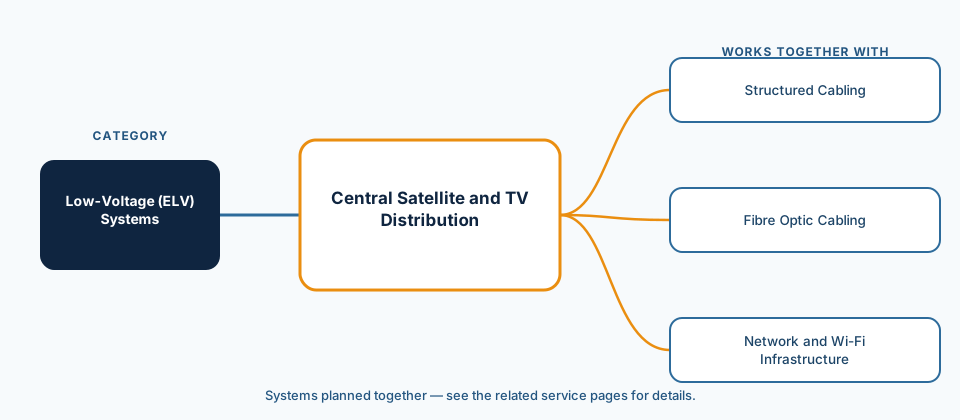
How does a central satellite system work with other systems?
Because central TV distribution shares risers and distribution panels with the building's other low-voltage installations, planning them together saves both space and labour.
On multi-block sites and large campuses, the satellite signal can be carried between blocks over fibre, in which case distribution is planned together with the inter-building backbone: fibre optic cabling. In hotels and student halls, solutions that deliver TV to room screens over the computer network are designed with network capacity and segmentation in mind: network and wireless infrastructure.
For the overall picture of the building's other systems, see the low-voltage (ELV) systems page.
Which questions do we ask during discovery?
A sound distribution plan depends not only on today's outlet count but also on understanding which channels residents or guests watch and how, so we work through the following questions together during discovery.
- How many flats, rooms or screens are there, and how many outlets are wanted in each?
- Which satellites and terrestrial channels will be distributed?
- Are the existing coaxial cables and risers in usable condition?
- Will users have their own satellite receivers, or will channels be supplied centrally?
- Is there safe roof access, and a suitable dish position with a clear view of the sky?
- Has management approval been obtained, and will individual dishes be removed?
What are the common mistakes in central satellite systems?
Most problems such as freezing pictures, lost channels and weak reception in some flats stem from the distribution plan and the choice of materials.
- Installing the multiswitch at full capacity: with no spare outputs, the system has to be reworked for any new flat or outlet.
- Using low-quality cable and connectors: connectors that let in moisture or work loose lead to lost channels over time.
- Not fixing the dish securely: a dish that shifts in the wind affects reception for the whole building.
- Handing over without measuring the outlets: problems are only noticed when residents complain.
- Leaving no documentation: if nobody knows which cable goes to which multiswitch output, fault-finding takes longer.
Related services
- Structured CablingIn-building copper horizontal cabling, racks, patch panels, labelling and testing.View
- Fibre Optic CablingBackbone and inter-building fibre links, splicing, termination and fibre testing.View
- Network and Wi-Fi InfrastructureSwitch and access point installation, coverage planning, VLAN and guest network setup.View
Frequently asked questions
Can an existing apartment block move from individual dishes to a central system?
How many flats or rooms can be served?
Why does the picture freeze in rain or wind?
Can terrestrial TV be distributed through the same system?
How does the discovery call work?
Which areas do you cover for central satellite systems?
Sources
- Information and Communication Technologies Authority of Türkiye (BTK), “In-Building Electronic Communications Installation and Technical Specification (Bina İçi Elektronik Haberleşme Tesisatı ve Teknik Şartnamesi)”, 2018. https://www.btk.gov.tr/bina-ici-elektronik-haberlesme-tesisati
- Official Gazette of the Republic of Türkiye (Resmî Gazete), “Regulation Amending the Regulation on Electrical Internal Installations (21.02.2018, No. 30339)”, 2018. https://www.resmigazete.gov.tr/eskiler/2018/02/20180221-1.htm
- CENELEC (NSAI catalogue), “EN 60728-1:2014 — Cable networks for television signals, sound signals and interactive services — Part 1: System performance of forward paths”, 2014. https://shop.standards.ie/en-ie/standards/en-60728-1-2014-348065_saig_cenelec_cenelec_795443
Central satellite system request
Including the building type, the number of flats or rooms, whether there is an existing system and the location speeds up the first conversation.
- Free discovery call
- No commitment; the quote is prepared after the survey.
- Service area
- İzmir and its surroundings (districts such as Menemen and Selçuk, plus Manisa and Aydın)
- Your personal data
- Form details are processed to answer your request; see the privacy notice for details. Privacy notice
Let us talk about your central satellite system
Whether it is a new installation, a move from individual dishes or a fault or maintenance visit, share details of your building and existing installation, and we will start the discovery process together.