
Gas Suppression Systems: FM-200, Novec 1230, CO2 and Inert Gas
Automatic suppression that puts out fires without water damage in enclosed spaces such as comms rooms, archives and electrical rooms: discovery, installation, testing and maintenance.
In short
A gas suppression system automatically floods an enclosed space with an extinguishing gas such as FM-200, Novec 1230, CO2 or an inert gas when a fire is detected. It suits comms rooms, data centres, archives and electrical rooms where water would cause damage. Sora Yazılım provides discovery, installation and maintenance in İzmir and its surroundings.
What is a gas suppression system and what does it do?
A gas suppression system (clean agent or gaseous fire suppression) puts out a fire in an enclosed space by discharging an extinguishing gas stored in cylinders into the space through pipes and nozzles when a fire is detected; the gases used do not conduct electricity and leave no residue.
Despite the similar names, gas suppression and gas detection systems do different jobs: gas detection notices a leak of a flammable or toxic gas such as natural gas or LPG, while gas suppression puts out a fire that has already started using an extinguishing gas. One tries to keep a dangerous gas out of the space; the other deliberately releases an extinguishing gas into it.
The success of gas suppression depends on keeping the gas in the space for long enough. That is why the system is more than cylinders and pipes: the room's airtightness, the behaviour of doors and ventilation dampers, and the safe evacuation of people are all part of the design.
Which areas is a gas suppression system suitable for?
Gas suppression is chosen for spaces that can be closed off and where water or powder would damage the equipment or contents.
Spaces with large openings that cannot be closed, or that cannot hold the gas, are not suitable for gas suppression; another suppression method is then considered.
- Comms rooms and data centres: to protect servers, storage and network equipment from water.
- Electrical switchgear, UPS and battery rooms: areas with live equipment, protected by a gas that does not conduct electricity.
- Telecoms and control rooms: technical spaces where downtime brings operations to a halt.
- Archives, libraries and museum stores: documents and objects that water could damage beyond repair.
- Medical equipment rooms and laboratories: enclosed areas with sensitive, expensive equipment.
What are the differences between FM-200, Novec 1230, CO2 and inert gases?
Extinguishing gases fall into two main groups: halocarbon agents such as FM-200 and Novec 1230 work mainly by absorbing heat from the fire, while CO2 and inert gases work by reducing the oxygen in the space; the choice depends on how the space is used, whether people may be present and the storage space available.
| Feature | FM-200 (HFC-227ea) | Novec 1230 (FK-5-1-12) | Carbon dioxide (CO2) | Inert gases (IG-541, IG-55, IG-01, IG-100) |
|---|---|---|---|---|
| Agent group | Halocarbon (hydrofluorocarbon) | Halocarbon (fluorinated ketone) | Carbon dioxide | Nitrogen, argon or blends of them; IG-541 also contains CO2 |
| How it extinguishes | Mainly absorbs heat from the fire | Mainly absorbs heat from the fire | Reduces the oxygen in the space | Reduces the oxygen in the space |
| Storage | Liquefied, in a pressurised cylinder | Liquid at room temperature; stored in a pressurised cylinder | Liquefied, in a pressurised cylinder or tank | As compressed gas in high-pressure cylinders; usually needs more cylinders and space |
| Spaces where people may be present | The design concentration is assessed together with the human safety conditions in the standard | The design concentration is assessed together with the human safety conditions in the standard | Lethal to people at extinguishing concentrations; pre-alarm, discharge delay and lock-off are vital | Because it reduces oxygen, the design concentration is assessed together with human safety conditions |
| Regulatory note | A fluorinated greenhouse gas; for projects in Türkiye it falls under the Regulation on Fluorinated Greenhouse Gases | Not a hydrofluorocarbon; ask about supply and refilling continuity in the proposal | Has its own European design standard (EN 17966) | Made up of gases found naturally in the atmosphere |
Whatever the gas, the main components of a gas suppression system are:
- Extinguishing gas cylinders: with a valve assembly and pressure or weight monitoring.
- Discharge pipework and nozzles: distribute the gas evenly through the space.
- Detection: detectors in the space; discharge is usually linked to confirmation from more than one detector.
- Extinguishing control panel: manages detection, pre-alarm, delay and discharge.
- Warning devices: pre-alarm sounder-beacons and an illuminated sign outside the door showing that gas has been released.
- Manual controls and lock-off: manual release, discharge hold, and a lock-off that prevents accidental discharge during maintenance.
- Pressure relief damper and ventilation control: to protect the room during discharge and ventilate it safely afterwards.
Where people may be present, the choice of gas is critical for life safety. The gas type, design concentration, pre-alarm and discharge delay should be set by a qualified design engineer on the basis of the relevant standard; the table on this page is general information, not a selection tool.
What does our gas suppression service scope include?
The service scope runs from discovery to periodic maintenance; the gas type and quantity are calculated for the project, installation follows the approved design, and the detailed scope is written into the proposal after discovery.
- Discovery: reviewing the dimensions and use of the space, whether people are present, openings and the existing detection system.
- Support with choosing the gas, an equipment list to the design and procurement.
- Installing cylinders, pipework, nozzles, detection and the control panel.
- Configuring pre-alarm, delay, damper and ventilation scenarios.
- Commissioning: functional tests and a room integrity (enclosure) test; handover of records.
- Training staff who use the space on what to do during a pre-alarm.
- Periodic maintenance and cylinder checks (under contract).
Installing, refilling and maintaining gas suppression systems may require the relevant authorisation or competence certificates. We recommend asking for the documents of whoever will carry out the installation at proposal stage.
How does a gas suppression project run?
The process starts by reviewing the space and how it is used, continues with choosing the gas and calculating the system, is commissioned with integrity and functional tests, and carries on with regular maintenance.
- Discovery call: we discuss the space to be protected, the equipment in it and how it is used.
- Site survey: dimensions, doors, openings, ventilation and the cylinder location are inspected.
- Design and calculation: the gas type, quantity, nozzle positions and pressure relief are calculated for the project.
- Proposal: the equipment, scope and work schedule are set out.
- Installation: cylinders, pipework, detection and the control panel are installed.
- Testing and commissioning: scenarios and room integrity are tested, and the results recorded.
- Training and handover: the pre-alarm, evacuation and lock-off arrangements are explained.
- Periodic maintenance: cylinder, panel and scenario checks are kept up regularly.
Which factors affect the choice and the cost?
The cost of a gas suppression system depends mainly on the size of the protected space, the chosen gas, the number of cylinders and the improvements needed to make the room airtight; an exact figure comes after discovery and calculation.
We do not publish price ranges; two rooms of the same size can differ greatly in gas choice, airtightness and safety needs.
- Size of the protected space and whether there is a suspended ceiling or raised floor.
- Gas type and, with it, the number of cylinders and the space they need.
- Whether people may be in the room, and the safety measures that follow from that.
- Airtightness improvements such as sealing cable and pipe penetrations.
- The need for a pressure relief damper, ventilation and door control.
- Integration with the existing fire detection system.
Which standards and regulations apply?
For projects in Türkiye, the Regulation on the Protection of Buildings from Fire requires gas suppression systems to be designed on the basis of TS ISO 14520, with audible and visual warnings during discharge, and openings such as vents and flues in the protected space closing automatically on discharge.
Values such as the design concentration, gas quantity, discharge time, pre-alarm delay and pressure relief area are calculated for each space and gas; the relevant standard and a qualified design engineer are the reference. The current regulation texts should be checked on mevzuat.gov.tr.
- Regulation on the Protection of Buildings from Fire (Binaların Yangından Korunması Hakkında Yönetmelik, Official Gazette 19.12.2007, No. 26735, as amended).
- ISO 14520-1:2023 — Gaseous fire-extinguishing systems, physical properties and system design, Part 1: General requirements (CO2 is out of scope).
- EN 15004-1:2025 — Fixed firefighting systems, gas extinguishing systems, Part 1: Design, installation and maintenance (modified European adoption of ISO 14520-1:2023; CO2 is out of scope).
- EN 17966:2024 — Carbon dioxide extinguishing systems for use on premises: design and installation (modified European adoption of ISO 6183:2022).
- NFPA 2001 (2025 edition) — Standard on Clean Agent Fire Extinguishing Systems; some projects may require it as an insurer or investor condition.
- Regulation on Fluorinated Greenhouse Gases (Florlu Sera Gazlarına İlişkin Yönetmelik, Official Gazette 15.10.2024, No. 32693) — also covers fluorinated greenhouse gases in fixed fire protection systems.
How does gas suppression integrate with other systems?
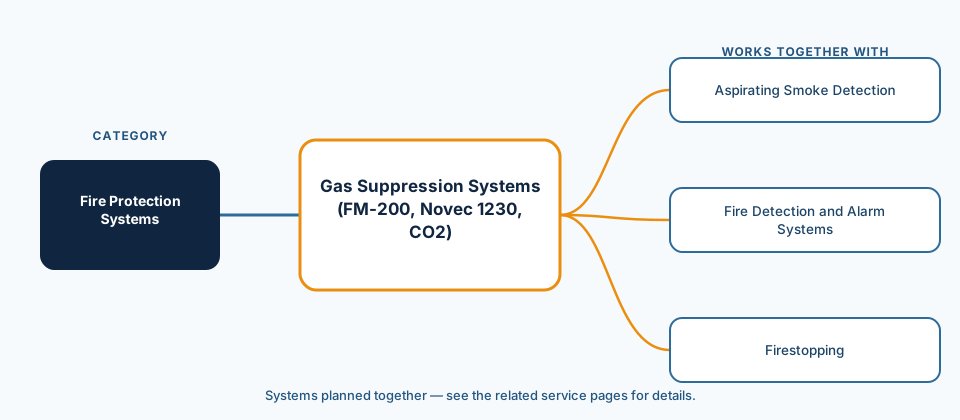
A gas suppression system works with its own detection and control arrangement, but it is planned together with other fire systems for early warning, building-wide alarms and the room's airtightness.
For the overall picture of detection, suppression and passive protection, see our fire protection systems page.
- In comms rooms, aspirating smoke detection (ASD) is the early warning layer that comes before suppression, giving staff time to respond and evacuate.
- Pre-alarm, discharge and fault information from the extinguishing panel is passed to the building's fire detection and alarm system.
- Cable and pipe penetrations made in the room later let the gas escape; sealing these openings falls under firestopping.
- Closing ventilation dampers and stopping air-conditioning units on discharge are set up according to the design.
Which questions do we ask during discovery?
The right gas and the right safety arrangements start with understanding how the space is used and whether it can hold the gas; during discovery we work through these questions together.
- What equipment is in the room, and how would downtime affect the business?
- Who goes into the room, how often and for how long?
- What are the room's door, windows, ventilation and cable penetrations like?
- Is there a suspended ceiling or raised floor?
- Is there a suitable place for the cylinders in or near the room?
- What is the existing fire detection system, and is there an approved design?
What are the common mistakes with gas suppression systems?
The most serious problems come from the space failing to hold the gas, neglected human safety measures and accidental discharges during maintenance.
- Breaking the room's airtightness later on: a hole drilled for a new cable and left unsealed stops the gas being held in the space.
- Putting safety second in occupied spaces: the gas choice, pre-alarm and delay should be planned around the safe evacuation of staff.
- Not locking off for maintenance: working on the system without locking it off can cause an accidental discharge.
- Not recalculating after refurbishment: a room that has been enlarged or divided may no longer be protected by the existing gas quantity.
- Not planning what happens after discharge: when and how to re-enter the room, and how to ventilate it, should be written down in advance.
Related services
- Aspirating Smoke DetectionVery early detection by sampling air in data centres, high ceilings and warehouses.View
- Fire Detection and Alarm SystemsFire panels, detectors, call points, sounder-beacons and cause-and-effect setup.View
- FirestoppingSealing cable and pipe penetrations with firestop materials.View
Frequently asked questions
What is the difference between FM-200 and Novec 1230?
Can a gas suppression system be used in a room where people are present?
Why is gas suppression preferred to sprinklers in a comms room?
What is a room integrity test and why is it done?
How does the discovery call work?
Which areas do you cover for gas suppression systems?
Sources
- Presidency of the Republic of Türkiye, Legislation Information System (mevzuat.gov.tr), “Regulation on the Protection of Buildings from Fire (Binaların Yangından Korunması Hakkında Yönetmelik), Official Gazette 19.12.2007, No. 26735”, 2007 (as amended). https://www.mevzuat.gov.tr/mevzuat?MevzuatNo=200712937&MevzuatTur=21&MevzuatTertip=5
- ISO (Swedish Institute for Standards catalogue), “ISO 14520-1:2023 — Gaseous fire-extinguishing systems — Physical properties and system design — Part 1: General requirements”, 2023. https://www.sis.se/en/produkter/environment-health-protection-safety/protection-against-fire/firefighting/iso-14520-12023/
- CEN (Estonian Centre for Standardisation catalogue), “EN 15004-1:2025 — Fixed firefighting systems — Gas extinguishing systems — Part 1: Design, installation and maintenance”, 2025. https://www.evs.ee/en/evs-en-15004-1-2025
- CEN (Estonian Centre for Standardisation catalogue), “EN 17966:2024 — Fire protection equipment — Carbon dioxide extinguishing systems for use on premises — Design and installation”, 2024. https://www.evs.ee/en/evs-en-17966-2024
- National Fire Protection Association (NSAI store listing), “NFPA 2001:2025 — Standard on Clean Agent Fire Extinguishing Systems”, 2025. https://shop.standards.ie/en-ie/standards/nfpa-2001-2025-829874_saig_nfpa_nfpa_3513855
- U.S. Environmental Protection Agency (EPA), “Carbon Dioxide as a Fire Suppressant: Examining the Risks”, 2026 (last updated). https://www.epa.gov/snap/carbon-dioxide-fire-suppressant-examining-risks
- U.S. Environmental Protection Agency (EPA), “Substitutes in Total Flooding Agents (SNAP)”, 2026 (last updated). https://www.epa.gov/snap/substitutes-total-flooding-agents
- Official Gazette of the Republic of Türkiye (Resmî Gazete), “Regulation on Fluorinated Greenhouse Gases (Florlu Sera Gazlarına İlişkin Yönetmelik), Official Gazette 15.10.2024, No. 32693”, 2024. https://www.resmigazete.gov.tr/eskiler/2024/10/20241015-2.htm
Gas suppression request
Including the type of room, its approximate dimensions, the equipment in it and whether people go into it speeds up the first conversation.
- Free discovery call
- No commitment; the quote is prepared after the survey.
- Service area
- İzmir and its surroundings (districts such as Menemen and Selçuk, plus Manisa and Aydın)
- Your personal data
- Form details are processed to answer your request; see the privacy notice for details. Privacy notice
Let us talk about your gas suppression project
For a comms room, archive or electrical room, tell us about the space to be protected and its current state, and we will start the discovery process together.