
Fire Hose Reel and Hydrant Systems: Fixed Firefighting Installations
A fixed firefighting installation that enables first response inside the building and gives the fire brigade water outside it: discovery, installation, testing and periodic maintenance.
In short
A fire hose reel and hydrant system is a fixed firefighting installation made up of hose cabinets permanently connected to the building's water supply, fire hydrants around the building and fire brigade inlets. It suits factories, warehouses, hotels, schools and commercial buildings. Sora Yazılım provides discovery, installation, testing and periodic maintenance for these installations in İzmir and its surroundings.
What is a fire hose reel and hydrant system and what does it do?
A fire hose reel is a wall-mounted cabinet with a hose, permanently connected to pressurised water, so that building occupants can tackle a fire with water in its first moments; a fire hydrant is an outdoor connection point that lets the fire brigade and trained teams draw large quantities of water.
Both are part of the building's fixed installation: they are designed together with the pipes, valves, water supply and, where needed, fire pumps. Hand-held fire extinguishers, by contrast, are portable equipment; their selection, supply, refilling and periodic inspection are the subject of our fire extinguisher sales and servicing page.
Hose reels and hydrants are operated by hand. Where automatic suppression is needed that works even when nobody is present, sprinkler systems are installed; in many buildings these systems share the same water supply and pump room.
Which buildings should have fire hose reels and hydrants?
For projects in Türkiye, which buildings must have a hose reel or hydrant system is set by the Regulation on the Protection of Buildings from Fire according to their use, size and height, and is shown in the approved design.
Buildings where fire hose reel and hydrant systems are commonly installed include:
- Factories, workshops and warehouses.
- Busy buildings such as hotels, student residences and hospitals.
- Schools and educational institutions.
- Shopping centres, shops and office buildings.
- Enclosed car parks and large boiler rooms.
- Sites and complexes with several buildings spread over a large area (for a hydrant network).
What types of fire hose cabinet are there and what are the system components?
Fire hose cabinets fall into two types according to the hose: semi-rigid hose reels and lay-flat hose systems; hydrants and fire brigade inlets serve firefighting from outside the building.
| Component | Who uses it | Characteristics |
|---|---|---|
| Hose reel with semi-rigid hose (TS EN 671-1) | Building occupants | The hose is wound on a reel; water can be delivered before it is fully unwound, so one person can use it easily. |
| Hose system with lay-flat hose (TS EN 671-2) | Trained people | The hose is stored folded or rolled; it must be fully run out before use. |
| Pillar fire hydrant | Fire brigade and trained teams | Located outside the building, at points fire appliances can reach. |
| Fire brigade inlet | Fire brigade | Lets the fire brigade pump water into the building's fire installation from outside. |
Which type of cabinet is used where is decided in the design. The main components of the system are:
- Cabinet: with hose, reel or hanger, valve and nozzle.
- Pipework and risers: connect the cabinets and hydrants to the water supply.
- Water supply: a fire water tank or a mains connection, according to the design.
- Fire pump set: provides the pressure the installation needs; any redundancy is arranged according to the design.
- Hydrant and hydrant cabinet: outlets around the building, with hose and coupling equipment beside them.
- Valves and pressure gauges: for controlling the lines and monitoring their status.
What does our fire hose reel and hydrant service scope include?
The service scope runs from discovery to periodic maintenance; installation follows the approved design, and the detailed scope is written into the proposal after discovery.
- Discovery: reviewing how the building is used, existing cabinets, hydrants, the pump room and the approved design.
- Selection of cabinets, hoses, hydrants and valves to the design, bill of materials and procurement.
- Installing the pipework, cabinets, hydrants and fire brigade inlet.
- Connecting and commissioning the pump set (where included in the design).
- Pressure and flow tests; handover of test records.
- Briefing building occupants on how to use the hose reels.
- Periodic maintenance and hose checks (under contract).
Installing and maintaining hose reel and hydrant systems may require the relevant authorisation or competence certificates. We recommend asking for the documents of whoever will carry out the installation at proposal stage.
How does a fire hose reel and hydrant project run?
The process starts with a review of the existing installation and the approved design, continues with installation and testing to that design, and carries on with regular maintenance.
- Discovery call: we discuss the building, its use and the current situation.
- Site survey: cabinet positions, escape routes, the water supply and the pump room are inspected.
- Design: an existing approved design is reviewed; if there is none, its preparation with a qualified designer is planned.
- Proposal: the materials, scope and work schedule are set out.
- Installation: pipework, cabinets, hydrants and connections are installed.
- Testing and commissioning: pressure and flow tests are carried out and recorded.
- Briefing and maintenance: occupants are shown how to use the hose reels, and periodic maintenance is scheduled.
Which factors affect the choice and the cost?
The cost of a fire hose reel and hydrant system depends mainly on the number of cabinets and hydrants, the length of the pipe route and the need for a water supply and pumps; an exact figure comes after the approved design and discovery.
We do not publish price ranges; two buildings of the same size can differ greatly in their water supply, pump and routing needs.
- Number of cabinets and hydrants, number of storeys and size of the area around the building.
- Pipe route, risers and any need for underground lines outside the building.
- Whether a water tank and fire pump are needed.
- Cabinet type: semi-rigid or lay-flat hose.
- Measures for outdoor lines at risk of freezing.
- The state of the existing installation: renewal, extension or new installation.
Which standards and regulations apply?
For projects in Türkiye, the Regulation on the Protection of Buildings from Fire requires semi-rigid hose reels to comply with TS EN 671-1, lay-flat hose systems with TS EN 671-2, and periodic maintenance to be carried out to TS EN 671-3; responsibility for this maintenance lies with the building owner, manager or responsible building officer.
Values such as hydrant flow rate, outlet pressure, spacing between hydrants and cabinets, and pump and tank capacity are calculated according to the building and its hazard class; the regulation, the relevant standard and a qualified design engineer are the reference. The current text of the regulation should be checked on mevzuat.gov.tr.
- Regulation on the Protection of Buildings from Fire (Binaların Yangından Korunması Hakkında Yönetmelik, Official Gazette 19.12.2007, No. 26735, as amended). It also requires hydrants to be placed where fire appliances can easily reach them and pillar hydrants to comply with the relevant Turkish Standards.
- EN 671-1:2012 — Fixed firefighting systems, hose systems, Part 1: Hose reels with semi-rigid hose.
- EN 671-2:2012 — Part 2: Hose systems with lay-flat hose.
- EN 671-3:2009 — Part 3: Maintenance of hose reels with semi-rigid hose and hose systems with lay-flat hose.
- EN 14384:2005 — Pillar fire hydrants.
How do hose reels and hydrants work with other systems?
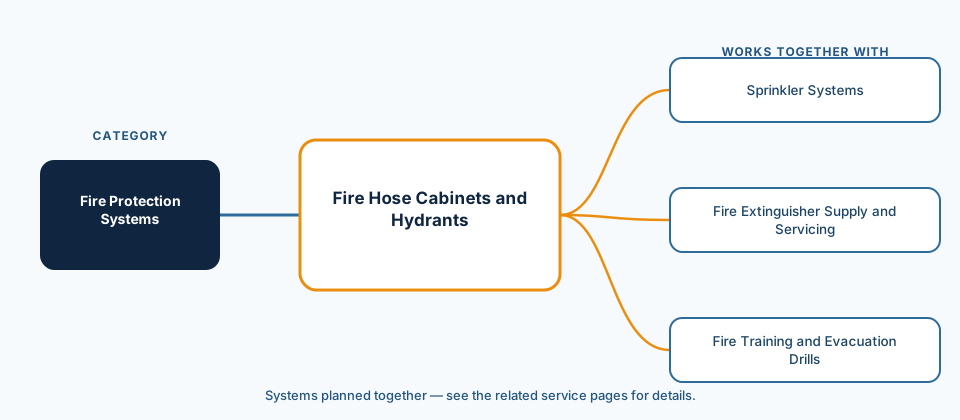
In most buildings, the hose reel and hydrant installation uses the same water supply and pump room as the sprinklers; the status of pumps and valves can be monitored through the fire alarm panel.
For the overall picture of detection, suppression and passive protection, see our fire protection systems page.
- A shared water tank and pump set means the sprinkler and hose reel installations must be calculated together in the same design.
- Pump running and fault signals and the position of critical valves can be passed to the fire panel or to building automation.
- A hose reel is only useful when someone knows how to use it; fire safety training and evacuation drills help staff use hose reels and extinguishers correctly.
Which questions do we ask during discovery?
The right installation starts with understanding how the building is used and how the fire brigade will reach it; during discovery we work through these questions together.
- Is there an approved fire design; are the cabinet and hydrant positions shown on it?
- What is the water supply: mains or a fire water tank?
- Is there a fire pump, and when was it last tested?
- Which sides of the building can fire appliances reach?
- Are there outdoor lines or hydrants at risk of freezing?
- When were the existing cabinets last maintained, and where are the maintenance records?
What are the common mistakes with hose reel and hydrant systems?
Most problems come not from the installation itself but from cabinets and hydrants being forgotten in day-to-day use.
- Blocking the cabinet or hydrant: goods placed in front of it prevent access in a fire; the regulation also prohibits blocking access to fire hydrants.
- Using the hose for other jobs: a hose used for cleaning or watering wears out and is not stowed properly.
- Leaving a valve closed: a valve forgotten after maintenance or refurbishment leaves the cabinet without water.
- Not testing the pump: a pump that has not been run for years may not deliver pressure when needed.
- Ignoring frost on outdoor lines: unprotected hydrants and pipes can be damaged in winter.
Related services
- Sprinkler SystemsAutomatic water suppression with heat-activated sprinkler heads and piping.View
- Fire Extinguisher Supply and ServicingChoosing and supplying portable extinguishers, refilling and periodic checks.View
- Fire Training and Evacuation DrillsStaff fire training, extinguisher use and evacuation drill exercises.View
Frequently asked questions
What is the difference between a fire hose reel and a fire extinguisher?
Should I choose a semi-rigid or a lay-flat hose cabinet?
Who is responsible for maintaining fire hose reels?
Can hose reels or hydrants be added to an existing building?
How does the discovery call work?
Which areas do you cover for fire hose reel and hydrant systems?
Sources
- Presidency of the Republic of Türkiye, Legislation Information System (mevzuat.gov.tr), “Regulation on the Protection of Buildings from Fire (Binaların Yangından Korunması Hakkında Yönetmelik), Official Gazette 19.12.2007, No. 26735”, 2007 (as amended). https://www.mevzuat.gov.tr/mevzuat?MevzuatNo=200712937&MevzuatTur=21&MevzuatTertip=5
- CEN (Estonian Centre for Standardisation catalogue), “EN 671-1:2012 — Fixed firefighting systems — Hose systems — Part 1: Hose reels with semi-rigid hose”, 2012. https://www.evs.ee/en/evs-en-671-1-2012
- CEN (Estonian Centre for Standardisation catalogue), “EN 671-2:2012 — Fixed firefighting systems — Hose systems — Part 2: Hose systems with lay-flat hose”, 2012. https://www.evs.ee/en/evs-en-671-2-2012
- CEN (Estonian Centre for Standardisation catalogue), “EN 671-3:2009 — Fixed firefighting systems — Hose systems — Part 3: Maintenance of hose reels with semi-rigid hose and hose systems with lay-flat hose”, 2009. https://www.evs.ee/en/evs-en-671-3-2009
- CEN (Estonian Centre for Standardisation catalogue), “EN 14384:2005 — Pillar fire hydrants”, 2005. https://www.evs.ee/en/evs-en-14384-2005
Fire hose reel and hydrant request
Including the building type, number of storeys, the number of existing cabinets and hydrants and the water supply speeds up the first conversation.
- Free discovery call
- No commitment; the quote is prepared after the survey.
- Service area
- İzmir and its surroundings (districts such as Menemen and Selçuk, plus Manisa and Aydın)
- Your personal data
- Form details are processed to answer your request; see the privacy notice for details. Privacy notice
Let us talk about your hose reel and hydrant installation
For a new installation, renewal or periodic maintenance, tell us about your building and its current state, and we will start the discovery process together.