
Gas Detection Systems: Flammable and Toxic Gas Leak Alarms
Safety infrastructure that detects natural gas, LPG and toxic gas leaks early, raises the alarm and shuts off the gas supply: discovery, installation, commissioning and maintenance.
In short
A gas detection system detects leaks of flammable gases such as natural gas and LPG, or toxic gases such as carbon monoxide, gives audible and visual warnings and closes the gas shut-off valve when needed. It suits kitchens, boiler rooms, car parks and industrial sites. Sora Yazılım provides discovery, installation and maintenance for these systems in İzmir and its surroundings.
What is a gas detection system and what does it do?
A gas detection system (gas leak alarm system) uses detectors that continuously measure flammable or toxic gas in the air to spot a leak before it reaches a dangerous level; it raises the alarm, shuts off the gas supply and starts measures such as ventilation.
Despite the similar names, gas detection and gas suppression systems do different jobs: gas detection picks up a leak and tries to prevent a fire or poisoning, while gas suppression puts out a fire that has already started by flooding an enclosed space, such as a comms room, with an extinguishing agent. Likewise, a gas detector does not detect smoke; for smoke and heat, fire detection and alarm systems are installed.
The value of a gas detection system depends on what happens after the alarm. That is why the design defines not just the detectors but also the gas shut-off valve, the ventilation and the order in which the warnings run.
Which buildings and areas is a gas detection system suitable for?
Gas detection should be considered wherever flammable gas is used as fuel, stored or can be released by a process; for projects in Türkiye, the Regulation on the Protection of Buildings from Fire also requires it in certain areas.
- Commercial and industrial kitchens: detection, gas shut-off and warning suited to the gas used by the cooking equipment.
- Boiler rooms: spaces housing boilers that run on natural gas or LPG.
- Enclosed car parks: monitoring carbon monoxide from vehicle exhausts and managing ventilation.
- Factories and workshops: areas where process gases and solvent vapours are used.
- Refrigeration plants and cold stores: monitoring refrigerant leaks.
- Battery and generator rooms, laboratories: technical spaces where gas may build up.
What types of gas detector are there and what are the system components?
Gas detectors differ according to the gas they detect and the sensor technology they use; the right choice depends on the type of gas present and the ambient conditions.
| Sensor type | Typical use | Points to note |
|---|---|---|
| Catalytic (pellistor) | Flammable gases such as natural gas and LPG | Needs oxygen to work; some chemicals in the air can affect the sensor over time. |
| Infrared (IR) | Hydrocarbon-based flammable gases, carbon dioxide | Does not detect every gas; a model suited to the target gas must be chosen. |
| Electrochemical | Toxic gases such as carbon monoxide and ammonia, and oxygen level | The sensor has a limited service life and is replaced at the intervals the manufacturer recommends. |
| Semiconductor | General-purpose gas detection | Can respond to more than one gas; where it is used is assessed accordingly. |
Where a detector goes depends on whether the gas is lighter or heavier than air: natural gas rises, while LPG collects near the floor. The exact position and number of detectors are set by the design and the manufacturer's instructions. The main components of the system are:
- Gas detectors: fixed devices with sensors suited to the target gas.
- Gas alarm control panel: monitors the detectors and manages alarm levels and outputs.
- Sounders and beacons: alert people in the area to the leak.
- Automatic gas shut-off valve: closes the gas line during an alarm.
- Ventilation output: starts fans according to the design.
- Back-up power: keeps detection running if mains power fails.
What does our gas detection service scope include?
The service scope runs from discovery to periodic maintenance; the gases to be detected, detector positions and the post-alarm scenario are fixed in the design, and the detailed scope is written into the proposal after discovery.
- Discovery: reviewing the gases used, the gas line, the spaces, ventilation and existing systems.
- Selection of detectors and a panel suited to the gas and the environment, bill of materials and procurement.
- Mounting and cabling the detectors, panel and warning devices.
- Configuring alarm levels and the gas shut-off valve and ventilation outputs.
- Commissioning: bump testing detectors with test gas and testing scenarios; handover of records.
- Training users on what to do during an alarm.
- Periodic maintenance, calibration checks and sensor replacement (under contract).
Fitting a gas shut-off valve to the gas line is work on the gas installation and may require the relevant authorisation; we recommend asking for the documents of whoever will do this work at proposal stage. In buildings supplied with natural gas, the distribution company's requirements for internal installations should also be taken into account.
How does a gas detection project run?
The process starts by reviewing the gas sources and spaces, continues with installation and test gas trials, and carries on with regular calibration checks.
- Discovery call: we discuss the gases used, the areas and the current situation.
- Site survey: the gas line, appliances, spaces and ventilation are inspected.
- Design: detector types and positions, alarm levels and the scenario are set.
- Proposal: the equipment, scope and work schedule are set out.
- Installation: detectors, panel, warning devices and connections are installed.
- Commissioning and testing: every detector is tested with test gas, and valve and fan outputs are checked.
- Training and maintenance: users are briefed, and calibration and maintenance are scheduled.
Which factors affect the choice and the cost?
The cost of a gas detection system depends mainly on the number of gases to be detected, the number of detectors, the sensor technology and the equipment to be controlled after an alarm; an exact figure comes after discovery.
We do not publish price ranges; two sites of the same size can differ greatly in the type of gas, ambient conditions and scenario requirements.
- The type and number of gases to be detected (flammable, toxic, oxygen level).
- The number and size of the spaces to be protected, and therefore the number of detectors.
- Sensor technology and sensor replacement intervals.
- The need for specially protected equipment in areas with an explosion risk.
- Integration with the gas shut-off valve, ventilation and the fire panel.
- Cable routes and working conditions in an operating facility.
Which standards and regulations apply?
For projects in Türkiye, the Regulation on the Protection of Buildings from Fire requires a gas detector in boiler rooms using natural gas or LPG, and gas detection, gas shut-off and warning installations in commercial kitchens within its scope; the EN 60079-29 series is used for industrial and commercial gas detectors.
Values such as alarm thresholds, detector height and number are calculated according to the type of gas and the space; the relevant standard, the manufacturer's instructions and a qualified design engineer are the reference. Domestic gas alarms fall outside the scope of EN IEC 60079-29-0.
- Regulation on the Protection of Buildings from Fire (Binaların Yangından Korunması Hakkında Yönetmelik, Official Gazette 19.12.2007, No. 26735, as amended). The regulation defines a gas detector as a detection and warning device with its own battery to cover power cuts.
- EN IEC 60079-29-0:2026 — Explosive atmospheres, Part 29-0: Gas detection equipment, general requirements and test methods (flammable gas, oxygen and toxic gas).
- EN 60079-29-2:2015 — Explosive atmospheres, Part 29-2: Selection, installation, use and maintenance of detectors for flammable gases and oxygen.
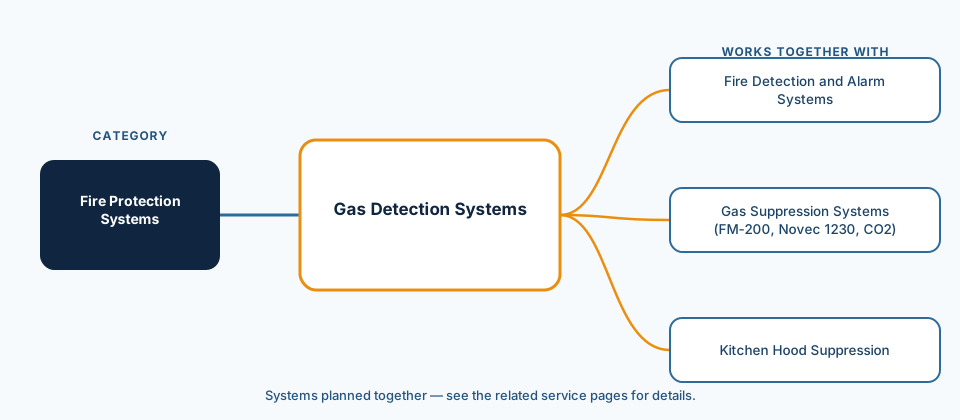
How does a gas detection system integrate with other systems?
During a leak, the gas alarm panel shuts off the gas supply, starts ventilation and reports its status to other systems; these links should be defined in the design from the start and tested at commissioning.
For the overall picture of detection, suppression and passive protection, see our fire protection systems page.
- In commercial kitchens, the gas shut-off valve is planned together with kitchen hood suppression systems; the gas should also be cut off when the suppression is released.
- Gas alarm and fault information can be passed to the fire panel or to building automation (BMS) for monitoring from one place.
- In enclosed car parks, ventilation fans can be run in stages according to the carbon monoxide level, as set out in the design.
Which questions do we ask during discovery?
The right gas detection system starts with understanding which gas is present, where and how; during discovery we work through these questions together.
- Which gases are used or can be released: natural gas, LPG, carbon monoxide, refrigerant?
- Where does the gas line come in, and is there an existing shut-off valve?
- How are the areas ventilated: naturally or mechanically?
- Is there an existing fire panel or building automation system?
- Who will respond during an alarm, and how will the gas be turned back on?
- Where are the latest maintenance and calibration records?
What are the common mistakes with gas detection systems?
The most frequent problems come from badly positioned detectors, installations that control nothing after an alarm and neglected calibration.
- Ignoring how the gas behaves: putting an LPG detector on the ceiling or a natural gas detector near the floor means a leak is noticed late.
- Connecting the alarm only to a siren: a system without valve and ventilation outputs reports a leak but does not stop it.
- Not tracking calibration and sensor life: a sensor that loses sensitivity over time can quietly stop working.
- Placing a detector in the path of airflow: a device in front of a window or fan measures diluted air.
- Not writing a post-alarm procedure: it stays unclear who turns the gas back on, and after which checks.
Related services
- Fire Detection and Alarm SystemsFire panels, detectors, call points, sounder-beacons and cause-and-effect setup.View
- Gas Suppression Systems (FM-200, Novec 1230, CO2)Extinguishing fires with suppression gas in server rooms, archives and similar spaces.View
- Kitchen Hood SuppressionAutomatic suppression of cooking-oil fires in commercial kitchen hoods and fryers.View
Frequently asked questions
What is the difference between gas detection and gas suppression?
Where should a gas detector be installed?
Does the system shut off the gas automatically when a leak is detected?
How often should gas detectors be maintained and calibrated?
How does the discovery call work?
Which areas do you cover for gas detection systems?
Sources
- Presidency of the Republic of Türkiye, Legislation Information System (mevzuat.gov.tr), “Regulation on the Protection of Buildings from Fire (Binaların Yangından Korunması Hakkında Yönetmelik), Official Gazette 19.12.2007, No. 26735”, 2007 (as amended). https://www.mevzuat.gov.tr/mevzuat?MevzuatNo=200712937&MevzuatTur=21&MevzuatTertip=5
- CENELEC (Estonian Centre for Standardisation catalogue), “EN IEC 60079-29-0:2026 — Explosive atmospheres — Part 29-0: Gas detection equipment — General requirements and test methods”, 2026. https://www.evs.ee/en/evs-en-iec-60079-29-0-2026
- CENELEC (Estonian Centre for Standardisation catalogue), “EN 60079-29-2:2015 — Explosive atmospheres — Part 29-2: Gas detectors — Selection, installation, use and maintenance of detectors for flammable gases and oxygen”, 2015. https://www.evs.ee/en/evs-en-60079-29-2-2015
Gas detection request
Including the gases used, the areas to be protected and whether there is an existing gas alarm system speeds up the first conversation.
- Free discovery call
- No commitment; the quote is prepared after the survey.
- Service area
- İzmir and its surroundings (districts such as Menemen and Selçuk, plus Manisa and Aydın)
- Your personal data
- Form details are processed to answer your request; see the privacy notice for details. Privacy notice
Let us talk about your gas detection system
For a kitchen, boiler room, car park or production area, tell us about the gases used and the current situation, and we will start the discovery process together.