
Very Early Smoke Detection: Aspirating Smoke Detection (ASD) Systems
Early warning infrastructure that continuously samples air through pipes and picks up smoke before it is visible: discovery, installation, commissioning and maintenance.
In short
An aspirating smoke detection (ASD) system continuously draws air from the protected area through a pipe network and analyses it in a central detector unit, picking up smoke at a very early stage. It suits data centres, high-ceiling warehouses and comms rooms. Sora Yazılım provides discovery, installation and maintenance for these systems in İzmir and its surroundings.
What is an aspirating smoke detection system and what does it do?
An aspirating smoke detection system (ASD, also called an air-sampling smoke detector) does not wait for smoke to reach a detector: a fan draws air through pipes to a central unit that analyses it, so it can raise a warning while a fire is still in its earliest stage.
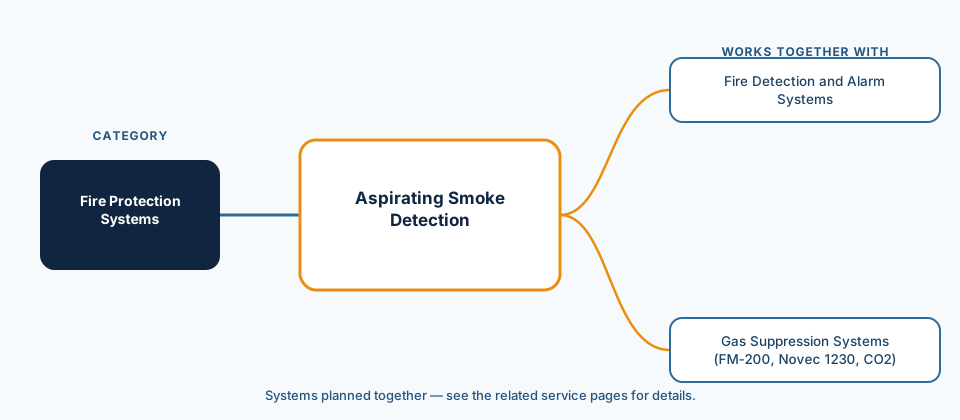
In a typical building, ceiling-mounted point smoke detectors are enough for most areas; that general use is the subject of our fire detection and alarm systems page. Aspirating smoke detection is a specialist solution for areas where smoke is diluted, airflow is strong or the ceiling is hard to reach, and it is usually connected to the existing fire alarm panel to complement it.
Because the detector unit sits in one place, maintenance and testing can be done without reaching individual detectors at height. The system usually offers several alarm levels: a low-level warning gives staff time to check the situation on site.
Which areas is aspirating smoke detection suitable for?
Aspirating smoke detection is chosen where early warning matters for business continuity, or where point detectors struggle.
- Data centres and comms rooms: to pick up smoke early when it is diluted by strong cooling airflow.
- High-ceiling warehouses and production areas: smoke can disperse before it reaches the ceiling; the detector unit stays at an accessible height.
- Cold stores: areas where conditions make maintenance of ceiling devices difficult.
- Archives, museums and historic buildings: small sampling points on ceilings where visible devices are not wanted.
- Clean rooms and laboratories: controlled environments where even a small rise in smoke matters.
- Electrical, UPS and telecoms rooms: technical spaces where downtime is costly.
How does aspirating detection differ from other smoke detectors, and what are its components?
There are three common methods of smoke detection: the ceiling-mounted point detector, the beam detector that monitors light between two points, and the aspirating system that samples air through pipes; the choice depends on the height of the area, the airflow and access for maintenance.
| Feature | Point detector | Beam detector | Aspirating system |
|---|---|---|---|
| How it detects | Smoke reaches the device on its own | Monitors the weakening of light between transmitter and receiver | Air is drawn in by a fan and analysed in a central unit |
| Suitable areas | General areas with standard ceiling heights | Large, open volumes | High ceilings, strong airflow, hard-to-reach areas or where early warning is wanted |
| Maintenance access | Each detector is reached individually | Transmitter and receiver are reached | The unit is placed where it is accessible; the pipe network is checked separately |
| Early warning | General purpose | General purpose | Can give staged warnings at very low smoke levels |
Which method, or which combination, is used is decided in the design. The main components of an aspirating system are:
- Detector unit: fan (aspirator), smoke detection chamber, filter and airflow monitoring.
- Sampling pipe network: pipes run through the area with calculated sampling holes.
- Capillary sampling points: thin tubes that leave only a small tip visible below a suspended ceiling.
- End cap and test point: access at the end of the pipe network for cleaning and testing.
- Fire panel connection: passing alarm and fault information to the existing system.
What does our aspirating smoke detection service scope include?
The service scope runs from discovery to periodic maintenance; the pipe network is designed and calculated for the project, and the detailed scope is written into the proposal after discovery.
- Discovery: how the area is used, ceiling height, airflow, the existing fire panel and any approved design.
- Selection of a detector unit and pipe network to the design, bill of materials and procurement.
- Installing the pipe network and sampling points and positioning the detector unit.
- Setting the alarm levels and fault warnings, and connecting to the fire panel.
- Commissioning: airflow and smoke tests, with the results recorded.
- User training for building and comms room staff.
- Periodic maintenance: filter checks, pipe network cleaning and testing (under contract).
How does an aspirating smoke detection project run?
The process starts by studying the area and its airflow, continues with calculating and installing the pipe network, and is completed once the tests have been recorded.
- Discovery call: we discuss the area to be protected, how it is used and what you expect.
- Site survey: the ceiling, rack layout, cooling and ventilation airflows are inspected.
- Design and calculation: the pipe route and sampling points are calculated for the project.
- Proposal: the equipment, scope and work schedule are set out.
- Installation: the pipe network and unit are mounted and connected to the panel.
- Commissioning and testing: airflow and smoke tests are carried out on every pipe run.
- Training and handover: the alarm levels and what to do are explained, and documents are handed over.
Which factors affect the choice and the cost?
The cost of aspirating smoke detection depends mainly on the size of the protected area, the length and complexity of the pipe network and the number of units needed; an exact figure comes after discovery and calculation.
We do not publish price ranges; two areas of the same size can differ greatly depending on the pipe network, rack layout and airflow.
- Size of the area to be protected, ceiling height and number of sections.
- Difficulty of the pipe route, work at height and work in an occupied area.
- Number of units and whether the alarm location must be shown zone by zone.
- Ambient conditions such as airflow, dust and humidity; the need for filters.
- Integration with the existing fire panel and systems such as gas suppression.
Which standards and regulations apply?
The European product standard for aspirating smoke detectors is EN 54-20; for projects in Türkiye, the Regulation on the Protection of Buildings from Fire requires fire detection systems and their components to comply with TS EN 54.
Values such as the number of sampling holes, pipe length, alarm thresholds and the time smoke takes to reach the unit are calculated for each project; the relevant standard, the manufacturer's design tools and a qualified design engineer are the reference.
- EN 54-20:2006 (corrigendum AC:2008) — Fire detection and fire alarm systems, Part 20: Aspirating smoke detectors.
- Regulation on the Protection of Buildings from Fire (Binaların Yangından Korunması Hakkında Yönetmelik, Official Gazette 19.12.2007, No. 26735, as amended). The current text should be checked on mevzuat.gov.tr.
How does an aspirating system integrate with other systems?
An aspirating system is usually connected to the building's fire panel and becomes part of its scenarios; in spaces such as comms rooms, it is the early warning layer that comes before suppression.
We summarise how detection, suppression and passive protection are planned together on our fire protection systems page.
- In comms rooms and archives, early warning gives staff time to respond and evacuate before gas suppression (clean agent) systems are activated; which detection condition starts the suppression is set in the design.
- Low-level warnings can be sent as a separate notification to comms room staff and building management.
- In data centres, early warning helps plan operational steps such as shutting servers down in an orderly way; for continuity on the server side, we also offer a server maintenance agreement.
Which questions do we ask during discovery?
The right pipe network depends on understanding how the area is used and how the air moves; during discovery we work through these questions together.
- What is the protected area used for, and how would downtime affect the business?
- What are the ceiling height and rack layout; is there a suspended ceiling or raised floor?
- Where does cooling and ventilation air come in and go out?
- What type is the existing fire panel; does it have spare inputs and capacity?
- Is there gas suppression or another suppression system in the area, or is one planned?
- When a low-level warning comes in, who will check it and who should be notified?
What are the common mistakes with aspirating smoke detection?
Most problems come not from the unit itself but from how the pipe network is planned and from neglected maintenance.
- Drilling holes without a calculation: if sampling points are not calculated, the points at the end of a run may not draw enough air.
- Ignoring airflow: if the direction of cooling air is not considered, smoke can pass by without reaching the sampling points.
- Not setting alarm thresholds for the environment: too sensitive means unnecessary warnings; too insensitive means late warnings.
- Skipping filter and pipe maintenance: a blocked hole or dirty filter can quietly weaken detection.
- Not updating the network after refurbishment: new racks or partition walls change the sampling layout.
Related services
Frequently asked questions
Does an aspirating system replace ordinary smoke detectors?
Can an aspirating system be connected to an existing fire panel?
Does aspirating smoke detection cause false alarms?
What does maintenance of an aspirating system involve?
How does the discovery call work?
Which areas do you cover for aspirating smoke detection?
Sources
- CEN (Estonian Centre for Standardisation catalogue), “EN 54-20:2006 — Fire detection and fire alarm systems — Part 20: Aspirating smoke detectors (with AC:2008)”, 2006. https://www.evs.ee/en/evs-en-54-20-2006
- Presidency of the Republic of Türkiye, Legislation Information System (mevzuat.gov.tr), “Regulation on the Protection of Buildings from Fire (Binaların Yangından Korunması Hakkında Yönetmelik), Official Gazette 19.12.2007, No. 26735”, 2007 (as amended). https://www.mevzuat.gov.tr/mevzuat?MevzuatNo=200712937&MevzuatTur=21&MevzuatTertip=5
Aspirating smoke detection request
Including the type of area, its approximate size, the ceiling height and the existing fire panel speeds up the first conversation.
- Free discovery call
- No commitment; the quote is prepared after the survey.
- Service area
- İzmir and its surroundings (districts such as Menemen and Selçuk, plus Manisa and Aydın)
- Your personal data
- Form details are processed to answer your request; see the privacy notice for details. Privacy notice
Let us talk about your aspirating smoke detection project
For a data centre, comms room, warehouse or high-ceiling area, tell us which section needs protecting and its current state, and we will start the discovery process together.