
Intruder Alarm Systems: Installation, Zone Planning and Maintenance
An alarm setup that spots unauthorised entry early, alerts the right person and does not wear users down with false alarms: survey, installation, commissioning and maintenance.
In short
An intruder alarm system (burglar alarm) is a security system that detects unauthorised entry through detectors on doors, windows and interior areas, sounds a siren and alerts nominated people. It suits offices, shops, warehouses and homes. Sora Yazılım provides survey, installation and maintenance of intruder alarm systems in İzmir and its surroundings.
What is an intruder alarm system and what is it for?
An intruder alarm system detects a door opening, glass breaking or movement inside while the building is empty or certain areas are set; the alarm panel triggers the sounders and passes the event to the relevant people through a phone app, a call or a contracted alarm receiving centre.
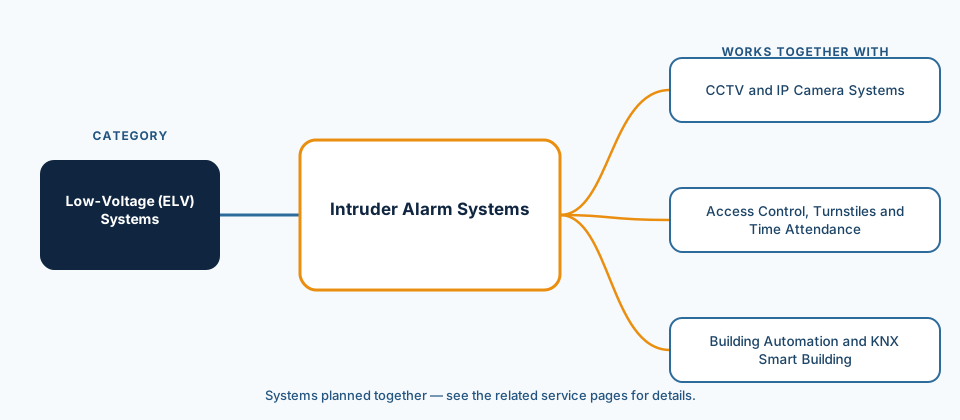
The alarm system's job is to detect and notify; recording the event on video is the camera system's job, and deciding who can enter through which door is the job of access control. Recording and monitoring are covered on the CCTV and IP camera systems page, and card-controlled doors and turnstiles on the access control, turnstile and time attendance systems page.
In most buildings the three systems sit side by side and complement each other: the alarm starts the event, the camera shows what is happening, and access control knows who is inside.
Which buildings and needs is an intruder alarm system suited to?
Buildings that are empty at certain times, hold valuables or stock, and where unauthorised entry needs to be noticed immediately benefit most from an intruder alarm system.
- Offices and office floors: work areas and archives left empty outside working hours.
- Shops and retail: the shop window, sales floor and stockroom after closing.
- Warehouses and workshops: wide doors, loading bay entrances and stock areas.
- Homes and villas: protection while the house is empty, or of the ground floor only at night.
- Plant and technical rooms: server rooms, electrical rooms and areas with valuable equipment.
What types of intruder alarm system are there and what are the components?
Intruder alarm systems are classed by how the detectors connect to the panel: wired, wireless, or hybrid systems that use both. The choice depends on whether the building is occupied, whether cables can be run and the size of the area.
| Feature | Wired system | Wireless system | Hybrid system |
|---|---|---|---|
| Detector connection | Each device is cabled to the panel | Devices communicate with the panel by radio | Some devices wired, some wireless |
| Installation | Needs cable routes; easy in new builds or refurbishments | Installed without running cables; practical in occupied buildings | Wired where cables can reach, wireless where they cannot |
| Maintenance | No battery replacement needed | Detector batteries need regular checks and replacement | Battery checks needed for the wireless devices |
| Points to watch | Protecting the cable routes | Radio coverage and obstacles in the area | Planning both parts together |
Which setup suits you is decided during the survey, based on the building's layout and how it is used. The main components of an intruder alarm system are:
- Alarm panel: evaluates signals from the detectors and manages zones and users.
- Keypad or remote fob: setting, unsetting and managing the system area by area.
- Motion detector: detects movement in interior areas; pet-tolerant types can be chosen where animals are present.
- Magnetic door contact: detects a door or window opening.
- Glass-break detector: detects breakage of shop windows and large glazed areas.
- Internal and external sounders: give audible and visual warnings.
- Communication module: passes the alarm to a phone app, nominated people or a receiving centre.
- Battery and power supply: keep the system working during a power cut.
What does our intruder alarm service scope include?
Our intruder alarm service runs from the survey to periodic maintenance; the detailed scope of each project is written into the proposal after the survey.
- Survey: review of entry points, interior areas, the building's hours of use and any existing system.
- Zone plan: which doors, windows and areas go into which zone, and how areas are set separately.
- Panel, detector and sounder selection, bill of materials and procurement.
- Cabling or placement of wireless devices, and mounting.
- Panel programming: zones, user codes, entry and exit delays and notification contacts.
- Commissioning: testing every detector and every notification path one by one.
- User training: setting, unsetting, what to do when the alarm goes off and managing users.
- Periodic maintenance: detector and sounder tests, battery checks (subject to contract).
How does an intruder alarm project run?
The process starts with a discovery call about how the building is used and ends with every detector tested and the system handed over to users with training.
- Discovery call: we discuss the building, its hours of use and the areas to protect.
- Site survey: entry points, windows, interior areas and cabling options are inspected.
- Zone plan and device list: detector types, positions and zones are defined.
- Proposal: scope, bill of materials and work schedule are put in writing.
- Installation: devices are installed and panel connections and programming are completed.
- Commissioning and testing: every detector, sounder and notification path is tried out.
- Training and handover: users learn to set and unset the system and what to do when it goes off.
Which factors affect the choice and the cost?
The cost of an intruder alarm system is driven mainly by the number of entry points and areas to protect, the choice of wired or wireless and the notification setup; an exact figure can only be given after the survey.
We do not publish price ranges: two buildings of the same size can differ greatly in the number of entry points, cabling options and notification needs.
- Number of doors, windows and interior areas to protect; number of zones and areas.
- Choice of a wired, wireless or hybrid system.
- Detector types: motion, magnetic contact, glass-break and outdoor detectors.
- Notification setup: phone app, calls, connection to a receiving centre and a backup communication path.
- Need for integration with systems such as cameras and access control.
- Condition of the existing system: an upgrade or a new installation.
Which standards and regulations apply?
Intruder alarm systems are covered in Europe by the EN 50131 series of standards; the first part of the series defines the general system requirements for intrusion and hold-up alarm systems installed in buildings.
EN 50131-1 also classifies components by the environment they are installed in, so devices for outdoor, damp or dusty areas are chosen to suit those conditions. The number of devices, their positions and the level the system is designed to depend on the building and the risk assessment; if your insurance policy sets an alarm requirement, it should be the basis of the design.
The alarm system stores user codes and setting and unsetting logs; where there is camera verification or data is passed to a receiving centre, personal data is processed. For projects in Türkiye, see the Personal Data Protection Authority website for general guidance; this page does not give legal advice.
- EN 50131-1:2006+A1+A2+A3:2020 — Alarm systems, intrusion and hold-up systems, Part 1: System requirements (consolidated version with amendments).
- Türkiye's Personal Data Protection Law (KVKK), Law No. 6698 (Official Gazette 07.04.2016, No. 29677).
How does an intruder alarm system work with other systems?
An alarm system also works on its own, but when it is planned together with cameras, access control and building automation, it becomes easier to see what is happening and respond correctly when the alarm goes off.
When an alarm is raised, the camera covering that zone can be brought onto the monitoring screen and the recording bookmarked. In buildings with card access, whether an area is set or unset can be reviewed alongside the access control logs.
Scenarios with building systems such as lighting and HVAC, for example switching off selected lights when the system is set, are possible with building automation and smart building (KNX) systems. For the overall picture of security systems, see our low-voltage (ELV) systems page.
Which questions do we ask during the survey?
A sound alarm plan starts with understanding how the building is used and at what times, so we work through the following questions together during the survey.
- At what times is the building completely empty; will some areas be protected while others are in use?
- Who is notified when the alarm goes off: your own phone, people you nominate or a contracted receiving centre?
- Are there factors that could cause false alarms, such as pets, curtains or heaters?
- Can cables be run, or should wireless be preferred because the building is occupied?
- Does your insurance policy set any requirement for the alarm system?
- How many users will there be, and who will be able to set and unset the system?
What are the common mistakes in intruder alarm systems?
Most problems stem not from the devices but from poor positioning, shared codes and notifications that are never tested.
- Tolerating false alarms: a system that gives frequent false alarms stops being taken seriously and eventually stops being set.
- Sharing one code with everyone: when everyone uses the same code, nobody knows who set or unset the system and when; each user should have their own code.
- Not testing notifications: even when the alarm sounds, check regularly that the alert actually reaches the right person.
- Neglecting batteries: when low-battery warnings are put off, wireless detectors can quietly drop out of service.
- Not updating the plan after refurbishment: a new door, window or partition wall can leave an unprotected entry point.
Related services
- CCTV and IP Camera SystemsCamera placement plan, recorders, storage and monitoring infrastructure.View
- Access Control, Turnstiles and Time AttendanceCard and biometric access, turnstiles, door control and staff time attendance.View
- Building Automation and KNX Smart BuildingMonitoring and controlling lighting, HVAC and building systems from one place.View
Frequently asked questions
Should I choose a wired or a wireless intruder alarm system?
Will a motion detector give false alarms if I have pets?
Who is notified when the alarm goes off?
What does intruder alarm maintenance include?
How does the discovery call work?
Which areas do you cover for intruder alarms?
Sources
- CENELEC (Estonian Centre for Standardisation catalogue), “EN 50131-1:2006+A1+A2+A3:2020 — Alarm systems — Intrusion and hold-up systems — Part 1: System requirements”, 2020. https://www.evs.ee/en/evs-en-50131-1-2006-a1-a2-a3-2020-consolidated
- Presidency of the Republic of Türkiye, Legislation Information System, “Law No. 6698 on the Protection of Personal Data (Official Gazette 07.04.2016, No. 29677)”, 2016. https://www.mevzuat.gov.tr/mevzuat?MevzuatNo=6698&MevzuatTur=1&MevzuatTertip=5
Intruder alarm request
Including the building type, approximate number of entry points, whether there is an existing system and the location speeds up the first conversation.
- Free discovery call
- No commitment; the quote is prepared after the survey.
- Service area
- İzmir and its surroundings (districts such as Menemen and Selçuk, plus Manisa and Aydın)
- Your personal data
- Form details are processed to answer your request; see the privacy notice for details. Privacy notice
Let us talk about your intruder alarm system
For a new installation, an upgrade or maintenance, share your building and the areas you want to protect, and we will start the survey process together.