
Sprinkler Systems: Automatic Sprinkler Installation and Maintenance
Automatic suppression pipework with heads that open on their own in the heat of a fire and deliver water straight onto it: discovery, installation, testing and maintenance.
In short
A sprinkler system (automatic sprinkler system) is an automatic suppression system that delivers water onto a fire through heads that open in its heat and pipework that is kept permanently ready. It suits warehouses, factories, car parks, hotels and commercial buildings. Sora Yazılım provides sprinkler installation, testing and maintenance to the approved design in İzmir and its surroundings.
What is a sprinkler system and how does it work?
A sprinkler system aims to put out a fire, or contain it until the fire brigade arrives, by delivering water directly onto the fire area from ceiling-mounted heads that open one by one in the heat of the fire; it needs no human intervention to work.
Each head responds to the temperature directly beneath it: heads close to the fire open, while those further away stay closed. So, unlike in films, a sprinkler system does not soak the whole building at once. When water starts to flow, the alarm arrangement at the valve set operates and the status can be reported to the fire panel.
A sprinkler system is an automatic suppression system. Hose installations used by hand by building occupants or the fire brigade are a separate subject, covered on our fire hose reel and hydrant systems page. In spaces where water would cause damage, such as comms rooms, gas suppression is often preferred.
Which buildings need a sprinkler system?
For projects in Türkiye, the buildings that must have a sprinkler system are set by the Regulation on the Protection of Buildings from Fire according to their use, height and size; for example, an automatic sprinkler system is required for enclosed car parks above a certain size.
Whether it is mandatory, and its scope, is set in the approved design by the qualified designer. Buildings where sprinkler systems are commonly installed include:
- Warehouses and logistics buildings, high-rack storage areas.
- Factories and production facilities.
- Enclosed car parks.
- Hotels, student residences and other accommodation.
- Shopping centres, shops and commercial buildings.
- High-rise buildings and multi-storey offices.
What types of sprinkler system are there and what are the components?
Sprinkler systems differ according to whether the pipes are permanently filled with water and when water is let into them; the most common types are wet pipe, dry pipe and pre-action systems.
| System type | How it works | Typical use |
|---|---|---|
| Wet pipe | The pipes are always full of water; when a head opens, water flows immediately. | Most heated areas without a risk of freezing. |
| Dry pipe | The pipes are filled with compressed air or inert gas; when a head opens, the air escapes and water enters the pipes. | Areas at risk of freezing, such as open car parks and cold stores. |
| Pre-action | The pipes are dry; water is only let in when a signal comes from a separate detection system. | Areas where accidental water discharge would cause serious damage. |
| Deluge | The heads are open; when the valve opens, water flows from every head in the protected zone at once. | Special risk areas where fire can spread very quickly; outside the scope of EN 12845. |
Which type is used depends on how the building is used, the ambient temperature and the risk of the material being protected. The main components of the system are:
- Sprinkler heads: with a glass bulb that breaks or a fusible element, of a type and temperature rating suited to the protected area.
- Pipework: main line, distribution lines and hangers.
- Control valve set: the main valve feeding the system, the alarm valve and the test arrangement.
- Flow switches and monitored valves: report to the panel that water is flowing and that valves are open.
- Water supply: a fire water tank and fire pumps, according to the design.
- Fire brigade inlet: lets the fire brigade feed water into the installation from outside when needed.
What does our sprinkler service scope include?
The service scope runs from discovery to periodic maintenance; installation follows the design prepared by a qualified designer and approved by the relevant authority, and the detailed scope is written into the proposal after discovery.
- Discovery: reviewing how the building is used, the storage layout, the existing installation and the approved design.
- Selection of heads, pipes and valves to the design, bill of materials and procurement.
- Installing the pipework, heads and valve set.
- Connecting flow switches and monitored valves to the fire panel.
- Pressure testing, alarm valve and flow tests; handover of test records.
- Training building staff on the valve set and what to do during an alarm.
- Periodic maintenance and testing (under contract).
Sprinkler design and installation may require the relevant authorisation or competence certificates. We recommend asking for the documents of whoever will carry out the installation at proposal stage; preparing and approving the design is the responsibility of the qualified engineer and the relevant authority.
How does a sprinkler project run?
The process starts with discovery and a review of the approved design, continues with installation and testing to that design, and carries on with training and regular maintenance.
- Discovery call: we discuss the building, its use and the current situation.
- Site survey: the ceiling, rack layout, water supply and routes are inspected.
- Design: an existing approved design is reviewed; if there is none, its preparation with a qualified designer is planned.
- Proposal: the materials, scope and work schedule are set out.
- Installation: the pipework, heads and valve set are installed.
- Testing and commissioning: pressure, flow and alarm tests are carried out and recorded.
- Training and handover: how to use the valve set and the check points are explained.
- Periodic maintenance: tests and maintenance records are kept up regularly.
Which factors affect the choice and the cost?
The cost of a sprinkler system depends mainly on the size and hazard class of the protected area, the system type and the water supply required; an exact figure comes after the approved design and discovery.
We do not publish price ranges; two buildings of the same size can differ greatly in hazard class, storage layout and water supply needs.
- Size of the protected area, number of storeys and ceiling height.
- Hazard class of the building and stored materials, rack height and layout.
- System type: wet, dry or pre-action.
- Water supply needs such as a water tank and fire pumps.
- Working conditions in an occupied building, suspended ceilings and installation at height.
- The state of the existing installation: extension, renewal or new installation.
Which standards and regulations apply?
For projects in Türkiye, the Regulation on the Protection of Buildings from Fire requires sprinkler systems to be designed to TS EN 12845 and their components to comply with TS EN 12259.
Values such as hazard class, design density, spacing between heads, pump capacity and water tank volume are calculated for each building; the relevant standard and a qualified design engineer are the reference. The information on this page does not replace a design.
- Regulation on the Protection of Buildings from Fire (Binaların Yangından Korunması Hakkında Yönetmelik, Official Gazette 19.12.2007, No. 26735, as amended). The current text should be checked on mevzuat.gov.tr.
- EN 12845 (current consolidated European version EN 12845:2015+A2:2026) — Fixed firefighting systems, automatic sprinkler systems: design, installation and maintenance. The national adoption in Türkiye is TS EN 12845.
- EN 12259 series — sprinkler system components; EN 12845 only covers the sprinkler types defined in EN 12259-1.
- NFPA 13 (2025 edition) — Standard for the Installation of Sprinkler Systems; some projects may require it as an insurer or investor condition. The standard to be followed is set in the approved design.
How does a sprinkler system integrate with other systems?
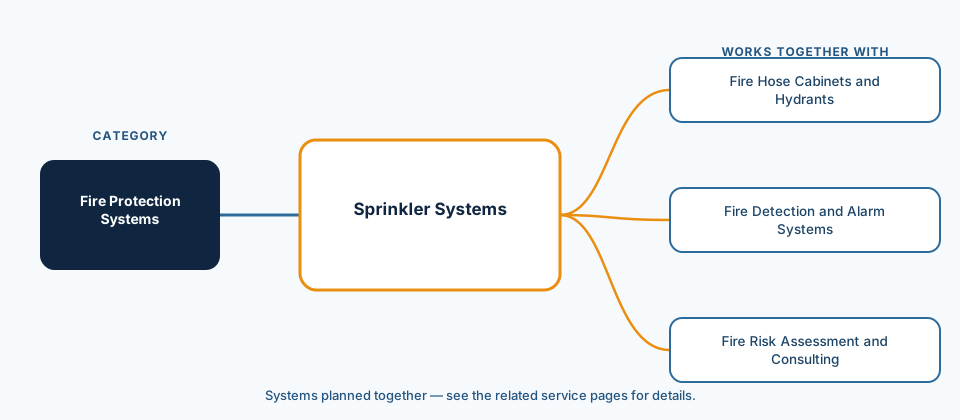
A sprinkler system works on its own, but it is connected to other fire systems so that flow and valve status are monitored and evacuation is started.
For the overall picture of detection, suppression and passive protection, see our fire protection systems page.
- Flow switches and monitored valves are connected to the fire detection and alarm system; a head opening also starts the fire alarm, and a valve left closed shows as a fault.
- In pre-action systems, water is only let into the pipes on a signal from the detection system; the scenarios for the two systems are designed together.
- Whether sprinkler coverage is adequate, and what changes after refurbishment, can be the subject of a fire risk assessment and consulting study.
Which questions do we ask during discovery?
The right sprinkler installation starts with understanding how the building is used today and how it will be used tomorrow; during discovery we work through these questions together.
- Is there an approved fire design, and when was it last updated?
- What is stored in the area, and will the rack height or layout change?
- Are there sections at risk of freezing?
- Are there a water tank and fire pumps, and when were they last tested?
- Are there spaces, such as comms rooms or archives, where water would cause damage?
- If there is an existing installation, where are the valve set and maintenance records?
What are the common mistakes with sprinkler systems?
Most problems with sprinkler systems appear after installation, as the way the building is used changes.
- Changing the rack layout without updating the installation: when storage height or materials change, the system's design assumptions may no longer hold.
- Painting or covering heads: a head that has been painted or covered may not respond to heat in time.
- Filling the space beneath a head: goods stacked up to the ceiling stop the water from spreading.
- Leaving a valve closed: a valve not reopened after maintenance leaves the installation without water in a fire.
- Ignoring the risk of freezing: wet pipework in an unheated area can freeze and crack.
Related services
- Fire Hose Cabinets and HydrantsFixed installations: hose cabinets, hydrants and fire brigade connections.View
- Fire Detection and Alarm SystemsFire panels, detectors, call points, sounder-beacons and cause-and-effect setup.View
- Fire Risk Assessment and ConsultingIdentifying fire risks in a building and prioritised improvement recommendations.View
Frequently asked questions
Does a sprinkler system soak the whole building in a fire?
How do you choose between wet pipe and dry pipe sprinklers?
Can a sprinkler system be added to an existing building?
How often should a sprinkler system be maintained?
How does the discovery call work?
Which areas do you cover for sprinkler systems?
Sources
- Presidency of the Republic of Türkiye, Legislation Information System (mevzuat.gov.tr), “Regulation on the Protection of Buildings from Fire (Binaların Yangından Korunması Hakkında Yönetmelik), Official Gazette 19.12.2007, No. 26735”, 2007 (as amended). https://www.mevzuat.gov.tr/mevzuat?MevzuatNo=200712937&MevzuatTur=21&MevzuatTertip=5
- CEN (Estonian Centre for Standardisation catalogue), “EN 12845:2015+A2:2026 — Fixed firefighting systems — Automatic sprinkler systems — Design, installation and maintenance”, 2026. https://www.evs.ee/en/evs-en-12845-2015-a2-2026-consolidated
- National Fire Protection Association (NSAI store listing), “NFPA 13:2025 — Standard for the Installation of Sprinkler Systems”, 2025. https://shop.standards.ie/en-ie/standards/nfpa-13-2025-829521_saig_nfpa_nfpa_3458274/
Sprinkler system request
Including the building type, approximate floor area, storage layout and whether there is an approved fire design speeds up the first conversation.
- Free discovery call
- No commitment; the quote is prepared after the survey.
- Service area
- İzmir and its surroundings (districts such as Menemen and Selçuk, plus Manisa and Aydın)
- Your personal data
- Form details are processed to answer your request; see the privacy notice for details. Privacy notice
Let us talk about your sprinkler system
For a new installation, extension or maintenance, tell us about your building and its current state, and we will start the discovery process together.